Nice flight... “Disc golf,” where you throw a disc instead of hitting a ball
- Input
- 2026-10-19 18:44:29
- Updated
- 2026-10-19 18:44:29

Japan’s Manabu Kajiyama, last year’s champion, finished runner-up in his bid for a second consecutive title, while Hong Kong’s Tiji Homing placed third. In the women’s division, Japan’s Rika Takaki won at 23 over par in her first appearance at the tournament. Taiwan’s Chen Chen and Japan’s Yuka Nakagawara placed second and third, respectively.
The amateur competition on the 18th was shortened to one round because of heavy rain. Participants competed across five divisions—MA1, MA2, FA1, FA2 and MA65—on an 18-hole, par-64 course measuring 1,756 m in total.
Amateurs are divided into categories based on factors such as skill and age. MA is the mixed division and FA is the women’s division; MA1 and MA2, as well as FA1 and FA2, are skill-based categories.
In MA1, the U.S.’s Seth Weimer won at 3 under par, while South Korea’s Park Yosep won MA2 at 4 over par. South Korea’s Lee Hyun-jin and Jo Bok-seon topped FA1 and FA2, respectively, both at 17 over par. The MA65 title, for players aged 65 and older, went to Singapore’s Jeong Hu Tei at 19 over par.
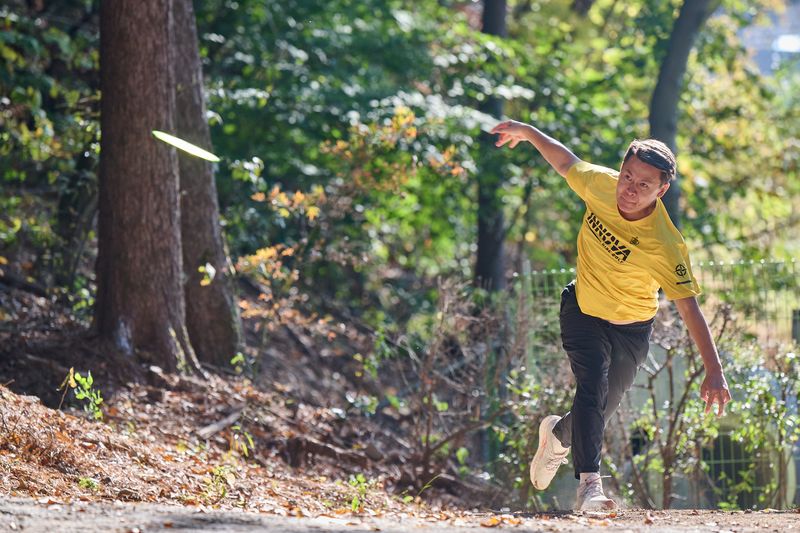
A player is under par if they take fewer throws than the course’s par, and over par if they take more. The pro and amateur courses at this tournament differed in length by 330 m, but both had a par of 64.
The target corresponding to the hole in golf is a basket made up of chains and a catching tray mounted on a pole. A hole is considered complete when the disc comes to rest supported by the chains or tray. Merely brushing the chains or landing on top of the basket is not enough to finish the hole.
Just as golfers choose a club to suit the situation, disc golfers switch discs according to their purpose. There are drivers for long throws, midranges for medium distances and putters for use near the basket. Part of the fun is choosing a disc and flight path based on the remaining distance, the position of trees, the slope and the wind.
If a disc comes to rest completely out of bounds (OB), beyond the designated playing area, the player receives a one-throw penalty. Even a long throw can cost strokes if the player misses the landing area, so players must decide whether to try to get close to the basket in one throw or advance in shorter throws along a safer route.
Natural features such as trees and slopes are also part of the course. Players cannot alter the course, for example by breaking branches, to make their shots easier. Players can enjoy outdoor activity and socializing as they repeatedly throw a disc and walk to the next spot.
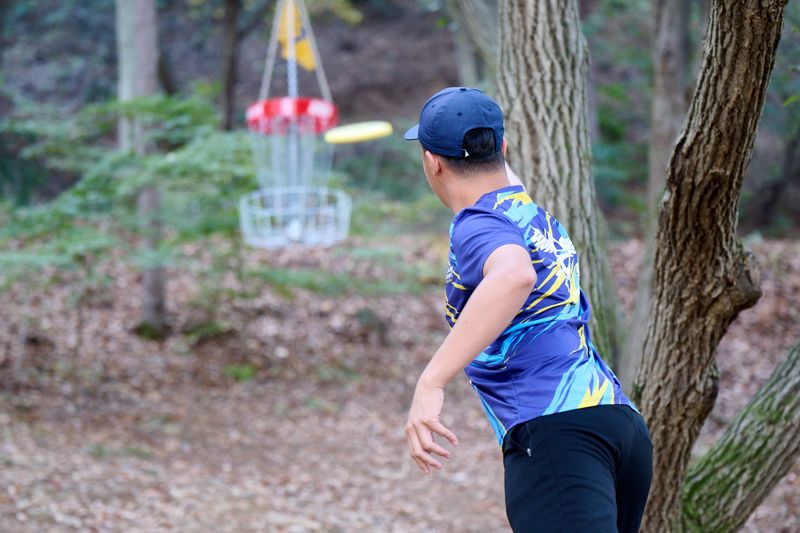
The format will also change from this year, when pros and amateurs each competed on a single day. Next year, the amateur competition is scheduled to take place over two days, divided into qualifying rounds and a main event. The aim is to expand opportunities to participate by securing space and time for amateur events alongside the new course exclusively for pros.
This year, the number of amateur participants was limited to 72 because of constraints on the venue and schedule. Organizers plan to accept more aspiring competitors through qualifying rounds, with those who advance competing in the main event.
Disc golf is a sport that requires relatively little equipment and lets participants enjoy throwing discs and walking at the same time. Crown Haitai Confectionery aims to turn the hosting of international tournaments into broader participation in recreational sports by expanding the course and opportunities to compete. “We hope that anyone interested in disc golf, whether a customer or a member of the public, will be able to learn and enjoy it at Yangju Art Valley Disc Golf Course,” said Yun Young-dal, chairman of Crown Haitai Confectionery.
[email protected] In-seo Jang Reporter