Fear gauge retreats, but debate remains fierce: “Buy the dip” vs. “AI bomb still looms” [KOSPI swings]
- Input
- 2026-10-19 18:39:43
- Updated
- 2026-10-19 18:39:43
■ KOSPI closes higher as volatility index stabilizes
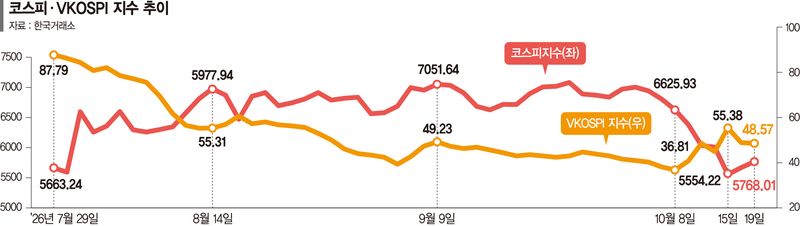
The Korea Exchange said the KOSPI closed at 5,768.01 on the 19th, up 99.96 points (1.76%) from the previous trading day. After opening sharply lower at 5,488.41 (down 3.17%), the index managed to turn higher on buying by institutional investors and other corporations. It rose 279.6 points from its opening level, the day’s low.
The market, rattled by the sharp drop in U.S. semiconductor stocks over the weekend, got some relief. The VKOSPI, which had surged to 55.38 on the 15th, closed at 48.57 today, showing signs of stabilizing again. On July 29, when the KOSPI fell as low as 5,663.24, the VKOSPI reached 87.79, nearly twice today’s level.
However, analysts say it is difficult to conclude that the KOSPI has bottomed based solely on the VKOSPI’s stabilization.
A securities industry official said, “In July, the VKOSPI’s decline even as the KOSPI fell was interpreted as a sign that fears of further losses had eased.” The official added, “The VKOSPI also appears to be stabilizing now, but that only means the index’s range of movement has narrowed. We also need to watch big tech’s AI investment plans and profitability, as well as whether foreign selling subsides.” The point is that while easing volatility was cited as evidence for a bottoming thesis in July, whether external uncertainties—including credit risks related to AI investment and foreign selling—are resolved is now seen as a factor that will determine whether a rebound can continue.
■ Buy-the-dip case and AI uncertainty collide
Analysts are divided over whether the KOSPI has formed a bottom. Some see the oversold indicators as evidence of a buying opportunity, while others argue that investors should moderate their pace of buying in light of foreign selling and uncertainty over AI investment.
The buy-the-dip case, targeting a rebound in November, is based on statistics showing rebounds after past sharp declines and on lower valuations. Since 2010, the KOSPI has fallen for seven consecutive trading days on 11 occasions, and its average return over the following approximately 20 trading days was 3.7%, according to the analysis.
Byun Jun-ho, a researcher at IBK Investment & Securities, said, “The 20-day price-disparity index has fallen to 83, and the 12-month forward price-to-book ratio (PBR) has declined to 1.08 times.” He said investors should “use this as an opportunity to buy the dip ahead of a November rebound.”
Some analysts acknowledge that oversold conditions present a buying opportunity but say investors should moderate their pace of buying. The KOSPI’s relative strength index (RSI) has fallen below 30, signaling oversold conditions, but foreign selling and uncertainty over AI investment remain, leading them to recommend buying in stages.
Kim Dae-jun, a researcher at Korea Investment & Securities, said, “Although the KOSPI is in oversold territory, it is difficult to switch to aggressive net buying at this point.” He recommended “taking a mechanical, staged-buying approach.”
Others take a cautious view, warning that concerns over AI investment could go beyond simple demand worries and become a question of whether funding can be sustained. Analysts say that if the financing burden grows for neocloud companies heavily reliant on borrowing amid high interest rates, data-center investments could be delayed or scaled back, weighing on semiconductor demand as well. They added that if global investors continue to reduce their exposure to AI, selling pressure from foreign investors in the Korean stock market, where semiconductors make up a large share, could also increase.
Kim Jae-seung, a researcher at Hyundai Motor Securities, said, “External factors will determine the KOSPI’s rebound.” He said analysts need to see declines in U.S. semiconductor stocks ease, credit default swap (CDS) premiums for AI-related companies fall, and oil prices come down.
[email protected] Bae Han-geul Reporter