Lee Hyeong-il floats a U.S.-South Korea currency swap... “The exchange rate is finding its way back to fundamentals”
- Input
- 2026-10-19 18:21:41
- Updated
- 2026-10-19 18:21:41
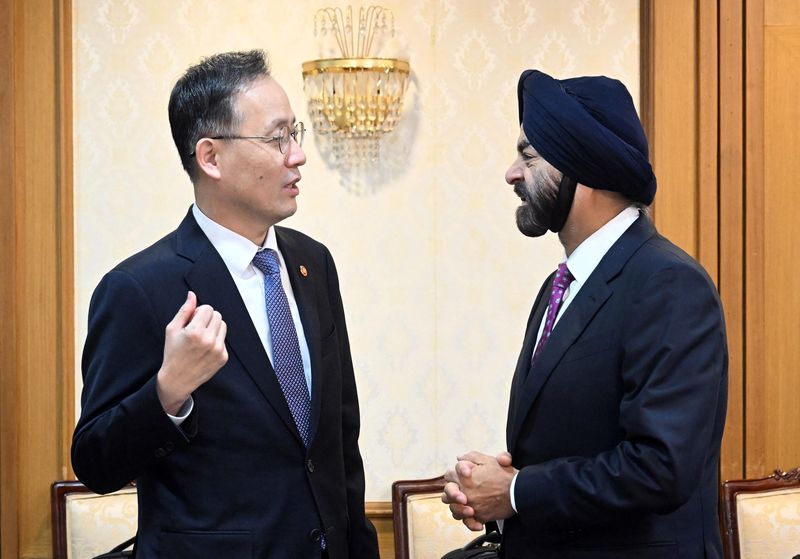
At a briefing with the accompanying press corps in Bangkok, Thailand, on the 16th (local time), Lee said, “A currency swap between South Korea and the United States is meaningful and necessary in that it strengthens the foreign-exchange market’s safety net.” He was in Bangkok to attend meetings of G20 and G7 finance ministers and central bank governors, as well as the annual meetings of the International Monetary Fund (IMF) and the World Bank.
A currency swap is an agreement in which one country deposits its own currency and borrows another country’s currency at a pre-agreed exchange rate. It serves as a safety net by supplying dollar liquidity when foreign-exchange markets are unstable. “This does not mean we are requesting a currency swap because we lack foreign-exchange liquidity,” Lee explained. “The point is that, as our economy has grown, we need a safeguard on a par with those of advanced economies.”
He assessed recent exchange-rate movements as part of a process of returning to economic fundamentals. “In July, the exchange rate reached the 1,550-won-per-dollar range, and I think that situation was actually a departure from our fundamentals,” Lee said. “The exchange rate is now in the process of finding its way back to economic fundamentals.”
On frequent fluctuations in the domestic stock market, he said, “It seems to undergo corrections when there are concerns that global interest rates may be rising more often than expected, questions about whether returns on investment in artificial intelligence (AI) and semiconductors will last as long as expected, or geopolitical risks such as those in the Middle East.”
However, he remained optimistic about the South Korean economy. “I want to say that [the South Korean economy’s] growth is very strong,” Lee said. “Investment is driving it now, but over time that growth will also carry over to consumption. Given the large current account surpluses and other factors, I think the fundamentals of our economy and stock market remain solid.”
He also proposed supplementary measures for the real estate tax reform plan. “We are considering additional capital gains tax relief if purchased-rental apartments in areas subject to adjustment are sold to the public sector and put to public use,” Lee said.
Purchased-rental housing is one type of registered rental business. The government provided tax benefits, including exemption from the higher capital gains tax rate, when business operators met the mandatory rental period—typically eight to 10 years—and did not raise rents by 5% or more per year.
However, after some criticized the tax benefits for operators of purchased-rental apartments as excessive, the government decided in its tax reform plan announced in August to end the exemption from the higher capital gains tax rate for such apartments in areas subject to adjustment. Lee explained, “There are reports that housing rental operators have difficulty completing sales even when they try to sell purchased-rental apartments, and that tenants are concerned about instability in jeonse and monthly rental prices.”
He was cautious about the outlook for housing prices. Lee replied, “There will be various factors, and I think we’ll have to keep monitoring the situation and see how it develops.”
Regarding the recent rise in consumer prices, Lee said, “With the war in the Middle East continuing, inflationary pressure remains, and every month we continue to face a situation in which we have to make an all-out effort to tackle inflation.”
As the war in the Middle East drags on, the oil price cap is expected to remain in place for the time being. Lee noted, “There is still a lot to watch before we can judge when the war in the Middle East and other developments will end.” On the sovereign wealth fund due to be established this year, he said, “The Korea Investment Corporation (KIC) invests only overseas, but the sovereign wealth fund can invest both domestically and abroad, so it will be a good opportunity to foster our country’s strategic industries.”
[email protected] Seo Yeong-jun Reporter