China grows 4.5% in Q3; domestic demand and real estate remain in deep freeze
- Input
- 2026-10-19 18:20:45
- Updated
- 2026-10-19 18:20:45
According to economic indicators released that day by the NBS, China’s GDP grew 4.5% in Q3 this year from a year earlier. The figure topped the market forecast of 4.4%, with increased production in manufacturing and high-tech industries underpinning growth. Demand for related products, driven by the growth of the artificial intelligence (AI) industry, is also thought to have supported China’s production and exports.
■Growing reliance on exports
Industrial production rose 5.5% in September from a year earlier, showing that manufacturing continued to grow. Production increased 5.3% in January–September, led by gains of 10.2% in equipment manufacturing and 14.3% in high-tech manufacturing. This strong industrial output is expected to help ease downward pressure on the economy.
The growth target set by Xi Jinping’s government for this year is 4.5–5.0%. China’s GDP growth slowed from 5.0% in Q1 to 4.3% in Q2, its lowest level in about three years, since Q4 2022. But it rebounded to 4.5% in Q3, easing some concerns about slowing growth. Growth for the first three quarters stood at 4.6%, keeping China within its annual target range and somewhat reducing the authorities’ burden to provide further stimulus.
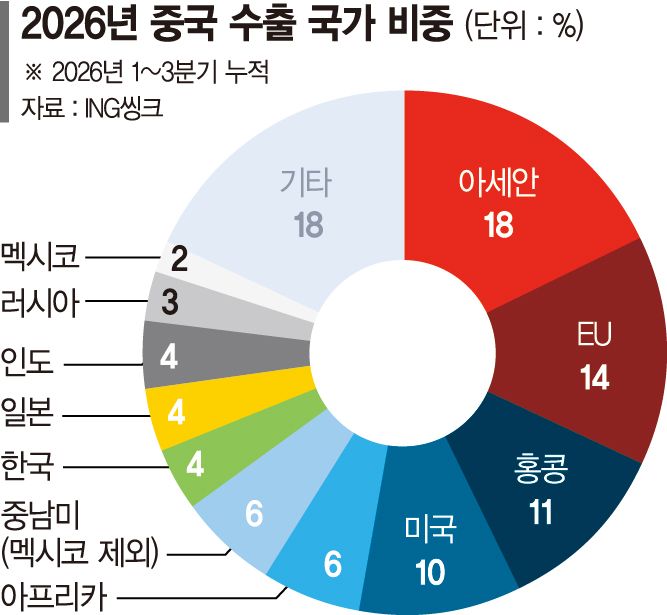
Despite weak domestic demand, strong industrial output translated into exports. The global AI boom helped drive export growth. Exports in Q3, measured in dollars, rose 28% from a year earlier. China’s exports for January–September, reported earlier on the 14th, reached a new high. September exports totaled $447.18 billion, up 36.3% from the same month last year (about 597.8 trillion won), while the trade surplus for January–September hit a record $938.11 billion (about 1,255 trillion won). The figure is expected to comfortably exceed $1 trillion when October data are released. The sharp rise in exports and the trade surplus has also heightened concerns that trade tensions with major trading partners, including the European Union (EU), could intensify.
■Concerns that growth imbalances will become entrenched
By contrast, the real estate market and domestic demand showed little sign of recovery. China’s fixed-asset investment fell 7.2% in January–September from a year earlier. Fixed-asset investment excluding real estate development also declined 4.2%, while investment related to intellectual property products rose 9.3%.
In particular, investment in real estate development fell 20.6% over the same period, showing that the downturn in the property sector is dragging on. The slump in the real estate market could worsen local public finances and constrain China’s economic recovery.
Retail sales, a measure of consumption, rose 1.1% in September from the same month last year. The imbalance in growth drivers was clear: industrial production grew 5.5% in September, while retail sales increased just 1.1%. As domestic demand fails to keep pace with expanding production, Chinese companies are becoming more reliant on overseas markets. This could intensify price competition in global markets and erode corporate profitability, while also entrenching an export-dependent growth model.
The NBS said that “China’s economy weathered pressure and remained stable in January–September,” adding that “production and supply grew relatively rapidly, foreign trade posted solid growth, and employment and prices were generally stable.”
[email protected] Lee Seok-woo, International Affairs Correspondent Reporter