A rout on the way down, only a trickle on the way up... KOSDAQ retail investors lose all this year’s gains
- Input
- 2026-10-19 18:10:37
- Updated
- 2026-10-19 18:10:37
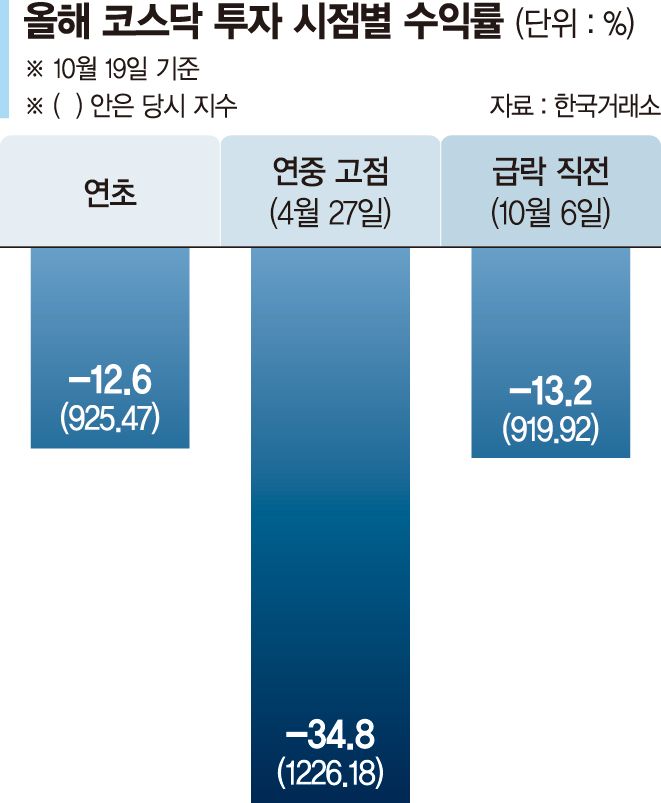
On the 19th, the KOSDAQ index closed at 808.89, up 14.11 points (1.78%) from the previous trading day. It rebounded for a second consecutive trading day after rising 4.46% on the 16th, but remained 12.6% below its year-end closing level of 925.47. An investor who had tracked the index at the end of last year would have given back all their gains for the year and lost money on their original investment as well. The KOSDAQ index fell for six consecutive trading days from the 7th to the 15th. It dropped 17.3%, from 919.92 on the 6th, immediately before the decline, to 760.82 on the 15th. On the 15th alone, it plunged 7.65%.
Investors who entered at the peak have taken an even bigger hit. Compared with the year’s highest closing level, 1,226.18 on April 27, the index has fallen 34.8%. An investment of 100 million won tracking the index at the time would now be worth about 65.15 million won. From its current level, the index would need to rise about 53.5% to recover its previous peak.
A securities industry official said, “The larger the loss, the greater the gain needed to recover the original investment,” adding, “Even if the index rebounds, investors who bought at the peak may need a considerable amount of time to recoup their losses.”
Individual investors began making large-scale purchases in the KOSDAQ market after the summer. Their cumulative net purchases in August and September totaled 3.3281 trillion won. Funds flowed into the market while the index was mostly moving around the 800 level. Even as the index fell for six consecutive trading days from the 7th to the 15th of this month, individuals net-bought 887 billion won. They continued to be net buyers in the falling market, but the index slid further.
The major stocks bought by individual investors also failed to avoid sharp declines. Jusung Engineering, their top net purchase last week, saw 220.4 billion won flow in, but its share price fell 21.3% over the week. Simmtech, which individuals net-bought for 85 billion won, fell 26.7%, while Robotis, which they net-bought for 52.6 billion won, dropped 22.7%. Individuals also net-bought EcoPro and EcoPro BM for 28.5 billion won and 28.3 billion won, respectively, but their share prices fell 11.5% and 17.0%.
Individuals were net sellers of 171.5 billion won over the two days, selling 74.8 billion won on the 15th and 96.6 billion won on the 16th. On the 19th, however, they turned back to net buying, purchasing 92.8 billion won. Buying in anticipation of a rebound and selling to reduce holdings are pulling in opposite directions.
The key question is whether investors have enough funds to support further purchases. Na Seung-du, a researcher at SK Securities, said, “In the short term, individual investors’ buying may help support share prices, but it seems necessary to assess whether they still have room to buy further on dips, given factors such as a reduction in margin lending.”
The increase in forced selling to the 80-billion-won range is also a concern. Actual forced sales triggered by unpaid brokerage balances surged about 14-fold, from 6.359 billion won on the 8th to 89.336 billion won on the 14th. The figure was also 80.498 billion won on the 15th, marking a second consecutive day in the 80-billion-won range. An investment industry official noted, “Investors who cannot come up with the funds to settle their trades or meet collateral maintenance requirements may have their shares forcibly sold even if they want to wait for a rebound,” adding, “If forced selling triggers further declines and leads to collateral shortfalls in other accounts, selling pressure could intensify further.”
[email protected] Choi Doo-sun Reporter