Army Audit at Gyeryongdae Sparks Debate Over Wartime OPCON and Intelligence Sovereignty; Parties Spar Over UFS Scenario of an Advance on Seoul
- Input
- 2026-10-19 17:34:17
- Updated
- 2026-10-19 17:34:17
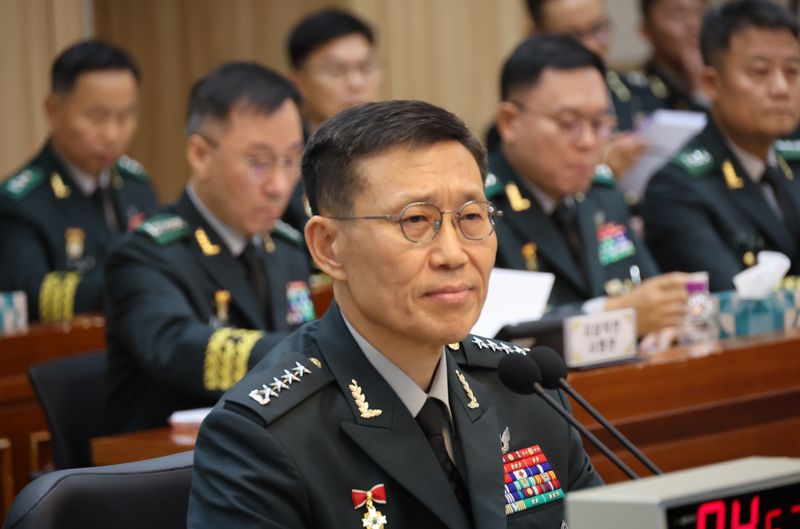
Army Chief of Staff Gen. Kim Kyu-ha, a four-star general, responded that “combined exercises are conducted according to a scenario and assume even the worst-case situations,” clarifying that “the result was not caused by inadequate performance by our actual forces.” Ground Operations Commander Lee Sang-ryeol also explained, “We need to use scenarios that are even harder to overcome in order to build the ability to overcome challenges in peacetime,” adding, “North Korean forces poured into the capital region during this exercise, causing some difficulties, but in the end we repelled all enemy forces.” It was also noted that this UFS exercise was shortened by five days, in accordance with U.S. President Donald Trump’s directive to scale back the drills, with only Part 1—the exercise to repel a North Korean attack—conducted on the shortened schedule.■ Fallout from Commander Brunson’s “DMZ territorial remarks”; opposition demands apology, sparring over mine provocationThe ruling party went on the offensive, calling recent remarks by General Xavier T. Brunson, commander of U.S. Forces Korea and the United Nations Command, an “infringement of the Republic of Korea’s territorial sovereignty.” Park Sun-won, a senior member of the Democratic Party of Korea, called Brunson’s statement at a U.S. think-tank seminar that “from the United Nations Command’s perspective, South Korea begins at the barbed-wire fence south of the DMZ” “truly inappropriate and dangerous” and called for an official apology. Park said, “Administrative authority under the Armistice Agreement does not grant the right to draw boundaries around territory,” citing past cases in which the United Nations Command denied access to Panmunjom, excessively restricting inter-Korean exchanges.
Park went on to call North Korea’s planting of mines in the DMZ an unequivocal provocation, while sharply demanding accountability for the South Korean military’s operational failure. He said, “An accident occurred when an unreasonable and reckless operation was carried out after a certain lawmaker visited a unit during an inspection of a hazardous area,” and called for a thorough investigation into failures in command decision-making and safety measures.■ “Don’t blindly trust U.S. intelligence assets” ... Song Young-gil calls for independent intelligence sovereigntySong Young-gil, a Democratic Party of Korea lawmaker serving as President Lee Jae-myung’s special adviser for peace and diplomacy, strongly called on the military to secure its own intelligence-gathering and assessment assets. Song cited the Gulf of Tonkin incident, CIA manipulation of intelligence during the invasion of Iraq, and the Nogun-ri incident as “stupid mistakes and errors by the U.S. military,” emphasizing that “U.S. intelligence assets and assessments are by no means omniscient.”
Song said, “The national interests of the Republic of Korea and the United States cannot be 100% aligned,” and argued that the military should shed its lack of autonomy and excessive reliance on the United States, despite possessing advanced assets such as reconnaissance satellites and high-altitude unmanned aircraft. In response, Army Chief of Staff Gen. Kim Kyu-ha explained the complementarity of the two sides within the combined defense system, while adding, “I fully agree with the idea that we must independently assess whether to initiate a war and identify signs of enemy activity.”
[email protected] Lee Jong-yun Reporter