Korea Deposit Insurance Corporation President Kim Seong-sik: “If the extension of the savings bank special account fails, it will take 10 years to eliminate the 3.5 trillion won deficit”
- Input
- 2026-10-19 17:45:27
- Updated
- 2026-10-19 17:45:27
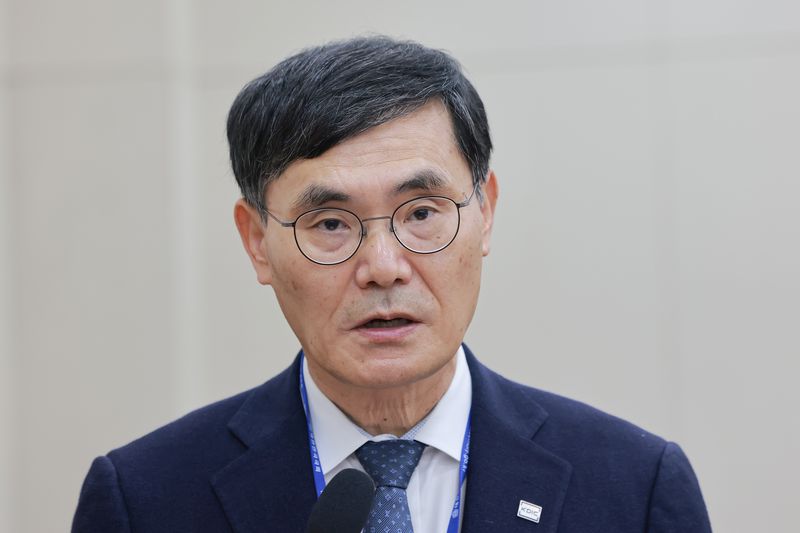
At the National Assembly’s Political Affairs Committee audit on the 19th, Kim answered a question from committee chair Yoo Dong-soo about what would happen if the special account’s extension fell through: “By the end of this year, the 1.5 trillion won in remaining special-account debt, added to the existing negative 2 trillion won balance in the savings banks’ own account, will leave a total deficit of 3.5 trillion won in the own account.” He added, “Savings banks pay around 400 billion won a year in deposit insurance premiums,” and “it would take about 10 years just to eliminate the deficit.” The special account’s total equity in the KDIC fund’s financial statements stood at negative 2.9482 trillion won.
The special account was established in 2011, during a major savings bank insolvency crisis, to share restructuring costs across the entire financial sector. The debt is repaid using 100% of the deposit insurance premiums paid by savings banks and 45% of the premiums paid by other financial sectors.
Financial authorities plan to extend the special account’s operating term by one year, from the end of this year to the end of next year, and settle all remaining debt. However, the National Assembly Political Affairs Committee’s Subcommittee No. 1 on Bill Review did not reach a decision on the relevant amendment to the Depositor Protection Act last month. The special account’s extension has become uncertain after the subcommittee decided to conduct further review.
If the extension falls through, the remaining debt in the special account will be transferred to the savings banks’ own account. In that case, it will have to be repaid solely from deposit insurance premiums paid by the savings bank sector. If it takes a long time to eliminate the existing deficit as well, the sector’s ability to respond to further financial distress at savings banks in the future could weaken.
Chair Yoo pointed out that further financial distress could arise at savings banks as debt repayment drags on. When Yoo asked Kim whether he had sufficiently explained the matter to members of the Political Affairs Committee, Kim replied, “I have explained it several times when pursuing an amendment to the law or an extension proposal.”
There were also calls to redesign the target size of deposit insurance funds and deposit insurance premium rates for each financial sector. Yoo said, “We need to reset the target size of the funds by comprehensively considering changes in the financial environment over the 17 years since the target fund system was introduced in 2009, as well as the characteristics of each sector.”
Kim replied, “The basic data for the findings of the (related) commissioned research are available, and we are consulting with the relevant sectors, industry practitioners and experts based on those findings.” Asked about concerns that the research proposal would sharply raise deposit insurance premium rates for the insurance sector, he said, “We are aware of (the insurance industry’s opposition),” adding, “We are also discussing it extensively ourselves.”
According to data released by Yoo, as of the end of last year, fund reserve ratios by sector (fund reserves/insured deposits) were 0.7318% for banks, 0.5529% for financial investment, and 0.5342% for non-life insurance. Yoo criticized the figures, saying, “They did not even reach the lower bound of the current target reserve ratio, which was lowered when the special account was established.” Savings banks stood at negative 2.1346%. Life insurance alone (0.9003%) exceeded the target’s lower bound but fell short of its upper bound.
Yoo said, “Compared with the initial target reserve levels introduced in 2009, the shortfall amounts to 42.8 trillion won relative to the upper bound and 26.5 trillion won relative to the lower bound.” He added, “We need to reset the target size of the funds by comprehensively considering changes in the financial environment over the 17 years since the target fund system was introduced, as well as the characteristics of each sector.”
The key issue is the burden on the insurance sector. The KDIC-commissioned research proposal calls for raising deposit insurance premium rates for life and non-life insurers from the current 0.15% to 0.40% and 0.50%, respectively. The increases would be 166.7% for life insurance and 233.3% for non-life insurance, bringing the rates to around 2.7 and 3.3 times their current levels, respectively. These proposed increases are far higher than those in Financial Services Commission briefing materials from September last year (0.171% for life insurance and 0.154% for non-life insurance).
Yoo said, “Under the research proposal, life insurers would face an additional burden of 927.1 billion won and non-life insurers 572.6 billion won,” adding, “These amounts represent 18.7% and 7.9% of net income, respectively, and 0.73% and 0.41% of premiums received.” Citing the fact that the detailed data from the commissioned research had not been disclosed, Yoo said, “There seems to be little reason not to make them public.” Kim replied, “I will further review (whether the detailed data can be disclosed).”
[email protected] Park Mun-su Reporter