Lee: “Perhaps it was overconfidence ... I was the biggest cause”
- Input
- 2026-10-19 17:30:00
- Updated
- 2026-10-19 17:30:00
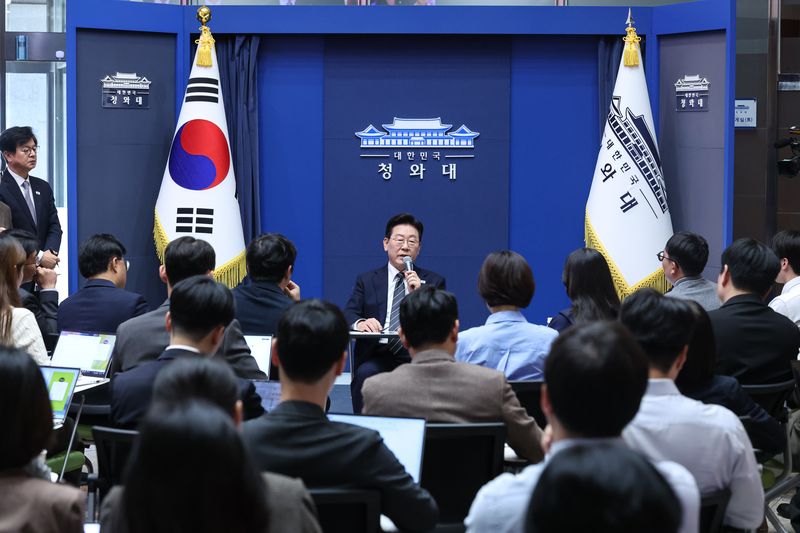
[Financial News] President Lee Jae-myung said on the 19th that, in carrying out reform initiatives, “I have also reflected that there may have been a kind of overconfidence.” While assessing that reforms were progressing beyond the original plan, he looked back on shortcomings in persuading stakeholders and explaining the changes to the public.
The president made the remarks after visiting Chunchugwan at Cheong Wa Dae without prior notice that day and meeting with reporters. “I wonder if the biggest cause was my lack of preparation and poor management of the process,” he said. After meeting with the president of the World Bank Group, Lee went to Chunchugwan, had a meal with reporters and spoke with them about current affairs for about 90 minutes.
“I think we may have been too focused on the idea that we were trying to do well, were doing well, and would ultimately bring about positive change, and that people should just bear with us for now,” Lee said. He added, “More importantly, I think we may have fallen short in persuading and empathizing with people who stand to lose something, and in offering them comfort.”
He also explained why he had met with reporters. “Even my decision to speak with you suddenly today is part of my reflection on whether I have become too detached from what is happening on the ground,” Lee said. “I am deeply reflecting on whether our sincerity is being properly conveyed. The biggest cause is me.”
However, he said he believed reforms had made progress beyond what was planned. He explained that work had begun on most of the administration’s policy agenda and that quite a few items had already been completed. On the backlash and resistance to reform, he said, “I think that is part of the growing pains.”
He also left open the possibility of adjusting the pace. Citing assessments of his administration following the local elections, Lee said, “I have been thinking that perhaps we should slow down a little.” He added, “We will seek to carry out the things we have decided to do—the things our society must do—at the right time and through the right methods and processes.”
Politically, he stressed that he must also win the support of centrists and rational conservatives. “No matter how much we unite among ourselves, if the centrist camp and a certain segment of rational conservatives unite on the other side, returning to power will be impossible,” Lee said. “We have to move toward a political landscape that centrists and rational conservatives can also support.”
He said the “structural majority” he had proposed carried the same meaning. “If we unite only among ourselves, we will ultimately become a structural minority,” Lee said, adding, “We need to broaden the political base so that we can win the support of a majority of the public.” However, he dismissed as “completely unfounded” claims linking this to plans for a political realignment.
“The biggest task of a president is bringing people together,” Lee said, adding that focusing on only one side would make him “an occupier, not a president.” He continued, “I said I would be president for everyone. I never said I would be president for just one side.”
On foreign and security issues, he reaffirmed his commitment to an early transfer of wartime operational control. “It must be transferred early, and we are fully capable of doing so,” Lee said. “Consultations between South Korea and the United States are generally proceeding well toward its return. The process, however, will not be easy.”
He described differences between South Korea’s National Intelligence Service and U.S. intelligence agencies as “minor disagreements that arise as each side works to protect its own national interests.” He added, “Each country pursues its own national interests. It is only natural to have differing views. The question is whether they remain within manageable bounds.”
Lee also said he intended to continue communicating directly through social media. “Would President Lee Jae-myung exist if there were no social media?” he asked rhetorically, adding, “I find it difficult to agree with criticism that my way of communicating with the public is too casual.” He said, however, “X is too emotionless. It’s sharp-edged. It’s text-based, so it has limitations,” adding, “I’m looking into ways to communicate face-to-face directly as much as possible.”
[email protected] Seong Seok-woo Reporter