They sighed and curled up in exactly the same way, but their brains responded in opposite ways. Why? [Health Lab]
- Input
- 2026-10-20 06:00:00
- Updated
- 2026-10-20 06:00:00
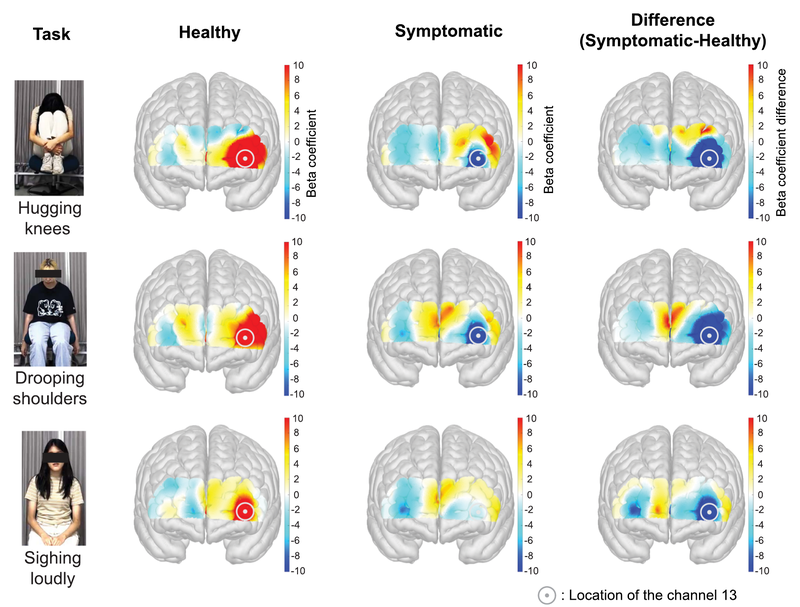
[Financial News] A study has found that the brain responds in opposite ways depending on the level of depressive symptoms, even to identical gestures such as curling up with the knees drawn to the chest or sighing. Activity in a particular brain region increased in people with few depressive symptoms, while it decreased in those with higher levels of symptoms. The finding comes from domestic researchers who measured brain activity as participants actually moved their bodies, and is expected to offer clues for developing mental health management approaches tailored to individuals' circumstances.
KAIST said on the 20th that a research team led by Professor Park Young-kyun of its Department of Bio and Brain Engineering used wireless brain-imaging equipment to measure brain activity as people moved their bodies and identify differences in responses according to levels of depressive symptoms.
The research team used a wireless functional near-infrared spectroscopy (fNIRS) device worn on the forehead. A leading brain-imaging method, functional magnetic resonance imaging (fMRI), requires people to lie in a narrow scanner and restrict their movements, making it difficult to examine brain responses while they crouch or jump.
fNIRS uses light to measure changes in the oxygenation of blood in the brain. When the brain is active, blood flow and oxygenation also change; fNIRS uses these changes to indirectly examine brain activity. Because people can move while wearing the sensors, the method can measure brain responses during actual movements.
The experiment involved 52 adults aged 20 to 35. After completing a depressive symptoms questionnaire (PHQ-9) and a mental health screening interview, participants were divided into a group of 27 with few depressive symptoms and a group of 25 with high levels of symptoms. The questionnaire asks how often respondents experienced nine symptoms, including low motivation and sleep problems, over the previous two weeks. The study grouped participants according to their level of depressive symptoms as measured by the questionnaire, not according to whether they had been diagnosed with depression.
Participants in each group were randomly assigned to one of two tasks: movements associated with negative emotions or movements associated with positive emotions. The negative-emotion movements were △hugging the knees △sighing deeply △slumping the shoulders, while the positive-emotion movements were △striking a victory pose △hopping △laughing while clapping. Participants repeated each movement four times, performing it for 30 seconds and then resting for 60 seconds.
The research team also took into account that sensors may shift when people move and that changes in blood flow in the scalp may become mixed into the measured signal. For example, changes caused by sensor movement may appear to be changes in brain activity. The team applied a correction process to reduce these effects before analyzing the brain responses.
As a result, the two groups showed opposite brain responses even when they performed the same movements—crouching, sighing or slumping their shoulders. The difference appeared in the left anterior part of the prefrontal cortex, a brain region located just behind the forehead. Activity in this area increased in the group with few depressive symptoms, but decreased in the group with high levels of symptoms.
In particular, the difference in responses in the same brain region was repeated across three distinct movements: hugging the knees, sighing and slumping the shoulders. By contrast, no brain activation pattern common to all three movements was observed for the positive-emotion movements.
Professor Park Young-kyun said, “The significance of this study is that it confirmed, through measurements taken during actual movements, that the brain responds differently to the same gesture depending on the level of depressive symptoms.” He added, “It could provide foundational data for understanding the relationship between bodily movement and emotion and for future research into movement-based mental health management approaches tailored to individuals’ circumstances.”
The findings were published online on July 31 in the international neuroscience journal Brain Research Bulletin.
[email protected] Yeon Ji-an Reporter