Park Chan-dae: “Local allocation tax must be maintained even if the Future Response Fund is created... More funding needed for firefighting”
- Input
- 2026-10-19 16:07:18
- Updated
- 2026-10-19 16:07:18
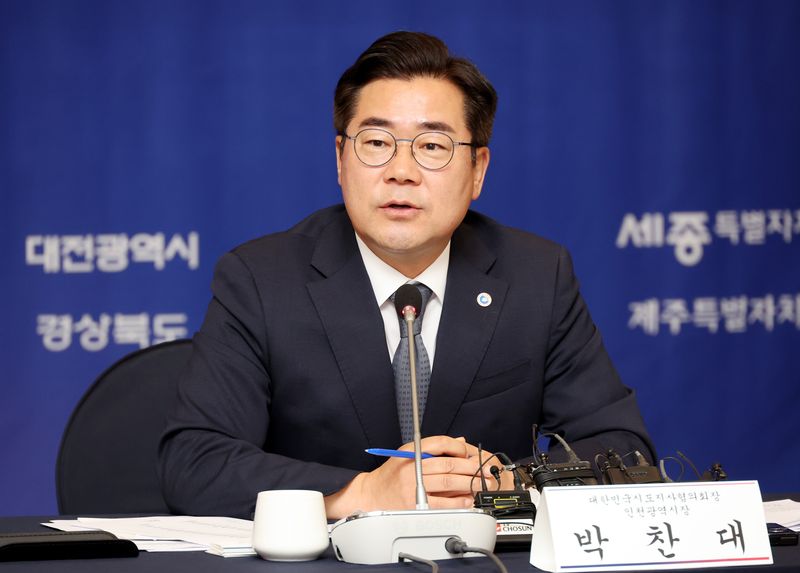
[Financial News] Park Chan-dae, chair of the Governors Association of Korea and mayor of Incheon, called for maintaining the current method of calculating local allocation tax regardless of the government’s creation of the Future Response Fund. He also called for increased central government funding for firefighting, most of which is borne by local governments even after firefighters became national civil servants.
At a meeting with reporters covering the Ministry of the Interior and Safety on the 19th at the Korea Press Center in Jung-gu, Seoul, Park said, “The 16 provincial and metropolitan leaders agreed that the portion equivalent to 19.24% of domestic taxes, which has been maintained to date, should remain unchanged, regardless of the Future Response Fund.”
The government plans to establish a Future Response Fund worth 162.3 trillion won next year, using additional tax revenue generated by factors including a boom in the semiconductor industry. Local allocation tax is currently calculated based on 19.24% of domestic taxes, but the amount distributed to local governments could shrink if the fund’s reserves are deducted first, as proposed by the government.
Park stressed, “I do not agree with a calculation method that diverts a certain portion of domestic taxes to the Future Response Fund before applying the 19.24% rate to domestic taxes.”
The Governors Association of Korea previously held a meeting in Jeju on the 16th and adopted a joint recommendation calling for the current method of calculating local allocation tax to be maintained. Explaining the process of reaching agreement, Park said, “We were unable to reach full agreement over three or four rounds,” adding, “There were differences of opinion among provincial and metropolitan leaders from the ruling and opposition parties, as well as regional differences.”
He also called for an increase in the local allocation tax rate and a larger central government funding share for national subsidy projects. Park noted, “Many central government responsibilities are being transferred to local governments, but local governments’ fiscal capacity has not kept pace.” According to the association, local governments will have to shoulder more than 3 trillion won in additional costs across 11 major national subsidy programs in 2027.
Park said, “The central government proposes good programs and passes laws, but a certain share of the costs is matched with local funds,” adding, “There are many cases where funds go unused or have to be returned because local governments cannot provide their matching share.”
He also called for increased central government funding for firefighting. Expressing his condolences over a firefighter’s death in the line of duty at a recent factory fire in Bucheon, Park said, “Firefighting became a national civil service in 2020, but fiscal responsibility has remained with local governments.”
He explained, “As of 2026, local firefighting budgets total 8.6 trillion won, of which the central government provides around 900 billion won, or about 10%,” adding that rising personnel costs for firefighters are reducing the funds available for projects such as replacing aging fire engines and upgrading rescue equipment.
Park said, “Firefighting must be adequately funded, one way or another,” adding, “In November, I will work to secure as much as possible of the local governments’ requests concerning firefighting finances through the National Assembly.”
[email protected] Lee Bo-mi Reporter