Yu Hong-jun Bows Head Over 'Self-Exhibition' of Pro-Japanese Collaborator's Calligraphy... Criticized by Ruling and Opposition Parties [2026 National Assembly Audit]
- Input
- 2026-10-19 16:04:41
- Updated
- 2026-10-19 16:04:41
The artwork in question is "Ilbansiguk-eun" (一飯是國恩), which was exhibited in the special exhibition "Our Table." The museum introduced it as the calligraphy of patriot Park Won-geun, but following an external tip-off, it withdrew the work from the exhibition and, after verification by seven experts, concluded that it was the calligraphy of Park Jung-yang, a pro-Japanese collaborator and anti-nationalist. It was also belatedly revealed that the piece was part of the collection purchased by Director Yoo for 50,000 won at an online auction in 2019.
Rep. Kim Seok-gi of the People Power Party called for the resignation, stating that it "left a stain on the 80-year history of the National Museum of Korea." Rep. Kim Seung-su of the same party raised issues of violations of museum ethics regulations and conflicts of interest, arguing that the director's submission of collection items could affect the value of the works.
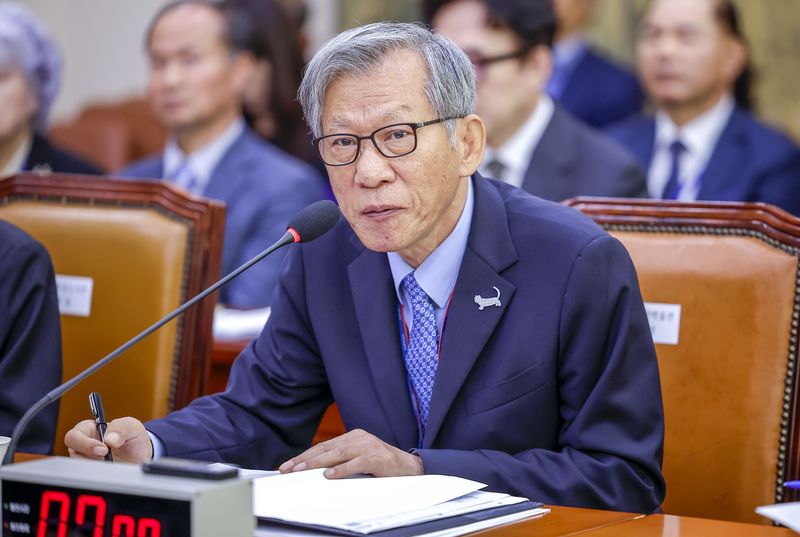
Representative Choi Min-hee of the Democratic Party of Korea also questioned why the director did not disclose that the items belonged to his personal collection in his previous apology. Director Yoo replied that he hesitated to publicly admit his mistake as an art historian, stating, "That was a major error on my part." In response to a question from Representative Cho Gye-won of the same party, he explained that he initially did not reveal the fact of his ownership for fear it would be perceived as personal boasting, and that he hesitated to disclose it out of shame after the mistaken exhibition was confirmed.■ Verification process under scrutiny... Allegations of 'Painting of the Ten Kings' being a forgery also raisedRep. Cho Eun-hee of the People Power Party pointed out, based on materials submitted by the museum, that the artwork in question was not on the initial list of exhibits finalized on February 3. She stated that after Director Yoo recommended it on May 8, a consent form for submission and a receipt for acceptance were drawn up on the 19th of the same month, and the exhibition location was finalized after a report to the director on the 22nd.
Representative Cho pointed out that during this process, there was no participation by calligraphy experts or separate comparative verification, and no documents regarding selection and approval were prepared.
In response to Assemblyman Kim Seung-su's question regarding whether he had received an appraisal, Director Yoo replied, "I was certain because I myself majored in the history of calligraphy." He clarified that he had submitted the work with the plan to donate it to the Buyeo Cultural Center and had no intention of obtaining personal gain. He admitted that it was his oversight to not carefully scrutinize whether the submission was appropriate as the head of the institution.
Suspicions were also raised regarding the forgery of three 'Siwangdo' paintings loaned to a special exhibition at the Cleveland Museum of Art in the United States. Siwangdo is a Buddhist painting depicting ten kings who judge the sins of the deceased.
Representative Lee Jung-moon of the Democratic Party of Korea pointed out that Professor Emeritus Jung Woo-taek of Dongguk University suggested the possibility that it is a commercial forgery produced in Japan. Director Yoo refuted this, stating, "It is absolutely not a forgery," and added that the academic community also regards it as an authentic work. However, he noted that there are differing opinions regarding whether it is a work from the Goryeo Dynasty or the Yuan Dynasty.
[email protected] Jang In-seo Reporter