“I only ate shiitake mushrooms” ... What happened to the 38-year-old woman who developed ‘whip marks’ all over her body?
- Input
- 2026-10-19 19:00:00
- Updated
- 2026-10-19 19:00:00
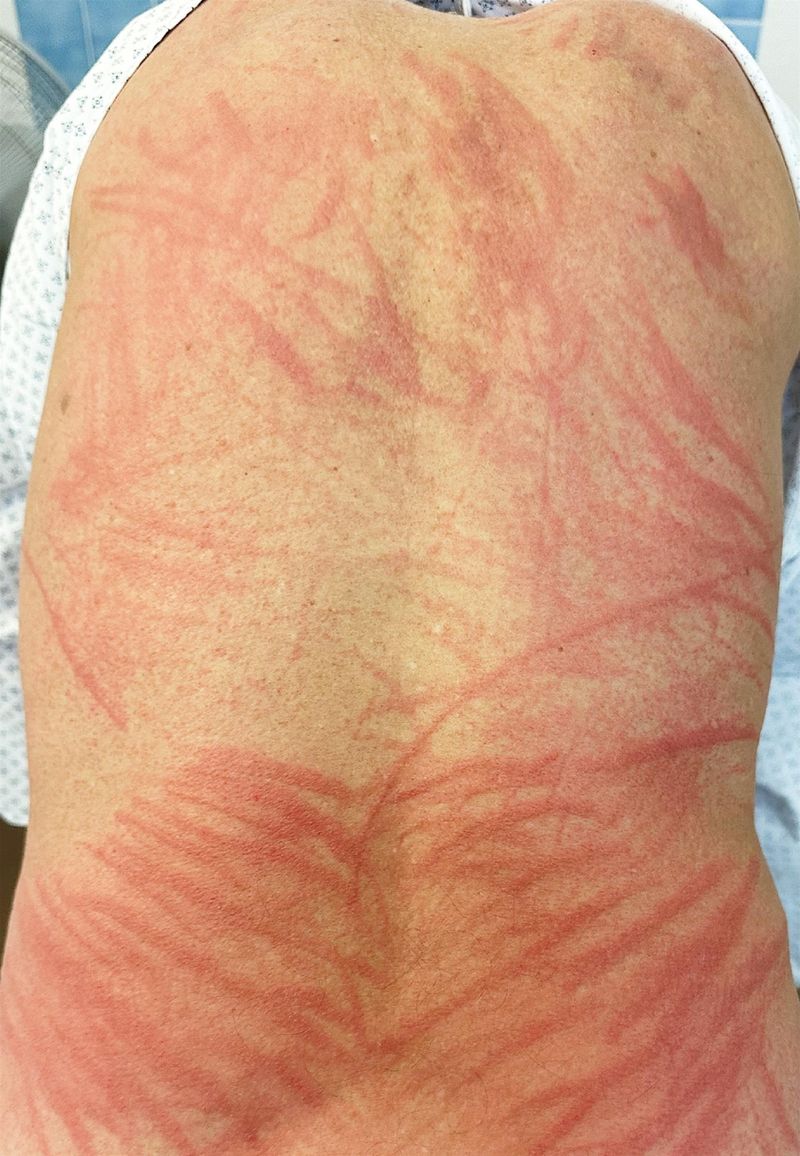
[Financial News] Stir-fried shiitake mushrooms served at an ordinary dinner table. No one could have imagined that this familiar ingredient, commonly eaten in Korea too, would leave a woman’s entire body covered in horrific ‘whip marks.’
On the 15th (local time), the US medical news outlet Medical Daily highlighted the unusual skin condition experienced by a 38-year-old woman in the UK after she ate stir-fried shiitake mushrooms. The case was reported in detail in the medical journal Oxford Medical Case Reports.
The episode began simply enough. Two days after eating stir-fried shiitake mushrooms, the woman began experiencing severe itching all over her body. Five days later, dermatographism—a condition in which raised welts appear along areas where the skin has been scratched—developed. Two days after that, a widespread red, linear rash spread from her thighs to her scalp.
The bizarre marks looked as though someone had severely whipped her all over. Interestingly, the rash was relatively sparse only in the middle of her upper back, an area difficult to reach with her hands. This suggests that scratching to relieve the itching made the streak-like rash more pronounced.
The medical team’s final diagnosis was ‘shiitake-induced flagellate dermatitis (Shiitake flagellate dermatitis).’
The culprit was lentinan, a polysaccharide found in large quantities in shiitake mushrooms. This substance, which affects the immune response, triggered allergic dermatitis in her body. Lentinan is generally heat-sensitive and is inactivated when heated sufficiently to 130–145 degrees or higher. As a result, this dermatitis usually occurs after eating raw or undercooked shiitake mushrooms.
Of course, the woman had eaten cooked mushrooms, not raw ones. However, it is highly likely that the cooking temperature and time were insufficient. (There have also been rare cases in which the condition developed after eating thoroughly cooked shiitake mushrooms.)
The diagnosis was not straightforward. The woman had a history of receiving targeted therapy for chronic myeloid leukemia 10 years earlier. The medical team conducted blood tests and other examinations, considering the possibility of a side effect from a particular anticancer drug or an inflammatory autoimmune disease, but all the results were negative. Ultimately, the fact that she had eaten shiitake mushrooms shortly before the rash appeared became the decisive clue.
Fortunately, the treatment was successful. After being prescribed steroid ointment and antihistamines, the woman was completely rid of the whip marks and itching within two weeks.
Specialists advise that shiitake-induced dermatitis appears within 1–3 days of eating the mushrooms and improves within a few weeks, but that accurate differential diagnosis is essential because its symptoms resemble those of medication side effects and other conditions. Above all, there is one sure way to prevent it: avoid eating shiitake mushrooms raw or lightly blanched, and instead boil them vigorously or stir-fry them thoroughly over high heat so they are ‘fully cooked.’
Even healthful wellness foods can become toxic if prepared improperly. That is the important lesson the shiitake mushroom revolt—which left whip marks all over the body—has taught us.
[email protected] Jeon Sang-il Reporter