Lee Chan-jin: “Financial Supervisory Service Reform Plan to Be Unveiled Next Month ... Step Up Penetration Testing to Strengthen Security”
- Input
- 2026-10-19 16:24:07
- Updated
- 2026-10-19 16:24:07
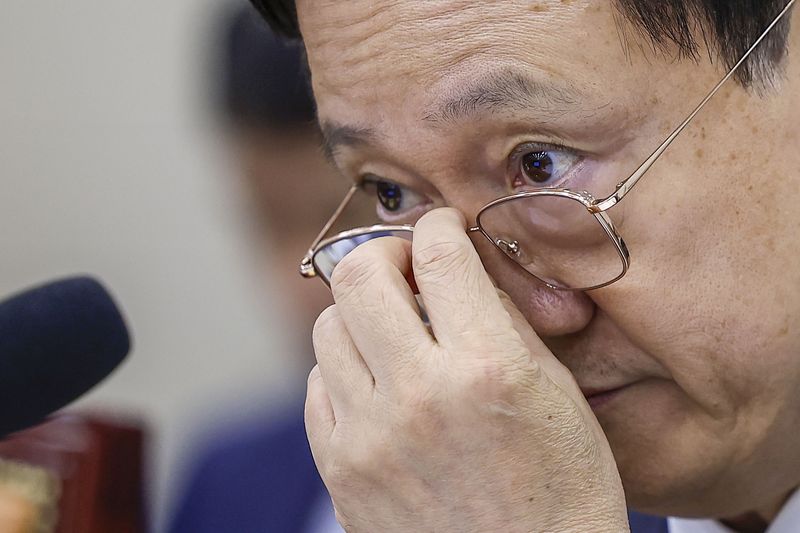
At the National Policy Committee’s parliamentary audit at the National Assembly in Yeouido, Seoul, on the 19th, Lee, the FSS governor, responded to a question from Han Chang-min of the Social Democratic Party about the delay in announcing the reform plan, saying, “Consultations with the Financial Services Commission are almost complete, and there are no major differences of opinion.” He added, “We expect to submit it sometime in November.” Earlier, in January, the Public Institution Management Committee deferred designating the FSS as a public institution while calling for reforms.
In his report to the parliamentary audit, Lee stressed, “We will swiftly address security vulnerabilities by thoroughly identifying the causes of information leaks resulting from recent cyberattacks in the financial sector.”
Lee said, “Given the public’s deep concern over the recent series of security breaches, we will actively encourage financial companies to strengthen their own security capabilities to ensure effective responses, including AI-based defense against AI-powered attacks.” He added, “We will bolster institutional measures, including strengthening the analysis and assessment of security vulnerabilities, making the identification and management of IT assets mandatory, and expanding penetration-testing exercises, including tests involving AI-based intrusions.” The FSS plans to encourage greater investment even as cyber threats using AI are spreading and the domestic banking sector’s response remains limited.
According to materials submitted by the FSS to the office of Rep. Park Sang-hyeok of the Democratic Party of Korea, a secretary of the National Policy Committee, domestic banks conducted a total of 78 penetration tests through August this year. Of these, only nine involved AI agents, accounting for 11.5% of the total. This is the first year that banks have used AI agents for penetration testing.
Lee also said he would verify the defense methods used by Woori Bank and NH NongHyup Bank, where no information leaks have been confirmed to date. When Rep. Han Min-su of the Democratic Party of Korea asked about the difference between banks that had suffered information leaks and those that had not, Lee replied, “Because they stayed true to the basics,” adding, “Woori Bank had a multi-factor authentication system, while NongHyup Bank had no entry points exposed to external attacks.”
Lee Hwan-ju, president of KB Kookmin Bank, said, “We are sorry to have caused concern to our customers and the public over a hacking incident at a financial institution where trust should be fundamental,” adding, “We will ensure sufficient budget and staffing to prevent a recurrence.” Lee Ho-seong, president of Hana Bank, also said, “We are sorry to have caused concern,” adding, “We will expand our budget and staff, equip ourselves with AI systems, and work to ensure this does not happen again.”
[email protected] Park Mun-su, Lee Hyeon-jeong, Seo Ji-yun Reporter