NH-Amundi Asset Management: “The AI investment cycle isn’t over ... 5,000 is the KOSPI’s floor”
- Input
- 2026-10-19 15:19:51
- Updated
- 2026-10-19 15:19:51
[Financial News] With concerns about semiconductors persisting despite growth in the artificial intelligence (AI) industry, the view has emerged that the AI investment cycle will last for an extended period, unlike in the past. While concerns may arise about some companies’ ability to raise funds in a high-interest-rate environment, analysts say this will not lead to a broader pullback in investment across the AI industry.
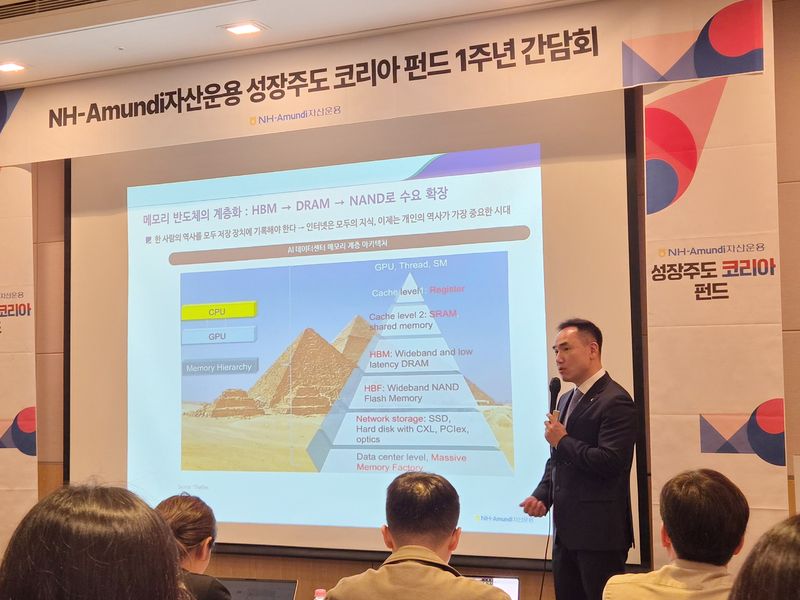
At a press briefing marking the first anniversary of the “Growth-Led Korea Fund” at FKI Tower in Yeouido, Seoul, on the 19th, Park Jin-ho, head of equity management at NH-Amundi Asset Management, said, “Considering KOSPI operating profits, 5,000 is near the floor,” and forecast that “the market will rebound as confidence in long-term semiconductor supply contracts builds.”
The market expects Samsung Electronics and SK Hynix to post combined operating profits of more than 900 trillion won next year. Even if their combined operating profits are conservatively assumed to be 300 trillion won, reflecting a worst-case scenario, the view is that 5,000 is the floor for the KOSPI.
The recent correction in South Korea’s semiconductor sector was seen as the result of concerns about the sustainability of AI investment in a high-interest-rate environment, intensifying competition from China, and other factors converging. The explanation was that fears of an investment slowdown were reflected in the market as rising interest rates increased borrowing costs while vast sums were being invested in building AI infrastructure.
However, Park said that new business models are emerging alongside the spread of AI agents, and that AI-related investment would continue regardless of the interest-rate environment. Some companies may struggle to raise funds, he said, but the likelihood of this leading to a broad-based pullback in investment across the AI industry is limited.
“In the past, during the zero-interest-rate era, there was nowhere to invest, so investment was not very active,” Park said. “AI is an industry that affects every area, from manufacturing and healthcare to everyday life. If it is clear that money can be made, investment will continue even when interest rates are high.”
“Unlike during the IT bubble of the 2000s, companies that make a lot of money are investing now,” he said, adding, “In CoreWeave’s case, given that it is a young cloud provider, I think the ‘weak link’ has given way. Even if some big tech companies experience business disruptions, AI business models will expand explosively.”
He noted that concentration in large-cap stocks such as Samsung Electronics and SK Hynix needs to be reduced to manage volatility. Accordingly, the “Growth-Led Korea Fund” also plans to diversify its investments across semiconductor materials, components and equipment, as well as financials and energy.
Choi Chi-hyeon, deputy head of Equity Management Division 2 at NH-Amundi Asset Management, said, “AI growth will continue, but the pace and direction of its rise will differ from the past year. The strategy of holding large-cap stocks remains valid, but we plan to shift part of our allocation to semiconductor materials, components and equipment companies to generate additional alpha.” He added, “Uncertainties such as interest rates and geopolitical risks remain, so hedging strategies are also needed to manage volatility. We will manage portfolio volatility by including financial stocks to hedge against interest-rate risk and energy stocks to hedge against inflation.”
[email protected] Seo Min-ji Reporter