Firefighters Become National Civil Servants, but Budgets Remain Local ... Debate Over ‘Halfway Nationalization’ as Calls Grow to Improve Their Conditions
- Input
- 2026-10-19 16:00:20
- Updated
- 2026-10-19 16:00:20
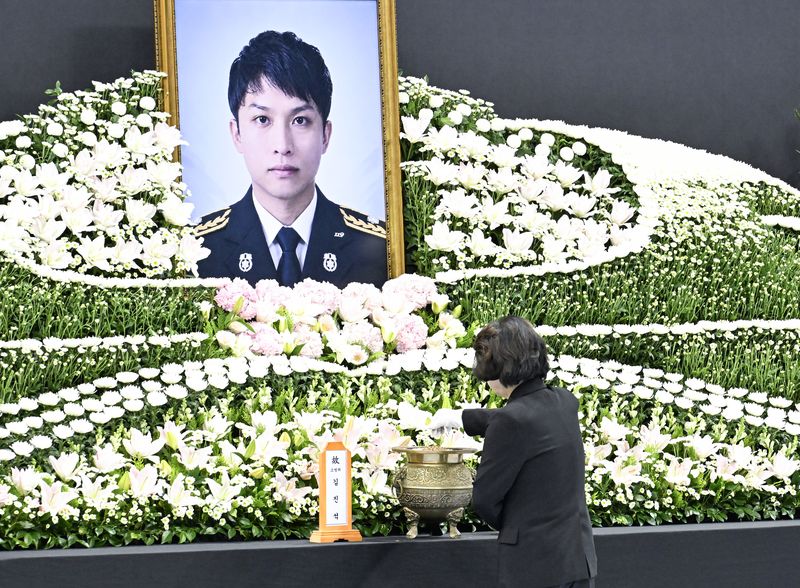
[Financial News] Calls for better treatment of fire service personnel are also mounting in political circles following the death in the line of duty of Fire Lieutenant Kim Jin-seok at the scene of a factory fire in Bucheon, Gyeonggi Province. Many say the distorted system in which local governments still share the costs must be fixed, even though fire service personnel were transferred to the national civil service in 2020. The aim is to improve their treatment by strengthening the central government's responsibility. Fire service personnel are urging sustained attention, saying, “The cycle of mourning briefly after someone dies in the line of duty and announcing short-lived measures must not be allowed to continue.”
Kim Min-seok, leader of the Democratic Party of Korea, promised at a Supreme Council meeting at the National Assembly on the 19th: “Creating a safe working environment for firefighters is an absolute responsibility of the state. All necessary equipment must be replenished in a timely manner, and support for firefighters’ mental health, including post-traumatic stress disorder (PTSD), must be adequate. We will continue to strengthen budget support for a safe working environment for firefighters.”
Floor leader Han Byung-do also said at the meeting, “I will take the lead in securing budgets, overhauling fire service-related systems, and developing effective measures to prevent a recurrence, including systems for rescuing and evacuating firefighters.” Senior Supreme Council member Choi Min-hee said, “At present, 72% of fire service duties are classified as national government responsibilities, but central government funding accounts for just 10.7%,” and proposed that “the National Assembly begin discussions as soon as possible on moving to a system in which the state also takes responsibility for fire service funding.”
Park Chan-dae, mayor of Incheon and chair of the association of provincial and metropolitan governors, pointed to the low share of the budget covered by the national government at a press briefing held at the Press Center in Jung-gu, Seoul. “Even essential project funding, such as for replacing aging fire engines, is declining every year,” he said. “There was a proposal to redirect the local education tax portion of the tobacco consumption tax, which was scheduled to expire this year, to fire service funding, but we were unable to reach agreement,” he said, expressing concern. He added that he was working with the government and the National Assembly, among others, to secure funding for the fire service.
The opposition also called for measures to improve the treatment of fire service personnel. On the 18th, party leader Jang Dong-hyuk visited the funeral home at Soonchunhyang University in Bucheon, where a funeral altar had been set up for Fire Lieutenant Kim, and stressed: “The state must protect the safety of firefighters who protect the lives and safety of the public. The state must take greater care to ensure that those who sacrifice and labor in the field to protect the public’s lives and safety receive the respect and treatment they deserve.” The People Power Party says it will work to increase budget allocations aimed at improving the treatment of fire service personnel during budget deliberations.
The key issue, ultimately, is likely to be how much to increase central government funding, which currently accounts for a share in the 10% range. Fire service personnel say that unless the national share of funding is increased, their treatment will vary depending on the financial circumstances of local governments. Discussions are expected to accelerate when deliberations on next year’s budget get under way in earnest this November.
The Firefighters’ Integrated Union also held a press conference at the National Assembly Communication Building on the 19th, calling for sustained attention from political circles and active efforts to improve their treatment. Union chair Choi Young-jae said, “Improvements to the working environment should not begin only after an accident; they must be made continuously and systematically in normal times.”
The union also urged President Lee Jae-myung to “strengthen the central government’s responsibility and authority over personnel and budgets for firefighters in the national civil service, secure stable staffing and funding, and improve their treatment so they are not marginalized by local governments or subjected to policy neglect.” It also called for separating field-response and administrative departments; implementing a single pay-scale system; holding open competitive recruitment for fire administration civil servants; abolishing the welfare system for senior fire officers; and meeting with the leaders of the ruling and opposition parties.
[email protected] Lee Hae-ram Reporter