“Seoul home prices will rise anyway, even at year-end” ... The key question is whether gains slow or accelerate
- Input
- 2026-10-20 09:44:57
- Updated
- 2026-10-20 09:44:57
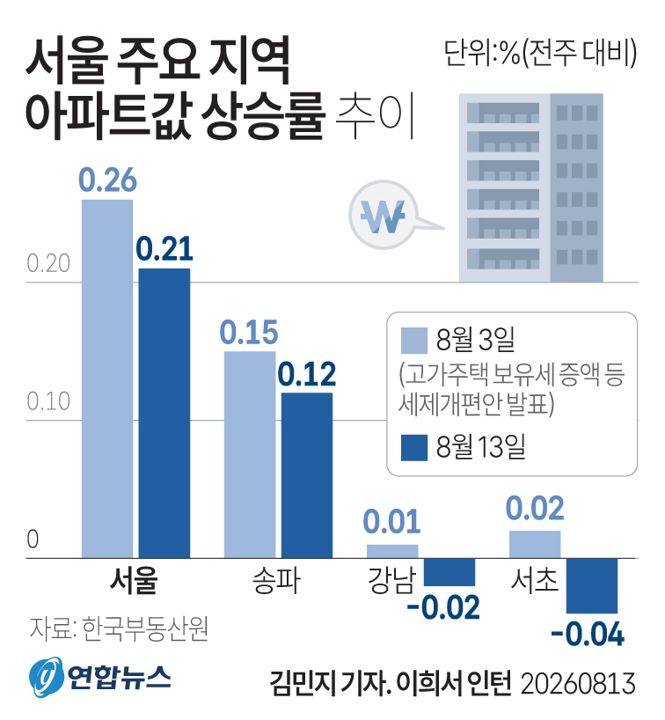
[Financial News] With the government prioritizing stability in the real estate market, attention is turning to where Seoul home prices will be by year-end. Apartment prices in the three Gangnam districts continue to fall, but gains are widening again in Seoul’s outer districts. Experts are also divided over the effects that interest rates and lending restrictions, among other factors, will have on the market.
According to the government and the real estate industry on the 20th, President Lee Jae-myung said the previous day at a press briefing held at Chunchugwan in Cheong Wa Dae, “From the government’s perspective, we need to reduce price swings.” He was underscoring the need to minimize the shock caused by sharp fluctuations in real estate prices.
President Lee also addressed the shortage of housing supply. He explained that the effects of the sharp drop in supply in 2022 are being felt now, and said supply would not return to normal until after 2028. He said lending restrictions should continue to curb speculative demand while minimizing harm to people buying homes for their own use.
Hong Ji-seon, Minister of Land, Infrastructure and Transport (MOLIT), had also previously raised the possibility of the housing market stabilizing by year-end. At a parliamentary audit on the 7th, Hong cited, among other things, the fact that apartment prices in the three Gangnam districts and Yongsan District had turned downward, saying, “I expect housing prices to stabilize by year-end and the rate of increase to narrow.”
Regional differences are pronounced in Seoul’s housing market. Seoul apartment sale prices rose 0.16% week over week in the second week of October (as of the 12th), according to data released by the Korea Real Estate Board. Prices have risen for 88 consecutive weeks, and the rate of increase was also 0.04 percentage points higher than the previous week.
The rate of increase in Seoul apartment prices fell from 0.29% on Aug. 24 to as low as 0.09% on Sept. 28. But after rebounding to 0.12% on Oct. 5, it reached 0.16% on the 12th, with gains widening for a second straight week.
The rise in prices is especially pronounced in Seoul’s outer districts. Across Seoul’s 14 northern districts, the rate of increase in apartment prices climbed to 0.31% from 0.24% the previous week. Jungnang District (0.42%), Seongbuk District (0.41%), Seodaemun District (0.40%) and Dobong District (0.39%) recorded some of the highest rates of increase.
By contrast, prices continued to fall in Gangnam District (-0.35%), Seocho District (-0.27%) and Songpa District (-0.21%). Yongsan District returned to growth, rising 0.03%. Apartment prices rose in 22 of Seoul’s 25 autonomous districts.
The Korea Real Estate Board said some transactions were completed at lower prices as discounted listings came onto the market, but prices continued to rise in popular areas, including large apartment complexes, small- and medium-sized apartments, and neighborhoods near subway stations. With prices undergoing corrections in the Gangnam area while continuing to rise outside Gangnam, it is difficult to judge the direction of the market based solely on Seoul’s overall rate of increase.
The forecast that the upward trend will cool by year-end puts more weight on demand weakening in response to interest-rate hikes and lending restrictions. Park Won-gap, chief real estate expert at KB Kookmin Bank, said, “I’m not sure whether prices will fall, but I expect the rate of increase to slow,” adding, “The Bank of Korea’s rate-hiking stance will have an effect.”
An industry source who requested anonymity also said, “I think the overall pace of price increases could slow by year-end.” One assessment is that the upward trend may ease, particularly in Seoul’s outer districts such as Nowon District, where there are relatively more buyers sensitive to interest-rate changes.
The source also mentioned the possibility that listings associated with rental business operators and landlords under the mutually beneficial lease arrangement could come onto the market in light of tax benefits. Some in the market, however, predict that the additional liquidity from year-end bonus payments at Samsung Electronics and SK Hynix could translate into demand to buy homes in prime areas such as Gangnam.
Others, however, believe interest-rate hikes alone will not be enough to significantly reverse the upward trend in existing home prices. They point to persistent inflationary pressure and the varying effects of interest-rate changes across regions and groups of buyers. Jin Mi-yoon, a professor in the Department of Real Estate at Myongji University, said, “There aren’t many groups that react sensitively even when interest rates rise,” adding, “I believe higher rates will hurt only neighborhoods and groups vulnerable to external shocks; they won’t be able to bring down prices that have already been established.”
[email protected] Jeong Gyeong-su Reporter