Oh Se-hoon: “Park Won-soon sprayed herbicide on housing supply ... Home prices to keep rising through early next year”
- Input
- 2026-10-19 16:44:19
- Updated
- 2026-10-19 16:44:19
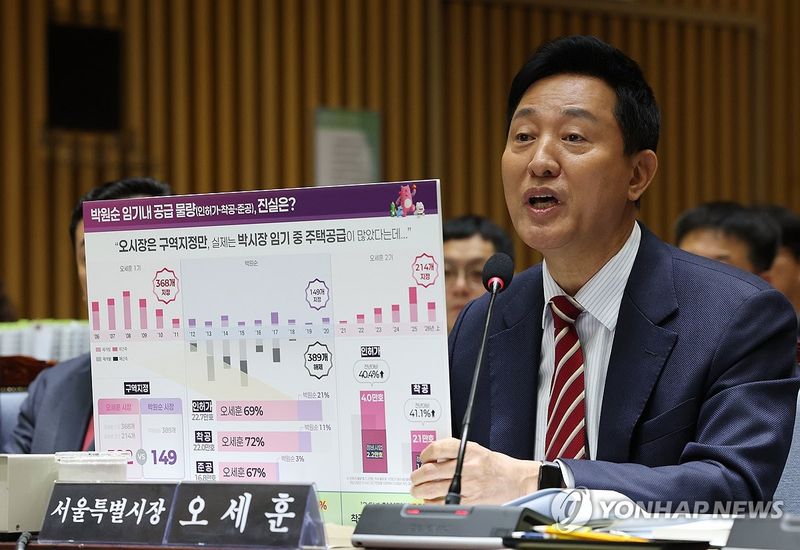
■ “I planted seeds for housing supply, but... Park uprooted them”
At the National Assembly Land, Infrastructure and Transport Committee’s audit of the Seoul government, held at Seoul City Hall in Jung-gu, Seoul, on the 19th, Mayor Oh took aim at a remark by Democratic Party lawmaker Jang Jong-tae that permits for housing construction had fallen sharply. “Former Mayor Park pulled out all the roots and even sprayed herbicide before he left,” Oh said. The claim is that during Park’s term, designations for 389 redevelopment and reconstruction projects were lifted, wiping out around 430,000 homes that would have been built five or 10 years later.
Oh stressed, “I planted the seeds, and just as the stems were coming up, the city administration passed to former Mayor Park. I’ve come back and am once again cultivating the field and planting seeds; we’re now at the stage where the stems are coming up.” In response to Jang’s point that completion and permitting figures in the other 22 districts were far below those in Seoul’s three Gangnam districts, Oh said, “Most of the areas where [Park] lifted designations were in northern Seoul. He lifted them there particularly heavily.” He added, “Of the projects completed during Park’s term, 70% had received permits during my first term as mayor,” and, “All the projects permitted or begun during Mayor Park’s term benefited from housing projects started during my previous term.”
Later, Democratic Party lawmaker Heo Young pointed out, “You said former Mayor Park lifted the designations arbitrarily, but it was not Park who lifted them first—it was Mayor Oh,” adding, “In April 2012, he pushed to lift the designations of 32 redevelopment zones, and 31 were actually lifted.” Oh strongly countered that this was “muddying the waters.” He said, “The 31 areas where I lifted designations accounted for 4% of all project sites, while Mayor Park lifted designations in 389 areas, or 67% of all project sites,” and sharply added, “He ruthlessly lifted designations even for projects that association members desperately wanted to pursue.”
■ “Jeonse supply is running out... The president must not ignore the severity”
The audit also revealed differences between the government and ruling party, on one side, and the Seoul government, on the other, over the causes of rising home prices. Lee Seong-hun, president of Korea Land and Housing Corporation (LH), had previously told a National Assembly audit on the 12th that “there is a strong possibility home prices will plunge.” In response, People Power Party lawmaker Jeong Dong-man asked Oh to forecast home prices, saying, “Apartment prices in Seoul have risen for 88 consecutive weeks, and the entire real estate market is in crisis. Apartment prices are rising even in Gyeonggi Province.”
Oh replied, “The general forecast is that it will be difficult for the rise in apartment prices in eastern or southwestern Seoul to ease before the end of the year or early next year,” adding, “That’s because the supply of jeonse homes in Seoul has dried up, and both jeonse and monthly rents are rising.” The view is that even residents who had no particular need to buy a home have joined the ranks of buyers, driven by desperation as the jeonse and monthly rental crisis worsens: “I have to buy a home now, even at this point.”
Oh stressed in particular that the policy of putting pressure on multi-home owners and emphasizing owner-occupation should be changed. “Another name for multi-home owners could be private rental housing providers. Of course, some people own multiple homes to build their assets or for speculative purposes, but those homes are being made available to residents as rentals, including jeonse,” he said. He added, “In northeastern and southwestern Seoul, the supply of jeonse homes hasn’t fallen by 10–20%; it has fallen by 70–80%. The situation is truly dire,” and said, “The president and the Ministry of Land, Infrastructure and Transport must not turn a blind eye to how serious this is.”
He also reiterated that easing regulations was essential to revitalize redevelopment projects. With available land in Seoul running out, redevelopment and reconstruction—demolishing existing apartments or densely packed low-rise housing and building new homes in their place—are a key pillar of housing supply. Oh stressed, “Projects such as redevelopment and reconstruction account for around two-thirds of new housing supply. Seoul’s housing shortage cannot be solved by ignoring them.”
In response to People Power Party lawmaker Shin Seong-beom’s question about supplying housing on the Tancheon site, Oh said, “I’ve met and discussed it regularly, even during the previous minister’s tenure,” adding, “I think I’ll meet with Minister of Land, Infrastructure and Transport Hong Ji-seon soon.”
[email protected] Jeon Min-kyung Reporter