Opening the gates to ‘sacrosanct’ Yongsan Park... Push begins to break the ban on housing development
- Input
- 2026-10-19 14:42:41
- Updated
- 2026-10-19 14:42:41
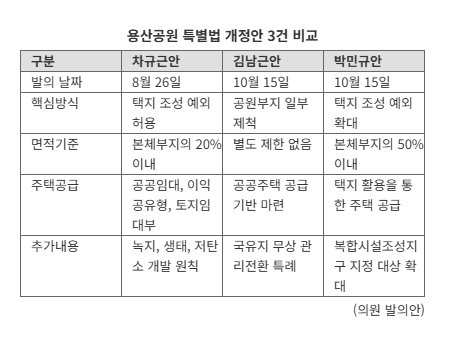
According to the National Assembly’s legislative tracking system on the 19th, Democratic Party of Korea lawmakers Kim Nam-geun and Park Min-gyu each introduced, as lead sponsors, bills on the 15th to partially amend the Special Act on the Creation of Yongsan Park. Both bills would create exceptions allowing part of the main site of the Yongsan U.S. military base, which under current law must be developed as a park, to be used for housing supply. They differ, however, in how the land could be used and in limits on its area.
Kim Nam-geun’s bill would exclude part of the main site from the area designated for park development. It would allow the Minister of Land, Infrastructure and Transport to remove some land from the designation after deliberation by the Yongsan Park Creation Promotion Committee, if the minister deems it necessary in the interests of significant public purposes, such as housing stability.
The Ministry of Land, Infrastructure and Transport would receive management authority over the excluded land from the existing managing agency free of charge and give priority consideration to pursuing public housing projects. The bill sets no specific ceiling on the area that could be excluded. In his statement of reasons for the bill, Kim said its intent was to establish a foundation for providing public housing for young people without homes and newlyweds, while seeking a balance between the park’s ecological value and housing stability in the city center.
Park Min-gyu’s bill would allow part of the main site to be used as residential development land on the condition that the land is not sold. The area to be developed would be set by an enforcement decree, up to half of the entire main site.
While Kim’s bill focuses on removing some land from the area designated for park development, Park’s would allow land within the main site to be used for housing while restricting its sale. Park cited the returned Yongsan U.S. military base site’s location in downtown Seoul and its easy access to major business districts as reasons it should be used for housing supply.
Earlier, on August 26, Cha Gyu-geun of the Rebuilding Korea Party also introduced an amendment allowing part of the main site to be used for housing development. That bill limited the development area to 20% of the entire main site and restricted the housing supplied to public rental housing, profit-sharing homes for sale, and land-leasehold homes for sale.
The two recently introduced bills broaden the scope for using the site compared with Cha’s bill. Park’s bill raises the cap on housing-site development to 50%, while Kim’s sets no separate numerical limit. As for the housing to be supplied, Kim’s bill gives priority to considering public housing projects, while Park’s does not restrict the housing to specific types.
Legislative efforts are continuing, but the Ministry of Land, Infrastructure and Transport and the Seoul Metropolitan Government have made no progress in reconciling their positions. A meeting between Minister Hong and Mayor Oh has yet to be scheduled. At two meetings in August, former Minister Kim Yun-deok and Mayor Oh also failed to narrow their differences over using the main site of Yongsan Park for housing.
Mayor Oh reiterated his opposition during the National Assembly Public Administration and Security Committee’s audit of the Seoul Metropolitan Government on the 15th, the day the bills were introduced, saying, “It will take at least three to four years, and possibly six to seven years, just to remediate soil contamination at Yongsan Park, making it impossible even to break ground during the current administration.” He said using the Tancheon Water Reclamation Center site instead of Yongsan Park was the realistic alternative.
Meanwhile, housing starts in the Seoul metropolitan area this year are expected to fall short of the government’s original target. According to a housing-supply review released by the Ministry of Land, Infrastructure and Transport on the 16th, at least 99,000 homes had started construction in the region through the second week of October, about 37% of the annual target of 268,000. The government’s year-end forecast is 218,000 to 235,000 housing starts, 33,000 to 50,000 below the original target.
[email protected] Choi Ga-young Reporter