Some in the ruling party and the broader progressive camp put the brakes on easing labor regulations in mega-special zones
- Input
- 2026-10-19 14:20:28
- Updated
- 2026-10-19 14:20:28
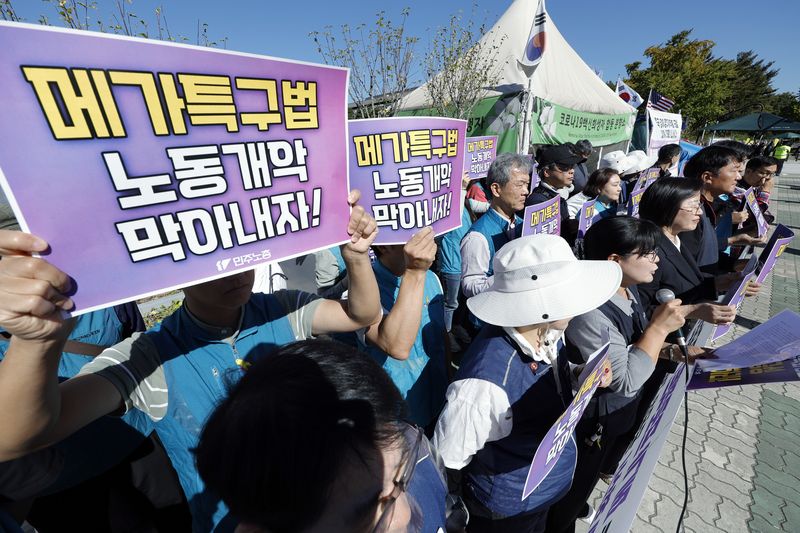
The Korean Metal Workers’ Union (KMWU) and Progressive Party lawmaker Jung Hye-kyung held a press conference at the National Assembly’s Communication Hall on the 19th, condemning the breakdown of collective bargaining at semiconductor materials, parts and equipment companies and urging the government to intervene. They criticized the situation, saying, “Even the basic rights of workers on the ground are not being properly protected,” as the government and ruling party pursue large-scale support for the semiconductor industry and an easing of labor regulations through the Mega Special Zone Act.
The key points of contention in the Mega Special Zone Act for labor groups include exemptions from the 52-hour workweek for research and development (R&D) personnel, extending the period fixed-term workers may be employed, and expanding the types of work for which dispatch workers may be used. The KMWU says, “Giving companies the added benefit of relaxed labor regulations before labor-rights violations in existing workplaces have been resolved could increase the burden on workers.”
Disagreements over special labor provisions for companies based in mega-special zones have also surfaced within the Democratic Party. Park Hae-cheol, a member of the National Assembly’s Climate, Energy, Environment and Labor Committee, said during the Ministry of Employment and Labor’s parliamentary audit on the 13th that “securing industrial infrastructure such as electricity and water, as well as skilled technical workers, should take priority over easing labor regulations.” Jang Cheol-min, secretary of the Democratic Party’s Special Committee on Mega Growth, also said the government’s draft contained no provision for a blanket exemption from the 52-hour workweek, and that the scope of the special provisions would be decided after consultation with labor groups.
In talks among labor, management and the government, business groups are calling for more flexible working hours and relaxed regulations on fixed-term and dispatched workers, while labor groups are resisting, voicing concern about long working hours and an expansion of non-regular employment. Employment and Labor Minister Kim Young-hoon says a point of agreement should be found through social dialogue, and further working-level talks are scheduled for the 20th.
For party leader Kim, too, passage of the Mega Special Zone Act is directly tied to his leadership. At the party convention last August, he secured support among party members in Honam by making the success of the three mega-projects for Honam and Daehan the “party’s No. 1 priority,” making legislative achievements to back them up necessary. However, if disagreements across the ruling bloc over special labor provisions continue, disruption to the fulfillment of the pledge will be unavoidable.
Ruling-party figures with labor backgrounds, including Secretary-General Han Jeong-ae, are reportedly trying to persuade unions—the party’s traditional base of support—by explaining the changed industrial environment and the need for institutional improvements. A ruling-party official said that, given the changes in the industrial environment, labor groups were being told of the need for change and asked for their understanding.
[email protected] Song Ji-won Reporter