Operating profits may rise, but there’s little to smile about: Pay-TV remains in a deep freeze
- Input
- 2026-10-19 15:46:56
- Updated
- 2026-10-19 15:46:56
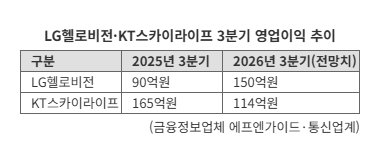
[Financial News] As the downturn in the pay-TV market drags on, forecasts for LG HelloVision and KT Skylife’s third-quarter results this year are diverging. LG HelloVision is expected to see operating profit rebound on the back of cost savings, while KT Skylife is forecast to post lower earnings due to declining subscribers to its traditional broadcasting service and marketing costs associated with expanding new services. However, both companies face the structural challenge of falling pay-TV subscriptions, prompting calls for institutional reforms to improve the industry’s sustainability.■ Diverging fortunes for LG HelloVision and KT SkylifeAccording to financial data provider FnGuide on the 19th, LG HelloVision’s operating profit for the third quarter this year is forecast to reach 15 billion won, up 67% from 9 billion won in the same quarter last year. KT Skylife’s operating profit is projected to fall 31% over the same period, from 16.5 billion won to 11.4 billion won.
Cost-structure improvements are expected to be a major factor behind LG HelloVision’s higher operating profit. The company has offered voluntary retirement for three consecutive years since 2024, reducing its labor costs. According to the Financial Supervisory Service’s electronic disclosure system, it had 933 employees as of June this year, about 7% fewer than the 1,000 in the same period last year.
It is also accelerating efforts to diversify its business through rentals. Its strategy is to promote a purchase service with long-term installment payments, differentiated from its existing home appliance subscription service, and secure new revenue streams through business-to-business (B2B) operations.
However, higher operating profit does not mean the core business is recovering. In the second quarter this year, LG HelloVision’s revenue declined year over year across all major business segments, including broadcasting and internet services. Analysts say there are limits to improving profitability through cost-cutting when revenue remains weak amid falling pay-TV subscriptions.
KT Skylife is expected to see operating profit decline due to falling subscriptions to its traditional broadcasting service and the marketing costs of expanding new services. However, revenue from telecommunications services is projected to grow, supported by increased sales of bundled internet plans.
A prime example is iFit TV, an internet protocol television (IPTV) service launched last July. It delivers TV programming over the internet without a separate satellite dish. DB Securities estimates that subscribers grew from 244,000 at the end of the second quarter this year to at least 280,000 by the end of August.
Sales of bundled internet plans centered on iFit TV are also expected to expand and contribute to growth in telecommunications service revenue. However, subscriber losses from traditional satellite broadcasting and Genie TV Skylife (GTS) are greater than the gains in iFit TV subscribers, so revenue from broadcasting services is expected to remain weak. Marketing costs to attract new subscribers are also projected to continue through the end of the year. In effect, the new service is growing, but not enough to offset the decline in the traditional broadcasting business.■ Cutting costs and growing new businesses still leaves pay-TV’s downturn as a shared challengeAlthough the two companies have diverging earnings outlooks, both face the shared challenge of a structurally declining pay-TV market. According to the Broadcasting, Media and Communications Commission, the number of pay-TV subscribers in South Korea fell by 210,000, from 36.36 million in the second half of 2024 to 36.15 million in the second half of 2025. As the subscriber base shrinks, fixed costs such as content acquisition and network operations remain a burden.
Contributions to the Broadcasting and Communications Development Fund, due in the second half of the year, are also seen as a cost burden. The levy collection rate for paid-TV providers, including cable TV operators (SO) and IPTV providers, has remained at 1.5% of broadcasting business revenue since 2017.
Industry observers say it is difficult to overcome the structural downturn in the pay-TV market through cost-cutting and new businesses alone. An industry source said, “Pay-TV subscriptions and revenue continue to decline, while providers still face burdens such as content acquisition costs. Institutional reforms are needed to give pay-TV providers greater financial room to operate, including easing their contributions to the Broadcasting and Communications Development Fund, resolving disputes over home shopping transmission fees, and establishing a reasonable system for determining content payments.”
[email protected] Hye-rim Choi Reporter