“Giving 500 Million Won, Then Another 500 Million Next Year” — The ‘Future Gift’ a Couple in Their 60s Prepared for Their Child with a Disability [PB’s Money Recipe]
- Input
- 2026-10-19 17:22:05
- Updated
- 2026-10-19 17:22:05

[Financial News] #. For one couple in their 60s, their child’s future is their biggest concern. Having spent their lives caring for a child with a disability, they worry more about their child’s ability to live independently than about their own retirement. The child’s mother said, “A parent’s wish is to live just one day longer than their child,” adding, “We want to build a foundation that will allow our child to be financially independent and live securely even after we are gone.”According to the financial industry on the 19th, trusts for people with disabilities and insurance for people with disabilities are considered asset-management tools to help children with disabilities live securely. That is because they can provide children with stable living expenses while reducing the gift-tax burden, rather than simply transferring assets. In particular, if the gift-tax exemption limit for trusts for people with disabilities is raised to 1 billion won starting next year under the government’s tax reform plan for next year, the options for wealth-transfer strategies are expected to expand.
Tax savings and asset protection through trusts
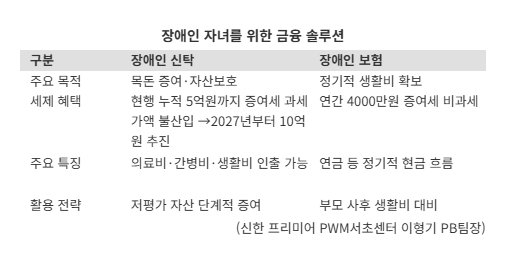
If you plan to gift a substantial sum, it is advisable to make active use of a trust for a person with a disability. By naming a child with a disability as the beneficiary and placing assets such as cash, securities or real estate with a financial institution, you can currently gift up to 500 million won without paying gift tax. The tax savings are significant compared with the general gift-tax deduction limit of 50 million won for an adult child over 10 years. Unlike the ordinary gift-tax deduction, the special provision for trusts for people with disabilities is also not subject to the 10-year aggregation rule.
The real value of a trust for a person with a disability lies in protecting assets. Withdrawals of principal from funds placed in the trust are strictly limited. This means it can safeguard the assets of a child with a disability who may have limited decision-making capacity or be vulnerable to unfair inducements and fraud. At the same time, funds can be withdrawn flexibly for expenses essential to the child’s independence—including medical care, caregiving and special-purpose education—as well as living expenses of up to 1.5 million won a month, allowing funds for daily needs to be managed securely throughout the child’s life.
In particular, under the government’s tax reform plan, the gift-tax exemption limit for trusts for people with disabilities is set to rise sharply, from 500 million to 1 billion won, starting next year. This would double the amount of assets parents can transfer to their children tax-free. The tax reform plan is expected to pass after deliberations in the National Assembly of the Republic of Korea at year-end. Experts therefore advise adopting a “phased wealth-transfer strategy”: use trusts within the current limit, focusing on undervalued assets, and make additional gifts in line with next year’s tax reform.
Lee Hyeong-gi, PB team leader at Shinhan PWM Seocho Center, said, “A sharp drop in stock prices amid market volatility like we’re seeing now is a time to consider using a trust for a person with a disability.” He added, “If you put high-quality stocks whose prices have fallen into a trust account and gift them to a child with a disability, the undervalued amount at the time of the gift is deducted from the gift-tax-exempt limit (currently 500 million won). Even if the stock market recovers and share prices rise later, the entire increase in asset value will accrue to the child without any additional gift-tax burden, maximizing the benefits of both gifting and asset building.”
A reliable safety net: insurance for people with disabilities
Insurance for people with disabilities can provide children with a stable stream of income. Under the Inheritance and Gift Tax Act, if parents pay the premiums and name their child with a disability as the beneficiary, insurance proceeds received by the child are eligible for a gift-tax exemption of up to 40 million won per year.
If parents pay the premiums during their lifetime and arrange for a pension to be paid regularly to their child, the child can use it for living expenses. Since the pension becomes the child’s asset as soon as it is paid, parents can guide the child’s investments while they are alive and help the child develop sound financial habits. The child can also gain experience building a financial foundation through their own efforts.
Above all, a major advantage is that, if the parents die, their child can take over as the policyholder of the insurance for a person with a disability. Even after the parents are gone, the child can take over the policy and receive a fixed monthly pension, providing a reliable financial safety net that helps cover living expenses despite the parents’ absence.
Lee emphasized, “A trust and insurance for people with disabilities are not simply ways to reduce taxes, but a compassionate form of financial planning intended to let a child’s life continue as before even when their parents are no longer by their side.” He added, “It is important to plan carefully for the future in a way that suits the child’s circumstances.”
[email protected] Seo Ji-yun Reporter