Mass Protests Rock France, Raising Fears of National Collapse
- Input
- 2026-10-19 15:48:37
- Updated
- 2026-10-19 15:48:37
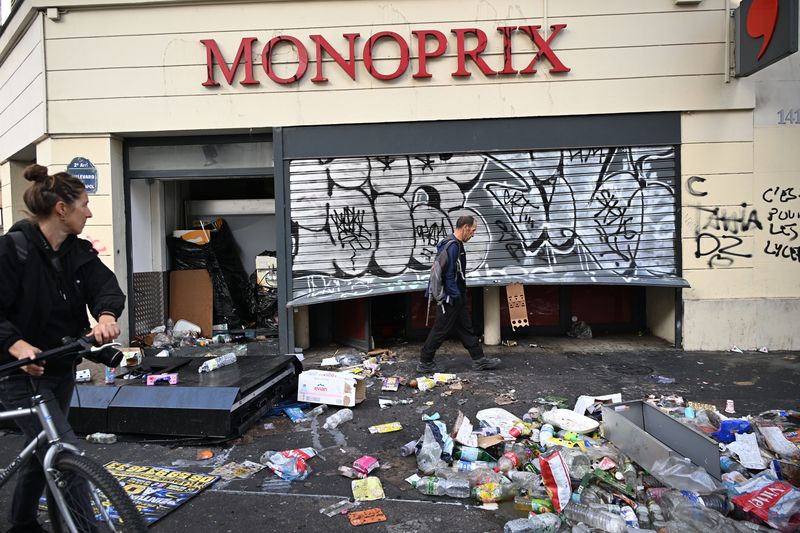
[Financial News] As mass protests fueled by anger over soaring prices and the cost of living sweep France, the country’s fiscal and political turmoil is escalating to its worst point.
According to major foreign media outlets on the 18th (local time), protests that began with a student movement lasting about a month and calling for more teachers and better educational conditions grew as members of the public and labor unions joined in. They spread across France over the weekend, drawing about 550,000 people, including 110,000 in Paris. Arson and looting also broke out, and about 2,400 people were detained in a single day. The business magazine Fortune reported that, as a national debt crisis and the damage wrought by populist politics erupted simultaneously ahead of a parliamentary vote scheduled for this week, “France is effectively on the brink of national collapse.”
The public held peaceful demonstrations, but some violent groups set fire to and looted public buildings, luxury stores, supermarkets and other businesses. About 1,000 police officers were injured, and one protester died of a heart attack in Paris. On the 17th, a city hall building with a 143-year history was destroyed by arson in Limoges, central France. Elsewhere, protesters broke into Marseille City Hall and a tourist information center in Lyon was set on fire. Up to about 100 shops were looted in Bordeaux alone, and hundreds of stores across the country suffered serious damage.
As the situation escalated, French President Emmanuel Macron said in a televised address to the nation on the 18th, “Seeing these scenes, we all asked ourselves, ‘How can the French do this to France?’” He strongly condemned the violence, saying, “Nothing can justify, explain or excuse violence.” Macron pledged a “firm response without compromise” to far-left violent groups and the criminals who joined them. However, rather than declare a state of emergency or impose a curfew, he decided to give regional prefects and mayors the authority to ban gatherings in order to protect public buildings and local businesses. Macron also rejected Interior Minister Laurent Nuñez’s resignation and urged him to work to restore public order.
Experts agree that this crisis stems not merely from protests but from structural fiscal weakness that has built up over a long period. France’s national debt currently stands at about $4 trillion (approximately 5,400 trillion won), or 119% of gross domestic product (GDP), the highest level since just after World War II. The COVID-19 pandemic and the wars in Ukraine and Iran worsened the country’s finances, and the situation became even more serious after Macron backed away from reforms intended to control the debt.
In an opinion piece for The New York Times, Mujtaba Rahman, Eurasia Group’s Europe director, said, “France is now grappling with a triple crisis: a crisis of liberal democracy, a crisis of failed fiscal management, and the disillusionment of its younger generation.” He added that “the fiscal crisis, which is driving the country toward ruin, is the most dangerous of them all.”
France’s education spending is indeed above the European Union (EU) average, but at least 25% of the budget goes toward pensions for retired teachers. Nobel Prize-winning economist Paul Krugman also criticized the system, saying, “Investment in education has been sacrificed because of an excessively generous pension system,” and “France is giving excessive privileges to the elderly at the expense of every other generation.”
The French cabinet has submitted a 2027 budget proposal that would gradually reduce the fiscal deficit from 5.4% to 5.0% of GDP, and the first consequential vote is scheduled for the lower house on the 20th. Rahman warned, “If the government fails to pass the budget, the cost of servicing France’s debt will rise explosively,” adding, “France, the world’s seventh-largest economy, could face the humiliation of having to seek a bailout from the International Monetary Fund (IMF) and support from the European Central Bank (ECB).”
Fortune noted that what markets fear most is not the economy itself but a state of “political loss of control.” With far-right and far-left candidates leading the polls ahead of next spring’s presidential election, a sense of despair is gripping the markets: whoever wins, it will be difficult to push through painful fiscal-cutting reforms. Marine Le Pen of the far right has vowed to lower the retirement age again to 62 or 60, while far-left candidate Jean-Luc Mélenchon is making the unrealistic argument that French government bonds held by the central bank should simply be “written off.”
Mujtaba Rahman, a director at Eurasia Group, said that if Le Pen’s party abstains in this week’s budget vote, allowing the budget to pass by a narrow margin, France may avoid immediate disaster, but this would be only a stopgap. “France has now reached a point where it can no longer control its own destiny,” he said.
Financial markets have already begun pricing in the possibility of a French default. In a note released last week, Thierry Wizman, a global strategist at Australia’s Macquarie Group Limited, wrote that France would have to endure severe pain over the coming months to regain the confidence of bond markets. Wizman outlined a series of developments France would need to see: a no-confidence vote against the cabinet and government paralysis; a downgrade of its sovereign credit rating by Moody’s; the spread of street riots and bloodshed; a sharp surge in sovereign bond yield spreads; and Le Pen’s election as president. He added that the ECB, concerned about moral hazard, would not step in immediately, and that existing bailout mechanisms lacked the funds to support an economy the size of France’s.
[email protected] Yoon Jae-jun Reporter