KOSPI turns higher after an early-session plunge; chip and biotech stocks rebound [fn Morning Market Update]
- Input
- 2026-10-19 10:43:20
- Updated
- 2026-10-19 10:43:20
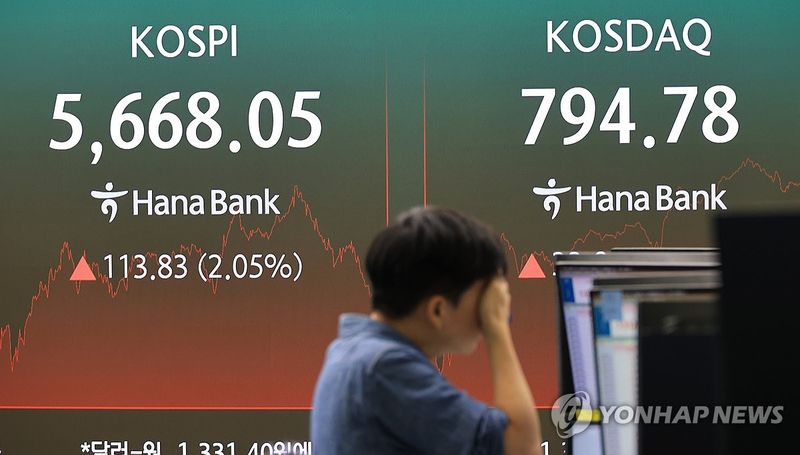
[Financial News] The KOSPI overcame fears of a sharp drop early in the session and turned higher.
Before the market opened, futures trading pointed to the possibility of a 7–8% drop, but the decline had narrowed to around 3% by the opening. Bargain hunting then came in, and the index turned higher during the morning session.
The market is holding up better than expected, led by a rebound in large-cap semiconductor stocks and biotech shares.
As of 10:33 a.m. on the 19th, the KOSPI was trading at 5,682.69, up 14.64 points (0.26%) from the previous trading day, according to the Korea Exchange. It initially fell as low as 5,488.41, down 3.17%, but quickly pared its losses and turned higher.
The market appears to be seeing some easing in selling pressure after recovering much of the shock of the sharp early-session drop.
Foreign investors’ shift to net buying stands out in trading flows. On the main board, foreign investors were net buyers of 526.7 billion won. Institutional investors were also net buyers, by 671.3 billion won.
By contrast, individual investors were net sellers of 1.2482 trillion won. In a report that day, GL Research said foreign investors’ 12-trading-day streak of net selling in the KOSPI had ended.
Large-cap semiconductor stocks are rebounding among the top companies by market capitalization. Samsung Electronics was trading at 218,250 won, up 2,750 won (1.28%) from the previous trading day.
SK hynix was up 19,000 won (1.49%) at 253,000 won. Samsung Electro-Mechanics (3.70%), LG Energy Solution (5.58%) and Hyundai Motor (2.24%) were also strong. Samsung Biologics was trading at 1,368,000 won, up 70,000 won (5.39%), adding to the rebound in biotech shares.
GL Research said, “Biotech, shipbuilding, defense and robotics-related stocks are strong in the domestic market, while semiconductor stocks are seeing their gains narrow during the session.”
The report attributed the rebound in major biotech names such as Alteogen Inc. and Celltrion, and the spread of buying across pharmaceutical and medical-device stocks, to falling U.S. Treasury yields and strength in healthcare stocks.
Factors drawing attention included expectations of high-margin vessel orders amid rising very large crude carrier (VLCC) freight rates and increased ship orders, and investment demand related to geopolitical tensions for defense stocks.
As of 10:33 a.m., the KOSDAQ stood at 793.34, down 1.44 points (0.18%) from the previous trading day. Individual investors were net sellers of 2.7 billion won and foreign investors net sellers of 24.6 billion won, while institutional investors were net buyers of 24.5 billion won.
Unlike the KOSPI, which turned higher, the KOSDAQ remained weak, leaving the recovery trajectories of the two indexes divergent.
On the 16th, U.S. markets fell, led by technology stocks. The Dow Jones Industrial Average fell 0.34%, the S&P 500 fell 1.09%, and the Nasdaq fell 2.15%. The Philadelphia Semiconductor Index (SOX) also dropped 3.83%, adding to the pressure on the domestic market that day.
GL Research said financing pressures from increased investment in AI infrastructure and concerns about monetizing those investments weighed on technology stocks. International oil prices also rose 3.5% to $101.4 a barrel, adding to market uncertainty.
The domestic market’s reversal to gains despite a sharp drop in U.S. technology stocks and the burden of high oil prices is seen as reflecting bargain buying in response to recent share-price declines.
GL Research also drew attention to semiconductor stocks’ gains narrowing after their rebound. With external uncertainties still in place, whether the KOSPI’s upward trend continues will depend on whether foreign investors keep buying and whether large-cap semiconductor stocks rebound further, the firm said.
[email protected] Kang Jung-mo Reporter