Gangneung City to open applications for living-stability grants on November 9; 100,000 won in Gangneung Pay per resident
- Input
- 2026-10-19 10:33:46
- Updated
- 2026-10-19 10:33:46
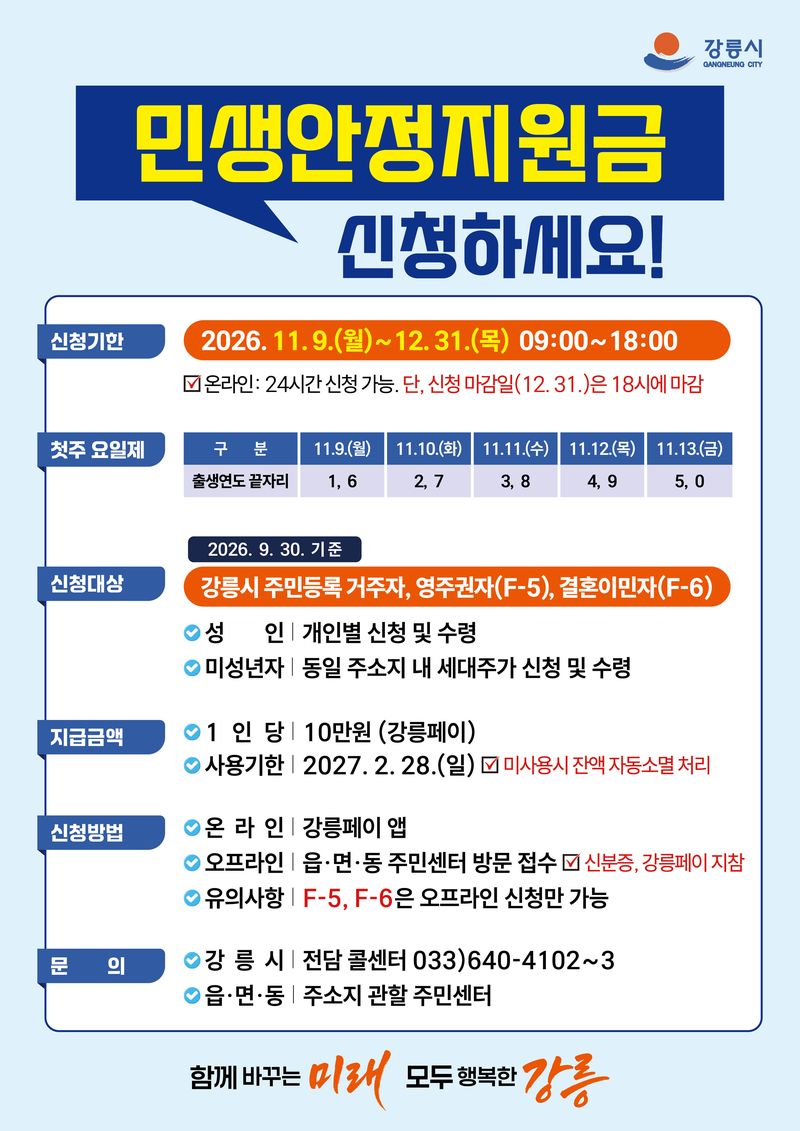
【Financial News | Gangneung—Reporter Kim Gi-seop】Residents living in Gangneung will be able to receive 100,000 won per person in living-stability support through Gangneung Pay from the 9th of next month and spend it within the region.
According to Gangneung City on the 19th, the city announced that day its plan for distributing living-stability grants, including the application period and eligibility. The support is intended to help residents whose household burdens have grown due to the economic slowdown and high prices, and to boost spending at traditional markets and neighborhood businesses to bring vitality to the local economy. Eligible recipients are residents of Gangneung, permanent residents and marriage immigrants who live in the city as of September 30 this year.
Applications can be submitted through the Gangneung Pay app or at the community service center serving the applicant’s registered address. Adults born on or before December 31, 2007, must apply individually to receive the grant. As a rule, a minor’s registered head of household applies on their behalf. However, a minor who is the head of a household with no adult members listed on the resident registration may apply directly.
Online applications through the app can be submitted 24 hours a day during the grant period, but applications close at 6 p.m. on the final day. In-person applications at community service centers are accepted on weekdays from 9 a.m. to 6 p.m. To prevent congestion at the start of the application period and system overload, a weekday schedule based on the last digit of the applicant’s birth year will apply to both online and in-person applications during the first week.
Under the schedule, residents whose birth-year digits end in 1 or 6 can apply on the 9th (Monday), those ending in 2 or 7 on the 10th (Tuesday), 3 or 8 on the 11th (Wednesday), 4 or 9 on the 12th (Thursday), and 5 or 0 on the 13th (Friday). Starting on the 14th (Saturday), the schedule will be lifted and anyone can apply.
Grants applied for through Gangneung Pay will be credited the following day and must be spent by February 28 next year. Any amount left unused by the deadline will automatically expire. To ensure the funds provide practical support to small businesses with annual sales of 3 billion won or less, they can be spent only within Gangneung City. The grant will be managed separately from the regular Gangneung Pay balance and deducted before that balance when a card is used. The remaining balance can be checked on the card receipt or through an app notification.
The city plans to reduce gaps in support by offering a home-visit application service for residents who have difficulty visiting in person, including older adults with limited mobility. Township, town and neighborhood officials will visit their homes to take applications and deliver the grants. The city also plans to thoroughly check the application and payment systems before distribution begins and quickly open a call center to respond to residents’ inquiries.
The city also urged residents to beware of text-message scams (smishing) targeting the grant. The operator of Gangneung Pay will not send any text messages containing a web address or link in connection with the living-stability grant. Anyone who receives a message impersonating the city or a financial institution and urging them to follow a link should not open it and should delete it immediately.
Gangneung Deputy Mayor Kim Man-ho said, “This grant is intended to provide relief to households strained by high prices and neighborhood businesses whose sales have fallen, so it is significant that the review committee approved it as originally proposed.” He added, “Once applications open on the 9th of next month, I will make thorough preparations, including the home-visit application service and call center, so that not a single person is left out, including older adults with limited mobility.”
[email protected] Kim Gi-seop Reporter