Hanoi Signs Contract for Five Urban Rail Lines Worth About 1,000 Trillion Dong
- Input
- 2026-10-19 16:55:46
- Updated
- 2026-10-19 16:55:46
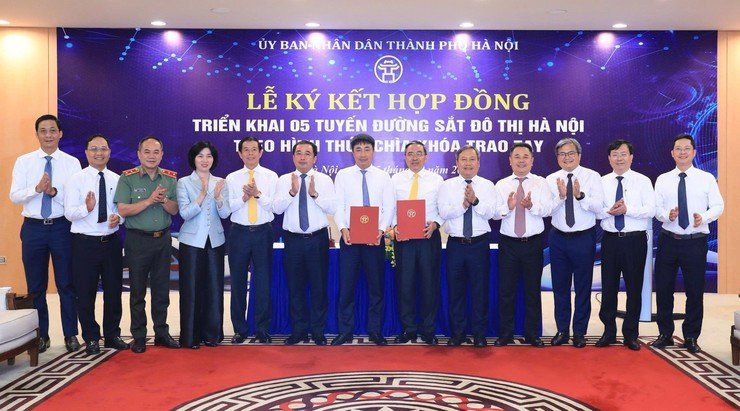
[HANOI, Vietnam—Special Correspondent Kim Jun-seok] Hanoi is moving ahead in earnest with a major urban railway (metro) construction project spanning 253 km, partnering with a Vinhomes consortium under Vingroup Joint Stock Company (Vingroup JSC) to ease urban traffic congestion and accelerate transit-oriented development (TOD).
Local media reported on the 19th that the Hanoi Urban Railway Management Board (MRTB) officially signed a contract with the Vinhomes-SGC investment and construction consortium on the 15th at the Hanoi People's Committee headquarters for the construction of five urban rail lines.
The large-scale project will build urban rail lines spanning about 253.5 km in total, along with vehicle depots and other facilities. The total project cost is estimated at about 1,000 trillion dong (about 51 trillion won). The project will use an EPC (engineering, procurement and construction), turnkey approach, with completion targeted for 2030.
The project covers five lines: Urban Railway Lines 1, 2, 8, 10 and 14. Each line will also have a depot for train maintenance, repairs and operations. The lines are expected to connect downtown Hanoi with new urban areas, the airport, major transport hubs and key development areas.
Hanoi expects the lines, once opened, to make a significant contribution to easing road congestion, improving the environment, enhancing residents' quality of life and securing new drivers of urban growth centered on TOD.
Hanoi People's Committee Chairman Bui Dai Thang, who attended the signing ceremony, explained, "This project is very large in scale, technically complex, and has a short construction period, so it requires a high level of project management and execution capability." He added, "To meet the schedule, we adopted a turnkey approach in which the contractor takes overall responsibility for the entire process, from design, equipment procurement and construction to systems integration, test operation and handover."
[email protected] Kim Jun-seok Reporter