Global oil prices stir again amid war fears ... Could climb further after U.S. elections
- Input
- 2026-10-19 11:16:38
- Updated
- 2026-10-19 11:16:38
[Financial News] International oil prices, which had briefly stabilized around the middle of the month, have surged again amid the fallout from the war. Markets are watching the U.S. and Israeli elections, which run from late this month into early next month, and Iran's response, and are concerned prices could rise further.
Russian refinery strikes and Hormuz jitters compound
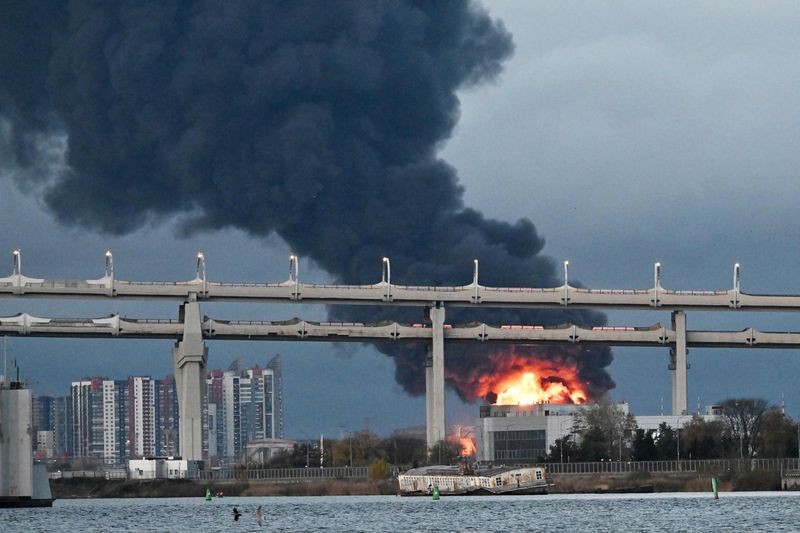
On the 18th (local time), December Brent crude oil futures traded on the U.K. futures market hit an intraday high of $109.65 a barrel, nearing the peak reached in May. They later fell about 1.3% and traded around $108. Brent crude oil futures stood at about $105.92 a barrel on the 15th, but surged nearly 3% in a single day on the 16th. November West Texas Intermediate (WTI) futures on the U.S. futures market also jumped about 4% on the 16th. WTI rose to as high as $101.75 a barrel on the 18th, before trading at $100–$101 that day.On the 18th, Alexander Beglov, governor of Russia's St. Petersburg region, posted on Telegram that a large-scale drone attack launched by Ukraine had set fire to an oil terminal and warehouses in St. Petersburg. According to Kpler, a multinational maritime intelligence firm, Russia exported an average of 120,000 barrels of refined petroleum products per day through the terminal. The specific extent of the damage to the facilities was not known.
Earlier, U.S. President Donald Trump claimed in an announcement on the 11th that Ukraine and Russia had agreed not to attack each other's energy-related facilities. However, Russia continued to strike Ukrainian power plants after the announcement. Ukrainian President Volodymyr Zelenskyy said in an announcement on the 14th that Ukraine would resume attacks on Russian refineries.
The Middle East also drove oil prices higher. According to the U.K. Maritime Trade Operations (UKMTO), two tankers were struck on the 16th in waters near Saudi Arabia, inside the Strait of Hormuz. One was hit by a rocket fired from a small boat, and the other by an unidentified long-range projectile. In an announcement on the 19th, Iran's Islamic Revolutionary Guard Corps (IRGC) claimed that a tanker violating transit regulations had struck a mine south of the Strait of Hormuz and caught fire.
Prices could climb further after the U.S. and Israeli elections
Oil prices could climb further after Israel's general election on the 27th of this month and the U.S. midterm elections on the 3rd of next month. In an interview published on the 1st by the U.S. outlet Time, Trump was asked whether he planned to intensify the bombing of Iran after the midterms. He replied, “It's possible,” adding, “We have stockpiled weapons over the past six months.” On the 8th, he said he would not attack Iran before the midterm elections. Israeli Prime Minister Benjamin Netanyahu also said in an interview on the 14th that attacking Iran before the general election would be “inappropriate.”However, Trump posted on Truth Social on the 18th, “Unless they (Iran) change their behavior quickly, we will bring that (the war) to an end.” He went on to write, “If Israel had a ‘wrong leader’ instead of Netanyahu, the United States would have to do this itself. I don't want to do that.” Netanyahu also stressed in a video message on the 18th that Trump “will end the threat from Iran within the next two years or sooner.”
Iran gave conflicting responses to the possibility of further attacks by the U.S. and Israel. Ali Abdollahi, chief of staff of the Iranian Armed Forces, said in an interview with local media on the 18th, “We will respond to any miscalculation on their part with a military retaliation far harsher than before.” On the same day, Mohsen Rezaee, secretary-general of Iran's Supreme National Security Council, also announced a larger-scale military operation on X. He said, “Iran's armed forces have already prepared a new operation far more destructive than the previous Twelve-Day War (the airstrikes last June) and the 40-Day War (the airstrikes from February to April this year).”
That day, Iranian Foreign Minister Abbas Araghchi, described as a moderate in Iran, visited Baghdad, Iraq, to attend the Organization of Islamic Cooperation (OIC), saying, “The seven-day proposal we presented to the United States remains valid, and our position is clear.” He added, “If the United States is sincere, the way to reopen the Strait of Hormuz is clear.” Iran had earlier proposed to the United States during last month's U.N. General Assembly that it could reopen the Strait of Hormuz within seven days if the U.S. accepted Iran's conditions, but the two sides failed to reach an agreement.
[email protected] Park Jong-won Reporter