Gyeonggi apartment record-high sales double Seoul’s; lead reversed for five straight months
- Input
- 2026-10-19 14:38:02
- Updated
- 2026-10-19 14:38:02

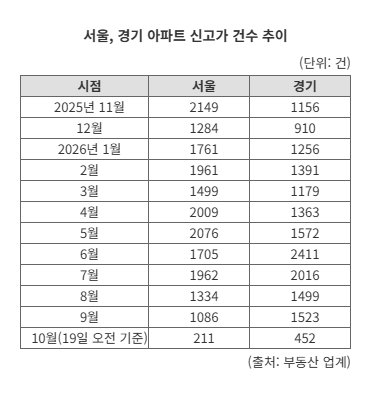
As apartment prices rise more sharply in areas such as Seoul’s outskirts, more buyers are looking to Gyeonggi Province. Demand remains strong in designated regulatory zones such as Dongtan in Hwaseong, Suji in Yongin and Yeongtong in Suwon, while record-high sales are also becoming common in Byeongjeom, Hwaseong, and Gwonseon, Suwon. Gyeonggi has now overtaken Seoul in the number of apartments selling at record highs, after Seoul had held a substantial lead.
Gyeonggi overtakes Seoul in record-high sales starting in June
According to the real estate industry, as of the 19th, the number of apartments in Gyeonggi Province selling at record highs in October stood at 452, more than double Seoul’s 211. The numbers in the two regions had not reversed in January through May this year, nor in November or December last year.Seoul had been ahead by at least 40%, but Gyeonggi began to overtake it in apartment sales at record highs in June this year. The shift coincided with the government’s addition of Dongtan, Guri and Giheung in Gyeonggi to the land transaction permit zones. Since June, Gyeonggi has continued to lead Seoul in apartment sales at record highs.
The number of apartments in Gyeonggi Province selling at record highs rose from just 1,156 in November last year to 2,411 in June this year, surpassing 2,000. It remained above 2,000 in July, with 2,016 transactions.
Seoul, by contrast, is on a downward trend. In November last year, it recorded 2,149 record-high sales, at least 85% above Gyeonggi’s total, and then fluctuated between the high 1,000s and low 2,000s through May. But the number plunged to 1,334 in August and barely topped 1,000 in September, at 1,086.
More affordable prices and greater borrowing capacity
The reasons Gyeonggi is outperforming Seoul in the number of apartment sales at record highs are multifaceted: relatively lower apartment prices and the resulting borrowing capacity, demand shifting away from Seoul because of the burden of home prices there, and a spillover effect in areas near newly designated land transaction permit zones, among other factors.Woo Byung-tak, an expert adviser with Shinhan Bank’s Premier Pathfinder, said, “Some parts of Dongtan and Bundang have apartment prices comparable to those in Seoul, so buyers there can borrow only 200 million to 400 million won. But overall, more areas in Gyeonggi than in Seoul have homes priced at 1.5 billion won or less where buyers can get a loan of 600 million won.” He added, “With home prices in Seoul having risen so much, interest is shifting to areas in Gyeonggi where people can still get a loan.”
Not all areas are seeing strength, however. Prices are being driven up in some areas near Seoul, including Namyangju, Gwangmyeong-si and Hanam-si, with gains centered on land transaction permit zones and areas slated for redevelopment, such as Yeongtong and Jangan in Suwon, Suji and Giheung in Yongin, and Bundang in Seongnam.
The number of people living in Seoul who are turning their attention to Gyeonggi Province is also rising. According to the Korea Real Estate Board, the figure stood at 4,660 cases in August this year, up at least 40% from 3,316 in the same month last year. The cumulative total for January through August was also up more than 43%.
Woo said, “The strength of apartment prices in Gyeonggi Province is likely to continue as long as there are no changes to lending restrictions or the land transaction permit system.” He predicted, “If home prices in Seoul and Gyeonggi Province fall, more demand will return to Seoul.”\u00a0
[email protected] Kwon Jun-ho Reporter