Lee Chan-jin, Governor of the Financial Supervisory Service: “Launch a Financial Consumer Protection Committee, Step Up Capital-Market Investigations” ... Five Major Bank Chiefs to Appear at Parliamentary Audit for First Time in Four Years
- Input
- 2026-10-19 10:10:00
- Updated
- 2026-10-19 10:10:00
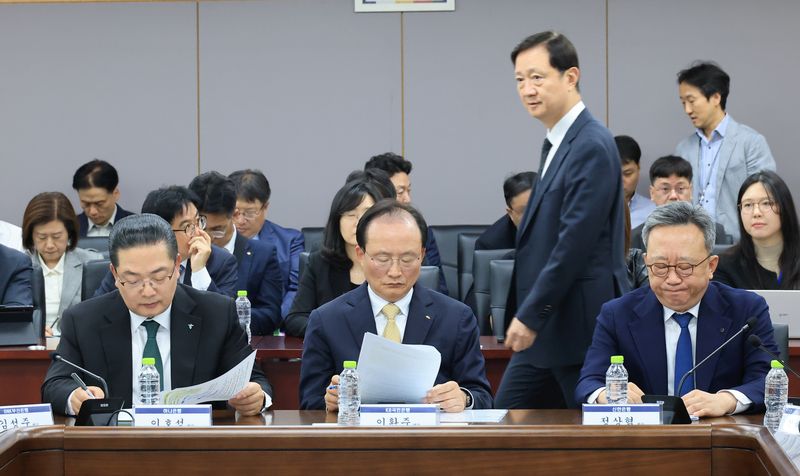
In his opening remarks at the National Assembly National Policy Committee’s parliamentary audit on the 19th, Lee Chan-jin, Governor of the Financial Supervisory Service, reported on the agency’s major activities.
Lee said, “To strengthen financial consumer protection, we established the Financial Consumer Protection Advisory Committee and built a proactive supervisory framework to protect consumers at every stage of a financial product’s life cycle.” He added, “We established a process for handling complaints and disputes by operating subcommittees in specialized fields, including medicine and investment, within the Dispute Mediation Committee.” He went on to explain, “We used the investigative authority introduced to address unfair trading in the capital market to pursue the swift transition of major cases to compulsory investigations.”
Lee explained, “To ensure the stability of the financial system, we strengthened checks on financial companies’ funding and asset quality in response to interest rate hikes, and proactively addressed financial-market risk factors by promoting housing supply and resolving troubled project-financing (PF) sites. We also pursued implementation of household-loan management plans, checks on the diversion of business loans for other purposes, and the swift restructuring of marginal companies.”
The FSS also pursued improvements to capital-market infrastructure. He said, “We laid the groundwork for funding by developing comprehensive measures to improve disclosures in the pharmaceutical and biotech sectors and establishing a risk-capital investment platform. We also worked to support people’s financial lives through measures to promote supply-chain linkages and mid-interest-rate lending, tailored financial education, and expanded financial counseling for vulnerable groups.” He added, “We also responded to financial crimes affecting people’s livelihoods by pursuing the introduction of special judicial police for this sector, establishing financial-sector-wide FDS detection rules, and issuing certificates confirming that antisocial illegal lending contracts are void.” The FSS had pursued the eradication of unfair trading in the capital market under the Lee Jae-myung administration’s slogan, “Stock-price manipulation means total ruin.”
Lee also addressed the response to hacking attacks that have recently hit the financial sector. He assessed that the FSS had responded to cyber threats by shifting financial-security supervision toward prevention, communicating with executives, operating an integrated monitoring system and strengthening coordination with relevant agencies. Regarding customer data breaches in the financial sector, he outlined plans to strengthen institutional safeguards, including fixing security gaps, responding to AI-based attacks and defenses, analyzing and assessing security vulnerabilities, making the identification and management of IT assets mandatory, and expanding simulated hacking exercises.
At the audit that day, KB Kookmin Bank President Lee Hwan-ju, Shinhan Bank President Jeong Sang-hyeok, Hana Bank President Lee Ho-seong, Woori Bank President Jeong Jin-wan and Nonghyup Bank President Kang Tae-young attended as ordinary witnesses. It had been four years since all five major bank chiefs were selected as witnesses for a parliamentary audit, following the audit on October 11, 2022. At the time, embezzlement and other financial incidents, along with internal controls were key issues.
Lee also stressed the need for internal reform. He said, “We have set out to improve the transparency and public nature of supervisory administration and strengthen the competitiveness of financial supervision by improving key work processes, including inspections and sanctions; pursuing management innovation in organizational operations; digitizing licensing and approval work; and upgrading the AI system for monitoring illegal information.”
[email protected] Park Moon-soo, Cho Eun-hyo Reporter