Relaxing parking rules near transit stations will boost housing supply
- Input
- 2026-10-20 07:00:00
- Updated
- 2026-10-20 07:00:00
According to industry sources on the 19th, the Construction & Economy Research Institute of Korea (CERIK) recently said in a report titled “U.S. Local Governments Abolish Minimum Parking Requirements One After Another” that easing these regulations is leading to an increase in housing supply.
According to the report, the United States has identified minimum parking requirements at the federal level as a major obstacle to expanding the supply of new housing. It is providing policy support to ease the regulations.
Seattle is a leading example of a region that has eased parking regulations. In 2006, it abolished minimum parking requirements for residential and commercial buildings in downtown central business districts and high-density development areas. In 2012, it introduced a policy to reduce the requirements by 50% or waive them for new housing in growth management areas and areas well served by public transit, making it one of the most active jurisdictions in easing parking regulations.
The report said, “A comprehensive analysis of all rental housing development projects that received building permits and approvals in Seattle from 2012 to 2017, when the easing of parking regulations was fully implemented, found that it led not only to increased supply but also to lower rents.” The Seattle effect has prompted major cities such as San Jose and Austin to ease or abolish minimum parking requirements one after another.
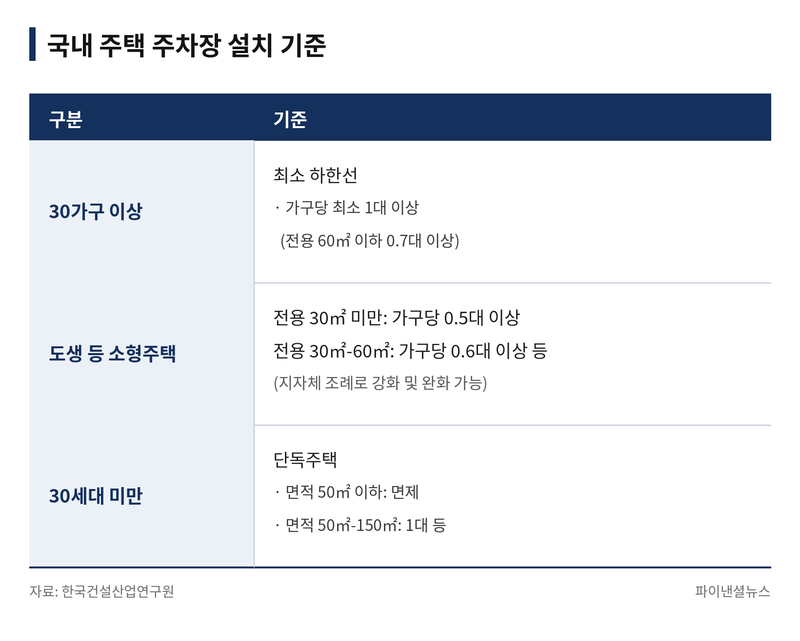
In South Korea, concerns that parking regulations are hindering housing supply have continued to be raised. In response, urban-type housing, which had relaxed parking requirements, was introduced in 2009 to expand the housing supply.
But the outcome was the opposite. As worsening parking shortages became a problem, regulations were tightened: a minimum number of parking spaces per household was introduced for urban-type housing, and officetels were required to follow the Housing Act’s parking standards based on exclusive-use floor area.
Recently, the government has eased and implemented some parking regulations as part of efforts to expand housing supply. In practice, however, the measures are limited to small homes and the conversion of vacant commercial properties and knowledge industry centers, among other buildings, to residential use. Industry sources say parking regulations are becoming entrenched in South Korea as an untouchable “unwritten rule.”
Heo Yun-kyung, a research fellow in the construction industry, said, “As U.S. empirical cases show, easing parking regulations can spur housing supply on small lots and sites with low project viability, making it a key way to ease regulations in order to supply non-apartment housing.” She added, “Taking conditions in South Korea into account, the scope of parking-regulation relief should be expanded gradually. In particular, areas near stations with excellent public transit access should be designated as pilot zones, where parking regulations can be eased dramatically.”
[email protected] Lee Jong-bae Reporter