“Have you no conscience?” Took a taxi from Seoul to Incheon Airport and got hit with a 700,000-won rip-off fare—but the bigger problem is...
- Input
- 2026-10-19 07:38:03
- Updated
- 2026-10-19 07:38:03
[Financial News] In Seoul, only 3.1% of reports by foreign tourists about taxi overcharging have resulted in actual administrative action, it has emerged. More than 6,400 reports have been filed over the past five years or so, but only three out of every 100 have led to administrative action.
According to data submitted by the Seoul Metropolitan Government to Mo Gyeong-jong, a Democratic Party of Korea lawmaker on the National Assembly’s Land, Infrastructure and Transport Committee, a total of 6,481 reports of taxi overcharging by foreign tourists were filed from 2021 through August this year. Just 204 of them resulted in administrative action, or 3.1%.
Warnings were the most common type of administrative action, with 176 cases. They were followed by 26 suspensions of driving qualifications and two revocations. Another 1,865 reports were resolved with cautions or guidance and training instead of administrative action. The Seoul Metropolitan Government closed 4,368 cases internally without taking separate action, accounting for 67.4% of all reports.
In particular, “other” accounted for 3,253 cases, or 74%, among the reasons for internal closure. This was followed by 762 withdrawn reports, 271 mistaken reports and 82 cases that did not meet the requirements. The Seoul Metropolitan Government said it classified as “other” cases that it closed internally because violations were difficult to verify during fact-finding or because it took individual circumstances into account.
The problem is that the share of cases closed as “other” has risen year after year. The proportion of all reports closed for this reason rose from 38.8% in 2023 to 56.2% last year, reaching 60.7% as of August this year.
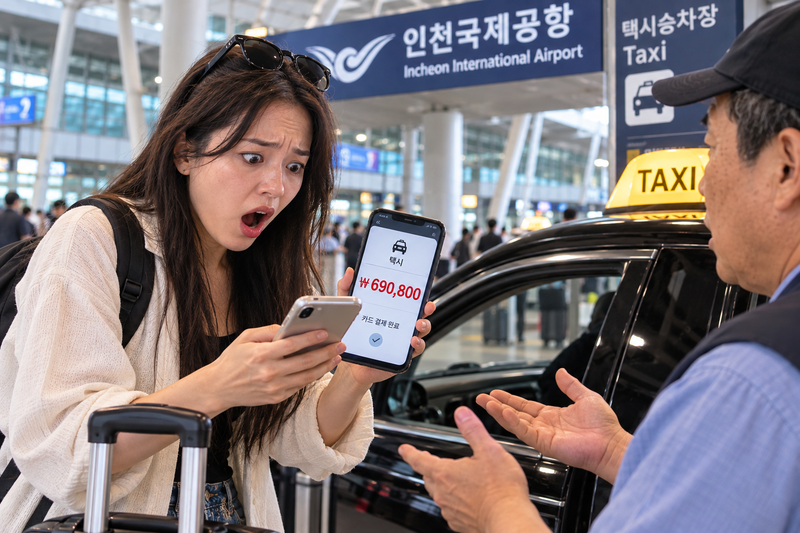
Cases of foreign tourists being overcharged are also continuing. In June, a Taiwanese tourist identified as A posted on social media that they had taken an Uber taxi from Jayang-dong, Gwangjin-gu, Seoul, to Terminal 2 of Incheon International Airport and paid a total of 690,800 won, including 66,000 won in tolls.
A initially set Seoul Station as the destination, then changed it to Incheon Airport during the trip. The additional fare was supposed to be charged automatically to the card registered in the app, but the driver, upon arriving at the airport, demanded a separate payment using the card terminal inside the vehicle. A said the flight was about to depart, leaving no choice but to pay. Given that the standard taxi fare for that route is around 70,000 won, including tolls, the amount was about 10 times as much. A fumed, “For that kind of money, isn’t it like traveling all the way from South Korea to North Korea?”
A reward system introduced to encourage reports of taxi overcharging has also failed to prove effective. In 2013, the Seoul Metropolitan Government amended the relevant ordinance to allow a reward of 500,000 won to be paid to a reporter when a foreign tourist’s report of taxi overcharging leads to administrative action. Tourists who were overcharged can also receive a reward by filing a report.
Yet despite 204 reports resulting in administrative action since 2021, there have been no applications for or payments of rewards. Under the current ordinance, anonymous reports are ineligible for a reward, so reporters must provide their name, address and phone number. After the period for appealing the administrative action has passed, rewards are reviewed and paid quarterly into an account belonging to the reporter or a family member. However, the ordinance and enforcement rules contain no procedure for short-term foreign tourists to apply for and receive a reward after leaving the country.
Information about the reward system was also inadequate. In August last year, the Seoul Metropolitan Government announced an intensive crackdown on illegal taxi practices targeting foreigners. Then, in January this year, it announced measures to include English on taxi receipts and promoted a multilingual QR-code reporting system. It placed reporting-information stickers on 71,000 Seoul taxis and publicized how to report incidents through foreign-language websites and social media, but neither initiative mentioned the reward system.
“Even when foreign tourists report taxi overcharging, only three out of every 100 cases lead to action,” Mo said, criticizing the system. “The reward was created with good intentions, but not informing foreigners about it and leaving in place procedures that are difficult for tourists to use after they leave the country meant it was never used even once.”
Mo continued, “Now that the government has raised the standards for administrative action, what remains is to ensure that reports backed by clear evidence actually lead to action. We need procedures that protect both reporters and drivers so that the majority of taxi drivers who work conscientiously are not unfairly viewed with suspicion,” Mo urged.
[email protected] An Gaeul Reporter