“Samsung Electronics and SK Hynix: Their Worst Monday Yet?” ... Rattled by “DeepSeek fears,” but brokerages say, “Buy more”
- Input
- 2026-10-19 07:21:53
- Updated
- 2026-10-19 07:21:53
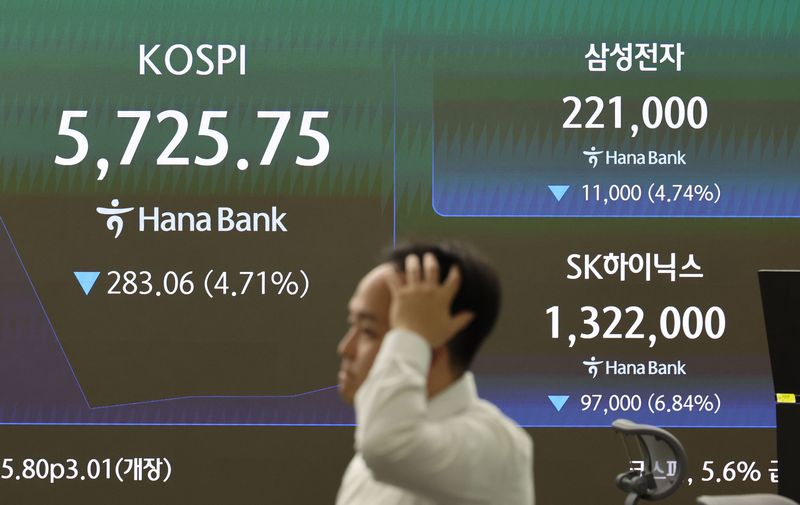
[The Financial News] Samsung Electronics and SK Hynix have posted their steepest weekly declines since the 2008 global financial crisis, and fears of further losses in South Korea’s stock market on the 19th are growing as Chinese artificial intelligence (AI) company DeepSeek has unveiled a low-cost, high-performance model. However, brokerages say the earnings outlook for semiconductor companies remains positive and are instead advising investors that this is the time to increase their stock holdings.
DeepSeek’s New Model Outperforms Anthropic’s Leading Models ... Cold Winds Hit New York Stocks
According to the Korea Exchange, Samsung Electronics closed at 215,500 won and SK Hynix at 1,272,000 won on the 16th. Since the start of this month, they have fallen 20.0% and 28.7%, respectively. In the past week alone, Samsung Electronics plunged 17.8% and SK Hynix 24.3%, recording their largest weekly declines since the 2008 financial crisis.
Heavy selling by foreign investors also continued. From the 12th to the 16th, foreign investors were net sellers of 11.2068 trillion won in the KOSPI market. Net sales of Samsung Electronics and SK Hynix totaled 3.4763 trillion won and 5.3565 trillion won, respectively, accounting for 78.8% of the total.
DeepSeek’s new model, “V4.1-Flash-1017,” unveiled on the 17th, has emerged as another factor. Enhanced for coding and AI-agent performance, the model outperformed some of Anthropic’s and OpenAI’s leading models in DeepSeek’s own evaluations.
Its price competitiveness was also highlighted. During off-peak hours, the fee per 1 million API output tokens is $0.60, about one thirty-third to one forty-second the cost of the major U.S. models used for comparison.
The market is wary that the emergence of low-cost AI models could raise questions about investment in large-scale data centers and semiconductors. When DeepSeek unveiled its reasoning model R1 in January last year, Nvidia shares plunged about 17% in a single day, wiping out about $589 billion in market capitalization.
Concerns about the profitability of AI investments have also been growing in U.S. markets recently. The Nasdaq fell about 2.1% on the 16th. Since DeepSeek’s new model was unveiled over the weekend, the fact that U.S. markets have yet to factor it in could also weigh on South Korean semiconductor stocks on the 19th.
Brokerages recommend increasing holdings, saying the declines are “excessive relative to corporate earnings”
However, analysts say the recent decline in the share prices of major semiconductor companies has been excessive compared with their corporate earnings.
According to KB Securities, based on finalized second-quarter results this year, the KOSPI’s price-to-earnings ratio (PER) is about 8, close to levels seen during the global financial crisis and the COVID-19 pandemic. Applying next year’s estimated earnings, the PERs of Samsung Electronics and SK Hynix have also fallen to 3.1 and 2.6, respectively.
Kim Dong-won, head of research at KB Securities, said, “The recent sharp drop in the share prices of Samsung Electronics and SK Hynix is the result of excessive concerns about an economic downturn and declining earnings having already been priced in.” He added, “This is an asymmetric investment opportunity, with greater upside potential from valuation normalization than risk of further declines. It is an opportune time to consider increasing holdings by taking advantage of short-term volatility.”
The outlook for semiconductor prices is also positive. Market research firm TrendForce expects fourth-quarter prices for conventional DRAM to rise 10–15% from the previous quarter, and NAND flash prices to increase 15–20%. TSMC also said in its recent earnings announcement that there were no signs of a slowdown in demand for AI semiconductors.
However, the possibility of a semiconductor supply glut remains. Lee Min-hee, a researcher at BNK Investment & Securities, said, “The growth rate in memory capacity per system, which drove demand growth this year, is expected to slow significantly next year.” He added, “If HBM production next year also falls short of expectations, as it did this year, then despite the aggressive capacity-expansion race currently underway, supply and demand could instead shift to oversupply from the second half of next year onward.”
[email protected] Han Seung-gon Reporter