Riots in France: 2,000 Arrested, 600 Police Officers Injured ... Fallout from the Unrest
- Input
- 2026-10-19 06:22:29
- Updated
- 2026-10-19 06:22:29
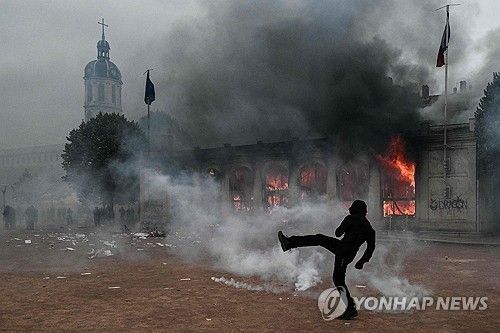
[Financial News] Large-scale protests in France against rising living costs and poor public services escalated into riots and looting. About 2,000 people were arrested and at least 600 police officers were injured, while one protester died. As government buildings and shops were destroyed across the country, political parties stepped up their dispute over who was responsible for the violence.
According to The New York Times (NYT), CNN and other outlets on the 18th (local time), protests attended by at least 500,000 people across France the previous day turned violent in some areas, causing major loss of life and property.
French Interior Minister Laurent Nuñez described the scale of the damage on social media that day and said the violence “cannot be justified for any reason.”
CNN reported that one protester died of cardiopulmonary arrest in northern Paris. However, no direct link has been established between the cause of death and the protests or the police response.
Arson and looting damage 1,500 shops ... Repair costs expected to run into hundreds of millions of dollars
Arson and looting by protesters caused extensive damage to public facilities and shops across the country.
In Limoges in central France, a fire broke out at the city hall, built in the 19th century, destroying most of the building. In Marseille in the south, rioters broke into city hall and toppled a bust of Marianne, a symbol of the French Republic. In Lyon, a tourist information center was destroyed by fire.
According to the French Federation of Commerce and Distribution, around 1,500 shops across the country were damaged or looted. Repair costs are estimated to reach several hundred million dollars.
Looting of shops and arson attacks on vehicles also continued in the capital, Paris. The Paris police headquarters said it initially clashed with a violent group numbering 500 to 1,000 people, and that large numbers of people seeking to steal and loot then flocked in, taking advantage of the chaos.
The protests began with students’ demands, ongoing since last month, for improvements to school conditions, and grew into a nationwide social movement against rising living costs and insufficient investment in public services.
As protests expanded to include students, farmers, teachers and union members, looting and arson broke out
Students, farmers, teachers, union members and others took part in the protests the previous day. Most participants marched peacefully, but clashes with police broke out in some areas, after which arson and looting spread.
Controversy also arose over the police’s use of excessive force. In Saint-Étienne in central France, a protester taking part in a march on the 17th lost a hand. This was the second case of a participant losing a hand during these student protests. In Alençon in the northwest, a camera captured a police officer restraining a girl by wrapping an arm around her neck. This restraint method is currently prohibited by law.
After the violence subsided, political disputes over responsibility intensified.
French Prime Minister Sébastien Lecornu criticized the far-left party La France Insoumise (LFI), saying it had fueled distrust of the police among student protesters. He also claimed that the groups that attacked police and government buildings even before the official protests began were far-left extremists.
Lecornu said France had reached “a point of no return” and that “we must choose whether to stand with the Republic and law enforcement agencies or with the rioters.”
LFI leader Jean-Luc Mélenchon, by contrast, countered that the government was responsible for the chaos. He claimed that Lecornu was either incompetent or was trying to use the restoration of order for political purposes to divert attention from failures in fiscal management.
However, Mélenchon also distanced himself from looting and violence, saying, “Those who join our struggle must not take part in looting.”
Far-right leader Marine Le Pen also weighed in. She said legitimate social demands had been hijacked by the far left, and criticized Mélenchon and his associates for justifying violence and fomenting chaos.
Far-right leaders shift blame to government ... Macron warns of “tough response”
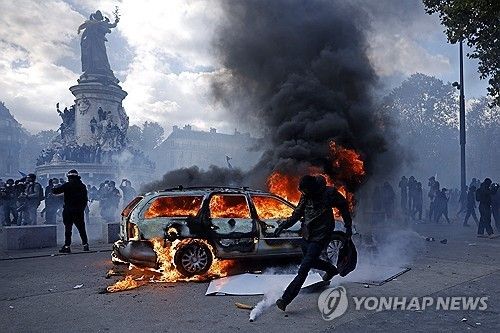
With next year’s presidential election approaching, the unrest appears to be emerging as a major political issue. Mélenchon is being discussed as a figure who could reach the runoff ahead of candidates from the centrist camp, while Le Pen is leading in presidential election polls.
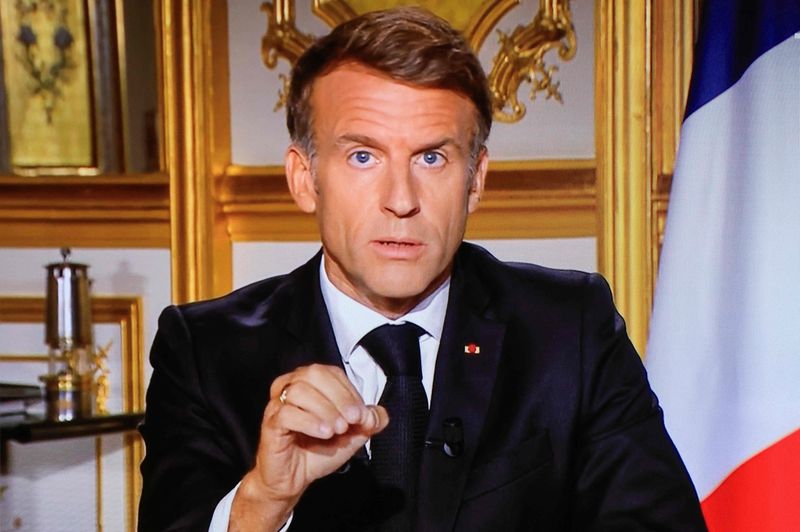
President Emmanuel Macron described the rioters as “those sowing chaos” and warned that they would be prosecuted and punished. He is scheduled to deliver a message to the nation in a televised address this evening.
Meanwhile, the future of the protest movement has become uncertain following the large-scale violence. Some observers say the student protests could lose momentum as French schools begin a two-week midterm break. However, some unions, including the General Confederation of Labour (CGT), one of France’s largest unions, are calling for another large-scale protest on the 5th of next month.
[email protected] Lee Seok-woo, International Affairs Specialist Reporter