Trump’s ‘Russia energy overture’ sparks Republican backlash, exposing divisions within the U.S. ruling camp
- Input
- 2026-10-19 05:40:37
- Updated
- 2026-10-19 05:40:37
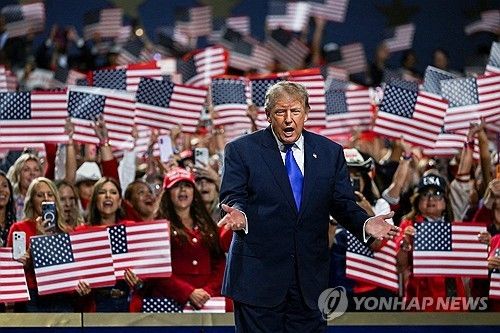
[Financial News] The Republican Party and the Trump administration are showing signs of internal discord over President Donald Trump’s abrupt cancellation of high tariffs on major countries importing Russian crude oil and natural gas.
The dispute began when President Trump announced on the 16th (local time) that he would exercise his authority to waive the restrictions and tariffs under the Lindsey Graham Russia and Iran Sanctions Act, also known as the Graham Act.
Named after the late former U.S. Senator Graham (Republican of South Carolina), once President Trump’s closest ally in Congress, the law’s key provision is to impose tariffs of up to 100% on all goods entering the United States from the top five countries importing Russian crude oil and natural gas.
Trump signed the bill, passed by Congress with bipartisan support in honor of former Senator Graham’s legacy, on the 18th of last month. But 30 days later, just before the law was due to take effect, Trump withdrew it himself.
Opposition grows to the waiver under the Russia and Iran Sanctions Act, or Graham Act
Criticism of Trump’s decision has since mounted among Democrats and some Republicans alike. Republican politicians who have often disagreed with Trump have spoken out, and even House Speaker Mike Johnson, considered a ‘loyalist,’ has raised doubts.
Appearing on Fox News on the 18th, Speaker Johnson said concerns had arisen among members of the House Intelligence and Foreign Affairs committees over Trump’s action. ‘We need to carefully consider the unintended consequences that could follow from it,’ he said.
Senator Darlene Graham, the late former senator’s younger sister, who is running as the Republican candidate in the midterms to succeed him, publicly opposed the move the previous day. ‘I would choose to keep up the pressure on Russia to end the war and lower gasoline prices,’ she said.
Republican criticism continued, with Senator Thom Tillis (North Carolina) saying the move ‘went beyond irresponsible,’ Senator John Cornyn (Texas) saying former Senator Graham ‘would have been appalled,’ and Senator Ted Cruz (Texas) calling it ‘a mistake.’
Administration officials defended Trump’s action for two days in a row, saying it was intended to get Russia to release large volumes of diesel onto U.S. and global markets. It was the same rationale used for the ‘diesel deal’ agreed on the 9th by Trump and Russian President Vladimir Putin.
Secretary of State Marco Rubio told reporters the previous day at Joint Base Andrews, ‘That (Russian) diesel fuel was going to be sold one way or another.’
Energy Secretary Chris Wright, appearing on ABC that day, emphasized that the waiver was not an ‘economic lifeline’ for Russia but ‘a carrot being offered to end the war.’
Wright said, ‘This is an inducement for Russia. If Russia can de-escalate its conflict with Ukraine—if it can secure an energy-sector ceasefire or scale back the conflict and obtain diesel fuel for export—we will allow that fuel to flow into global markets.’
Treasury Secretary Scott Bessent said on NBC, ‘European countries have given Russia and Putin more money than they have given Ukraine. They continue to voraciously consume Russian energy.’ In effect, he countered critics by arguing that Europe imports more than the United States.
The U.S. online outlet Axios pointed out that Secretary Rubio’s claim that the fuel ‘would have been exported anyway’ and Secretary Wright’s claim that the waiver was ‘an inducement to end the war’ sounded contradictory.
As Republican opposition to Trump’s energy truce grows, party infighting intensifies
This conflict within the U.S. ruling camp highlights the dilemma facing Trump and the Republican Party as diesel prices soar ahead of the midterm elections. It also appears to reflect the limits of U.S. foreign policy, which has been unable to find solutions to the wars in Iran and Ukraine.
Trump’s position is that diesel prices have surged because of Ukraine’s attacks on Russian oil refineries, not the Iran war, for which he would be held responsible. Experts point to the Iran war as the larger cause, but acknowledging that would contradict his declaration that ‘the Strait of Hormuz is open.’
As Trump presses Russia and Ukraine for an ‘energy truce,’ he appears to be seeking a breakthrough through the recent diesel deal and the waiver of the Graham Act’s implementation. But the Republican Party, which passed the law with bipartisan support, may find it difficult to accept the move. It also risks a backlash over appearing to side only with Russia while sidelining U.S. allies.
As diesel prices surge and the Iran war drags on, the more likely Republican losses in the midterm elections become, the stronger the centrifugal forces pulling the Trump administration and Republicans seeking to distance themselves from it are likely to grow.
[email protected] Lee Seok-woo, international affairs specialist Reporter