“U.S.-South Korea ties are being reset... It’s marriage counseling, not divorce,” says Trump ally and U.S. senator
- Input
- 2026-10-19 05:28:08
- Updated
- 2026-10-19 05:28:08
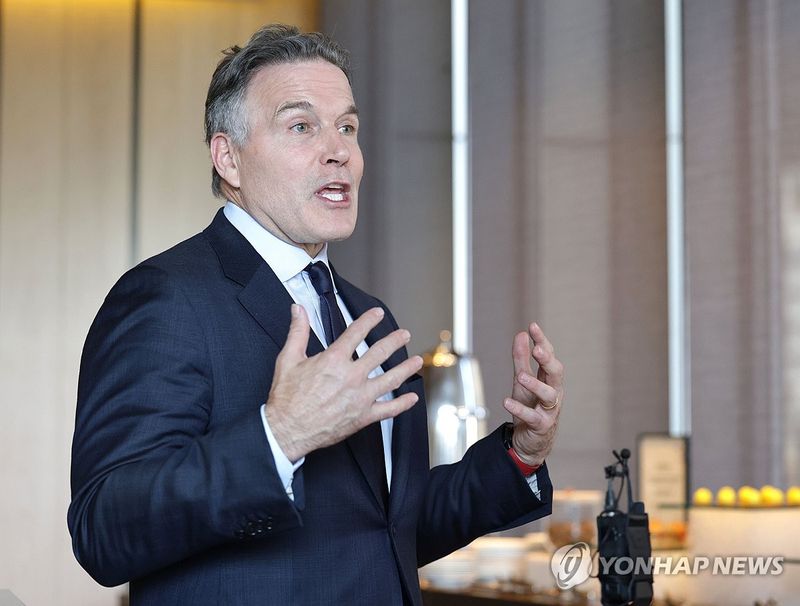
[Financial News] U.S. Senator Dave McCormick (R-Pa.), a close ally of President Donald Trump, said U.S.-South Korea relations were in the process of being “reset,” describing it as marriage counseling, not a divorce.
The U.S. think tank Hudson Institute said on the 18th (local time) that McCormick made the remarks on the 16th during a conversation in Washington, D.C., with Mike Gallagher, former chair of the House Select Committee on U.S.-China Strategic Competition.
“We are resetting the relationship,” McCormick said. “Resetting a relationship can lead to hurt feelings and friction.”
He emphasized that, as in a marriage, the balance can sometimes be off, prompting one side to tell the other that adjustments are needed. He said U.S.-South Korea relations were “going to marriage counseling, not getting divorced.”
He added, “We need more from our Asian allies. The relationship was imbalanced, and they acknowledge that too. I think we’re on our way to a much deeper and stronger relationship.”
McCormick recently returned from visits to Japan and South Korea. In South Korea, he visited the Demilitarized Zone (DMZ) and Hanwha Ocean’s Geoje facility. He also met with Foreign Minister Cho Hyun and Defense Minister Kang Shin-chul, among others.
McCormick cited Japan and South Korea’s commitments to make large-scale investments in the United States as a prime example of the realignment of alliance ties, saying, “(In meetings during my visit to South Korea,) I heard no controversy. The discussions were entirely focused on where that money would be invested and how it would be used.”
He also cited South Korea’s pledge to purchase $25 billion in U.S.-made military equipment and its plans to increase defense spending, saying, “It has not yet reached the level needed, but it is moving in a direction consistent with the share of the burden it should shoulder.”
McCormick argued that the United States and its allies must be able to innovate technologically faster than China and produce more defense materiel over the long term. “We have to train, plan and fight alongside our allies as one military force, with one military capability,” he said.
He said, “If we do this right, China will look across the Taiwan Strait every morning and conclude, ‘Not today.’”
[email protected] Lee Seok-woo, international affairs correspondent Reporter