[Editorial] The NPS’s 182 Trillion Won Loss After Saying It Had “Pushed Back Depletion by Seven Years”
- Input
- 2026-10-18 19:03:55
- Updated
- 2026-10-18 19:03:55
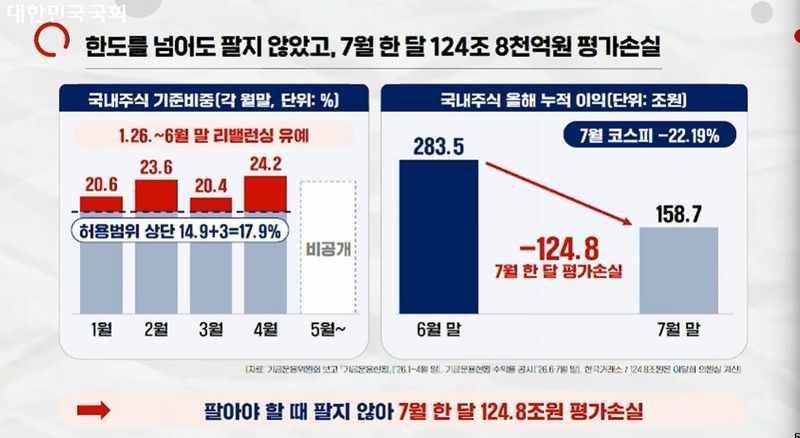
Of course, a decline in the value of its holdings does not mean the losses have been realized. The losses could shrink going forward, but that remains uncertain. Investment losses at the NPS translate directly into losses for the public. The painful point is that the NPS missed the time to rebalance. This past January, it delayed rebalancing while raising its year-end target for the share of domestic stocks in its portfolio from 14.4% to 14.9%.
The problem was that it raised the target share of domestic stocks once again, to 20.8%, this past May. Rather than sell, it increased the share further, focusing more on its role in propping up the market. At the time, as the NPS’s rate of return rose, the government proudly declared, “The pension fund’s depletion date has been pushed back by about seven years to 2071,” and expressed confidence. Market participants voiced concerns that if stock prices fell, “a problem that could have been contained with a hoe would become impossible to stop even with a shovel,” but the government paid no heed.
That was when it should have started rebalancing and locking in gains. The principle, for institutions and individuals alike, is to sell stocks at highs after they have gained value and buy them at lows. Since no one can know the exact peak, they should sell once a certain rate of return is reached, then wait for the right time to buy again. If the NPS had sold even part of its holdings then, it could have bought at low prices now and served as a shield in the market rout. How much has the projected depletion date been pushed back as of now? If losses deepen further, it is impossible to know whether the date might instead move forward.
While the NPS delayed rebalancing, stock prices turned downward, and foreign investors left with enormous profits. Profits come at someone else’s expense, and the NPS and individual investors were left to bear the losses. The rationale of long-term investment and protecting individual investors cannot serve as a “get-out-of-jail-free card” for risk management.
The NPS lost 131.0971 trillion won on its holdings in SK hynix and Samsung Electronics, accounting for as much as 71.8% of its total losses. There is nothing inherently wrong with holding a certain amount or more in high-quality large-cap stocks. The problem was excessive “concentration” without due regard for investment risks or principles. When holdings are heavily concentrated in particular stocks and sectors, gains grow when share prices rise, but losses tend to grow just as much when they fall.
The NPS must reestablish asset-allocation principles and a management system that will not be swayed by outside pressure. First, it should transparently disclose its asset allocation and risk limits for individual stocks and sectors at a level the public can understand. It should make its decision-making process public and strengthen post hoc evaluations so that political considerations cannot interfere in its management. The NPS must not forget that its top priority is not to be “kindling” for the stock market, but a “backstop” that grows the public’s retirement savings.