Philippines targets companies Vietnam missed out on ... makes bold bet on tax incentives
- Input
- 2026-10-18 18:35:03
- Updated
- 2026-10-18 18:35:03
According to the local government on the 18th, the administration of Ferdinand Marcos Jr. (Bongbong) is seeking a sweeping upgrade of the country’s manufacturing base, going beyond simply attracting foreign investment. It aims to move away from a traditional economic structure reliant on consumption and services (IT-BPM) and remittances from overseas Filipino workers (OFWs), and to develop advanced manufacturing, energy and digital industries into key national growth drivers.
In step with this shift, Korean companies are also increasingly expanding their production bases in the Philippines, particularly in manufacturing sectors such as semiconductors and shipbuilding.
■ From semiconductors to shipbuilding ... Korean companies turn their attention to the Philippines
One source we met recently in Manila said, “Most Korean companies that have invested in the Philippines are satisfied with the local business environment and are expanding or increasing capacity,” adding, “More companies are showing interest thanks to lower wages than in Vietnam and abundant incentives.”
He added, “In particular, since Vietnam introduced the global minimum tax and began applying strict standards for advanced industries, there has been a marked increase in cases of companies in heavy and light industries—classified by the Vietnamese government as non-advanced industries—turning their attention to the Philippines.”
Korean investment in the Philippines is particularly prominent in semiconductors and shipbuilding. Hanjin Heavy Industries’ road construction contract on Mindanao in the 1970s paved the way for Korean companies to enter the Philippines, and investment gained momentum in 1997 when Samsung Electro-Mechanics built a production base for multilayer ceramic capacitors (MLCCs) at the Calamba Industrial Estate. This was the Samsung Group’s first large-scale overseas investment after the IMF-era foreign exchange crisis. In the 2010s, LB Semicon, a memory semiconductor partner of Samsung Electronics, also set up operations there.
Shipbuilding investment has continued into the 2020s. HD Hyundai Heavy Industries is actively using the Subic shipyard not only for maintenance, repair and overhaul (MRO) but also for shipbuilding. In particular, as a U.S. ally with a mutual defense treaty with the United States, the Philippines has the unique advantage of being able to win MRO contracts for U.S. military vessels through Subic Bay. As a result, the Philippines is emerging as a key strategic hub for South Korea’s shipbuilding industry, linking the United States and the Asia-Pacific region.
Cooperation between the two countries is expected to expand beyond semiconductors and shipbuilding into advanced IT. During President Lee Jae-myung’s state visit to the Philippines last March, President Marcos expressed deep interest in expanding cooperation in “sovereign AI”—independent artificial intelligence optimized for the country’s culture and infrastructure—to secure digital sovereignty and develop advanced industries, and behind-the-scenes cooperation between the two countries is actively underway.
■ Beyond tax benefits, support for strategic industries ... revamping investment attraction
The Philippine government believes this is the last “golden window” to transform the economy into one centered on manufacturing. Another local source explained, “President Marcos is taking the most active steps of any administration in the Philippines’ history to expand the manufacturing base,” adding, “He clearly recognizes that national development has its limits if the country relies solely on tourism and services and remittances from overseas Filipino workers (OFWs), who account for 10% of the population.” The source added, “In fact, when you engage with the Philippine government, you can see that it is pulling out all the stops to build up its manufacturing base, including working hard to attract traditional manufacturers in sectors such as garments and processing, which have recently seen benefits reduced in places like Vietnam.”
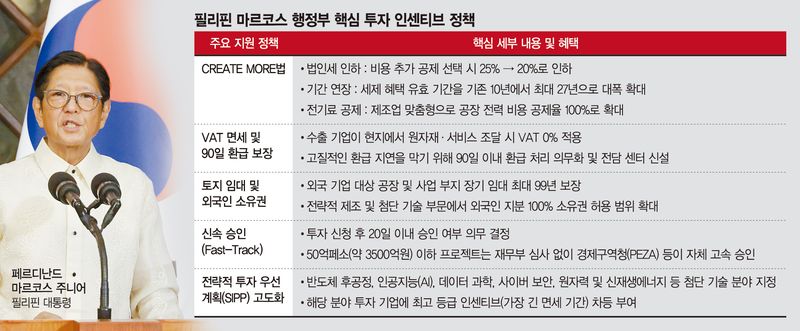
At the forefront of this manufacturing revival is President Marcos’s flagship investment-attraction law, the CREATE MORE Act (RA 12066). The law sharply cuts the corporate tax rate from 25% to 20% for companies that opt for the enhanced-deduction method, and includes a major extension of the tax-incentive period to up to 27 years. In particular, to ease the burden of high electricity costs, cited as the biggest obstacle to attracting investment to the Philippines, it raises the deduction for manufacturers’ power costs to 100%. It also guarantees land lease terms of up to 99 years to encourage long-term investment by foreign investors. The expansion of Samsung Electro-Mechanics’ MLCC factory by its Philippine subsidiary is cited as a case directly benefiting from the law’s incentives.
In addition, this year the Philippine government is upgrading its Strategic Investment Priority Plan (SIPP), offering generous incentives to steer investment not only toward semiconductor back-end processes but also into advanced technology fields such as artificial intelligence (AI), data science and nuclear power.
Meanwhile, the moves by Korean companies are also borne out by the figures.
According to the latest release from the Philippine Statistics Authority (PSA), the total value of approved foreign investment in the Philippines in the first quarter of 2026 surged 52.3% from the same period a year earlier to 42.64 billion pesos (approximately 1.04 trillion won). South Korea accounted for 59.5% of the total, with 25.37 billion pesos (approximately 616.6 billion won) in approved investment. It unexpectedly became the Philippines’ largest investor, overtaking Singapore and China. The figure represents a 105.3% surge in approved investment from South Korea compared with the same period last year, further cementing the Philippines’ position as a new “manufacturing outpost” in ASEAN.
[email protected] Kim Jun-seok Reporter