Autonomous driving extends beyond vehicles to roads... ITS Korea expands international cooperation
- Input
- 2026-10-18 16:17:28
- Updated
- 2026-10-18 16:17:28
[Financial News] The arena of competition in autonomous driving is expanding beyond vehicle performance itself to include integration with road infrastructure. The Korea Intelligent Transport Systems Association (ITS Korea) is seeking to strengthen its global cooperation network by establishing regular exchanges on policy and technology with transportation experts from various countries. It also plans to expand the overseas sharing of Korea’s digital road infrastructure technologies and its participation in international discussions.
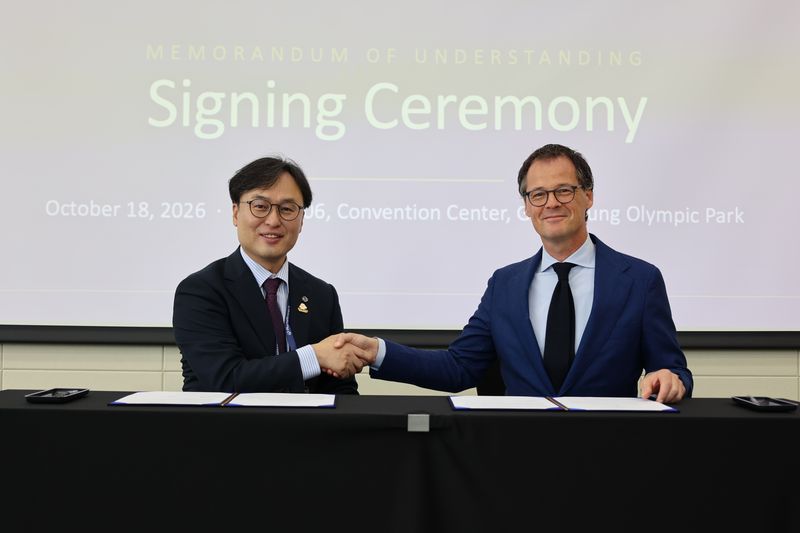
ITS Korea announced that it signed a memorandum of understanding (MOU) on the 18th at the Gangneung Convention Center with the International Task Force on Vehicle-Highway Automation (ITFVHA) to promote international cooperation in vehicle-road automation and Cooperative, Connected and Automated Mobility (CCAM).
The agreement was pursued in conjunction with the 29th ITFVHA annual meeting, held alongside the 32nd Gangneung ITS World Congress. ITS Korea President Huh Cheong-hoe and ITFVHA Chair Tom Alkim attended and signed the agreement, joined by relevant experts from the United States, Europe, Japan, the United Kingdom, Australia, China, Thailand and elsewhere.
Established in 1997, ITFVHA is an international forum of experts where specialists from governments, research institutions and industry in various countries share information on vehicle-road automation policies and technologies, as well as the status of infrastructure development. CCAM is a future mobility technology that enables safe and efficient automated driving by allowing vehicles and road infrastructure to exchange information and work together.
Under the agreement, the two sides agreed to share information on CCAM policies and the state of road infrastructure development in their respective countries, and to expand the participation of Korean experts in international discussions through the annual meeting. They will also pursue online knowledge-sharing activities, including sharing information about international events, exchanges among experts and joint webinars.
In particular, ITS Korea plans to share with overseas experts Korea’s technological and business experience in intelligent transport systems (ITS) and digital road infrastructure. The plan is also to introduce domestic audiences to policy and technology trends in major countries overseas and draw on them to help the government and industry respond to future mobility.
ITS Korea President Huh Cheong-hoe said, “As autonomous-driving technology is increasingly applied on public roads, the importance of the systems and road infrastructure that support it is growing.” He added, “I hope this agreement will provide an opportunity to discuss with the international community ways to connect vehicles with road infrastructure and foster cooperation between them.”
He went on to stress, “Drawing on a range of overseas cases and technology trends, we will explore ways to develop ITS suited to Korea’s road-transport environment and support the government and industry in responding to changes in the future transportation environment.”
[email protected] Kim Dong-ho Reporter