Lee pushes constitutional amendment on Busan–Masan Uprising anniversary; persuading People Power Party is key
- Input
- 2026-10-18 16:13:19
- Updated
- 2026-10-18 16:13:19
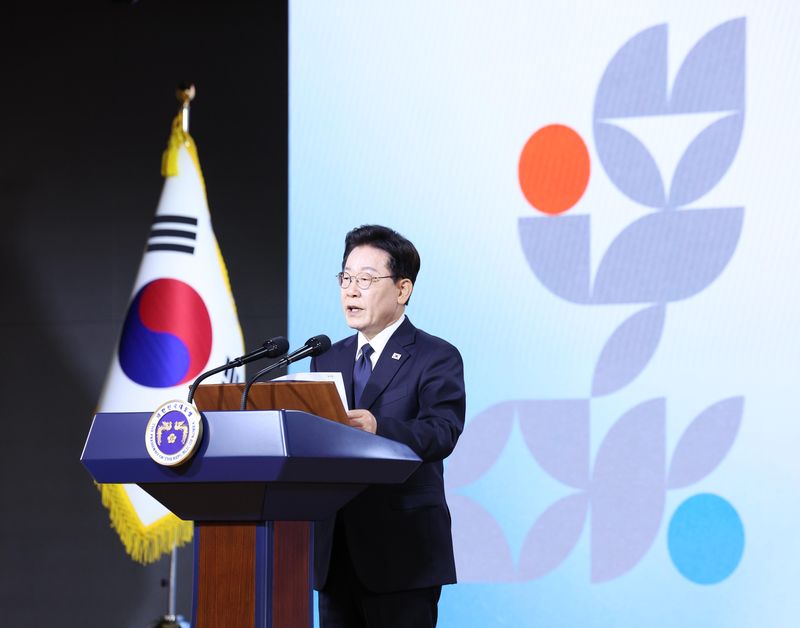
[Financial News] Marking the 47th anniversary of the Busan–Masan Uprising, President Lee Jae-myung renewed his call for constitutional amendment, saying, “Now is the time to put words into action.” He urged the National Assembly to act, noting that the ruling and opposition parties had shared the goal of including the spirit of the Busan–Masan Uprising and May 18 in the Constitution’s preamble. However, since the amendment failed again this year after the People Power Party abstained from the vote, observers say strong follow-up measures to persuade the opposition will be needed for the president’s call to lead to actual negotiations.
At a ceremony marking the Busan–Masan Uprising at Busan City Hall on the 16th, President Lee said, “I once again ask the National Assembly to promptly begin gathering public opinion and holding reasonable discussions on constitutional amendment.”
He went on to urge politicians to act, asking, “Wasn’t including the spirit of May 18 and the Busan–Masan Uprising in the Constitution’s preamble something that everyone, from both the ruling and opposition parties, has called for in unison whenever the occasion arose?” He said including the two pro-democracy movements in the preamble was “the minimum measure needed to ensure that our people do not forget their blood-soaked history.”
Having made the same call at a senior aides’ meeting the previous day, President Lee also rebutted claims on X (formerly Twitter) that constitutional amendment was intended to secure him another term or reshape the political landscape. He said, “Amending the Constitution requires the support of at least 200 lawmakers, including members of the People Power Party, so I cannot amend it as I please.” Saying that a parliamentary system or a semi-presidential system was not his preferred direction, he added, “You can put aside theories that constitutional amendment is aimed at securing another term, or conspiracy theories that it is intended to reshape the political landscape.”
However, an amendment bill introduced last May that included adding the spirit of the Busan–Masan Uprising and May 18 to the preamble and strengthening the National Assembly’s oversight of martial law, among other measures, failed to pass after the People Power Party did not take part in the vote. The plan to hold a referendum alongside the June 3 local elections also fell through. Constitutional amendments require the approval of at least two-thirds of all lawmakers, so the ruling bloc cannot pass one on its own.
The People Power Party has also questioned the motives behind the push for constitutional amendment. Last month, its floor leader Chung Jeom-sik cited the president’s intentions regarding another term and issues surrounding his trials, saying in a speech by the leaders of negotiating groups, “There will be no constitutional amendment under this administration.” Although President Lee has repeatedly said the amendment is not intended to secure another term, winning the opposition’s cooperation for passage in the National Assembly is a separate matter.
The scope of the amendment to be negotiated also needs to be determined. President Lee emphasized including material in the Constitution’s preamble, but the Democratic Party of Korea’s constitutional amendment task force also proposed expanding basic rights, strengthening the separation of powers, and improving the power structure and political system as topics for discussion. The issues the ruling and opposition parties need to negotiate will inevitably differ depending on whether they first agree to the preamble changes or pursue other institutional reforms at the same time.
The Democratic Party of Korea says that the opposition’s stated obstacle has been removed by President Lee’s explanation that he has no intention of seeking another term. Last month, it also set a goal of reaching an agreement by March or April next year and holding a separate referendum in the first half of the year. The idea is to keep the process separate from the 2028 general election, as parties may weigh electoral advantages and disadvantages more heavily as the election approaches. To make this happen, the party must secure the People Power Party’s participation in discussions, as well as agreement on the substance of the amendment.
However, President Lee also faces numerous pressing issues, including housing-market uncertainty and the recent sharp decline in the stock market. On the 15th, he said, “Despite the strong performance of major indicators, the pace of recovery in people’s livelihoods that the public expects remains slow,” and named housing, jobs, and finance as his top policy priorities for the rest of this year.
Cho Jin-man, a professor in the Department of Political Science and Diplomacy at Duksung Women’s University, said constitutional amendment should be pursued through a process led by the National Assembly and based on agreement. “Reaching an agreement in the National Assembly is the most appropriate approach and the most feasible,” Professor Cho said, adding that securing the approval of at least two-thirds of lawmakers would be difficult in a politically polarized environment.
Professor Cho predicted that it could become more difficult for the president to lead new policy initiatives once parties and politicians begin preparing for the general election next year. He added, “It is difficult to pursue every ambition and accomplish everything one set out to do at the outset,” and recommended distinguishing between tasks that can deliver results during the president’s term and those that lay the groundwork for the long term, while focusing selectively on policy achievements, including those related to people’s livelihoods.
[email protected] Seong Seok-woo Reporter