Ministry of Land, Infrastructure and Transport: Gangnam and Seocho Home Prices Fall for 10 Straight Weeks... “A Sign of Medium- to Long-Term Market Stability”
- Input
- 2026-10-18 15:20:43
- Updated
- 2026-10-18 15:20:43
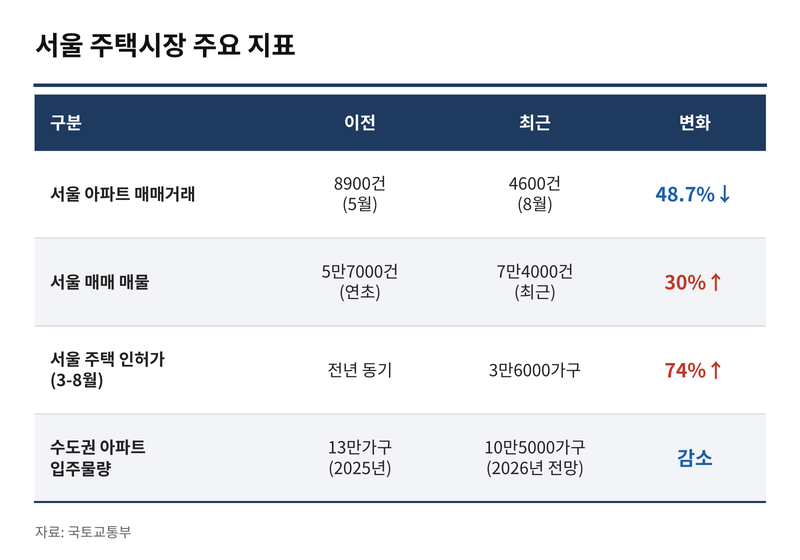
[Financial News] Apartment prices in Seoul’s Gangnam and Seocho districts fell for 10 consecutive weeks. From March to August this year, 36,000 housing units were approved in Seoul, up 74% from a year earlier. The government expects the foundations for home-price stability to strengthen over the medium to long term as supply gains build and household growth slows.
On the 18th, the Ministry of Land, Infrastructure and Transport (MOLIT) said the government had released the findings of a review of the housing market. The government has used supply and demand management in tandem. It increased private and public housing supply through the September 7 Housing Supply Expansion Plan in 2025 and this year’s August 13 Rapid Housing Supply Plan. Until supply recovers, it has used regulatory and financial measures, such as the October 15 Housing Market Stabilization Measures, to curb overheating. The government believes their effects are beginning to show up in some indicators as signs of a gradual decline and stabilization.
Transactions have fallen markedly. Apartment sales in Seoul declined from 8,900 in May to 7,700 in June and 6,600 in July, before falling to 4,600 in August. That was a 48.7% drop in just three months. Meanwhile, properties listed for sale rose to around 74,000, 30% more than at the start of the year (57,000). The government said listings had accumulated since the higher capital gains tax surcharge on owners of multiple homes resumed on May 10. It said the increase in listings was particularly pronounced in the Gangnam area, where prices have recently been falling. Transaction volumes in the three Gangnam districts, Yongsan District, and the seven districts in the Han River Belt have been below normal levels since July. The financial burden from rising interest rates, along with the gap between sellers’ asking prices and buyers’ offers, was cited as a reason transactions were being held back.
The government nevertheless expects a mixed phase to continue for the time being, with factors pushing home prices up and others pulling them down. The biggest upward pressure is the decline in the number of homes available for move-in, a consequence of weak permitting and construction starts in previous years. Apartment move-in supply in the Seoul metropolitan area fell from 204,000 units in 2023 to 173,000 in 2024 and 130,000 in 2025. This year, it is forecast to be 105,000 units, less than 60% of the 10-year average of 180,000. The government also cited increased purchasing power, driven by the boom in industries such as semiconductors and rising national income, as well as expectations that home prices would rise further, as factors widening the supply-demand imbalance. The Bank of Korea’s figures put real GDP growth at 1.1% in 2025 and forecast it at 3.3% this year.
The government rejected the view that instability in jeonse prices was caused by land transaction permit zones. It said listings for jeonse and monthly rentals had been declining since early 2024 as a nationwide phenomenon resulting from a shortage of supply. As of the second week of October, such listings were down 12% in Seoul from a year earlier. The decline was even steeper in the four major regional metropolitan cities, at 33%. The main reason was the sharp drop in the number of homes available for move-in since 2025. The impact is particularly pronounced in the Seoul metropolitan area, where the housing supply ratio is below 100%. In 2024, the ratio was 93.9% in Seoul and 99.4% in Gyeonggi Province, both below the national average of 102.9%. Listings sometimes increase in areas where large apartment complexes are receiving residents. In Eunpyeong-gu, Seoul, where a complex of about 2,400 units is scheduled to begin move-ins in October, the weekly rise in apartment jeonse prices slowed from 0.14% in the fourth week of September to 0.04% in the first week of October. It was 0.09% in the second week of October.
[email protected] Jeong Gyeong-su Reporter