Tolls frozen, compensation delayed... Double whammy for private-road operators
- Input
- 2026-10-18 15:17:16
- Updated
- 2026-10-18 15:17:16
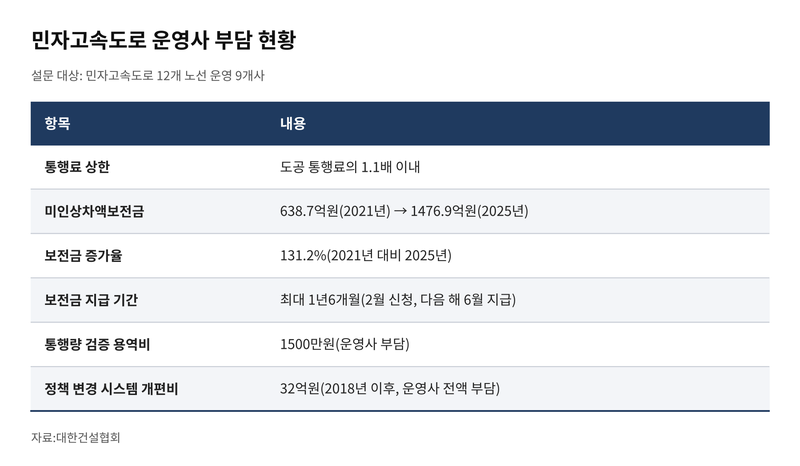
According to industry sources on the 18th, the Korea Construction Association recently surveyed nine companies operating 12 privately funded expressway routes. Privately funded expressways are roads in which construction firms or private companies involved in their construction hold stakes.
Under current laws and regulations, tolls on privately funded expressways can be set at no more than 1.1 times the tolls charged by the Korea Expressway Corporation (KEC). In 2018, the Moon Jae-in administration introduced a toll-management roadmap as part of its drive to strengthen the public character of privately funded expressways. KEC tolls have been frozen for 11 years, from 2015 through this year. As a result, privately funded expressways, which could have raised tolls in line with the consumer price index (CPI) under their agreements, have also kept the tolls they collect frozen.
The government compensates for losses caused by inflation. The system pays compensation for the difference between the toll revenue that would have been collected after the inflation-based increase stipulated in the agreements and the toll revenue actually collected under the freeze.
The Korea Construction Association survey found that compensation payments have risen every year. They increased 131.2%, from 63.87 billion won in 2021 to 147.69 billion won last year. The prolonged freeze on KEC tolls has widened the gap, adding to the burden not only on privately funded expressway operators but also on the national budget.
There is also a liquidity problem caused by delays in payment. Compensation for a given year is applied for in February and paid in June of the following year. Operators said it can take up to 18 months to receive the money, making it difficult to secure the liquidity needed to repay principal and interest and cover essential operating costs. In addition, extra financing costs, such as interest incurred due to the payment delay, are excluded from the compensation calculation, and operators must also pay the 15 million won fee for the KEC traffic-volume verification service required for compensation payments.
The industry also argued that the burden of frequent policy changes is being shifted to operators. They said that although system overhauls prompted by policy changes since 2018—including toll discounts for electric and hydrogen vehicles and the introduction of an integrated welfare card—have cost 3.2 billion won, operators have had to cover the full amount.
The Korea Construction Association proposed abolishing the cap that limits tolls to 1.1 times KEC rates to encourage private-sector projects, and improving the system, including ending the unreasonable transfer of burdens to operators. An industry source lamented, “Since all the compensation is paid out of tax revenue, it burdens the government, while the fact that tolls are not being raised burdens businesses too. With everyone caught up in this, it is difficult to propose projects.”
The Ministry of Land, Infrastructure and Transport acknowledged that the fiscal burden is growing but said it has no immediate plans to raise tolls. A ministry official explained, “It is true that the fiscal burden is increasing every year. However, from the perspective of privately funded expressway operators, it is not as though they are losing money. There is also the aim of curbing inflation, and if the gap with publicly funded expressways widens too much, that could become a problem for the policy of privately funded expressways itself.” The official added that toll revenue losses from government policies, including discounts, reductions and exemptions, are reflected in the financial calculations, with a 4% saving factored in.
[email protected] Jeong Gyeong-su Reporter