Fallout continues despite apology for 'fire service as a fiscal drain' remark; tensions between Choo Mi-ae and the pro-Lee faction resurface
- Input
- 2026-10-18 15:18:17
- Updated
- 2026-10-18 15:18:17
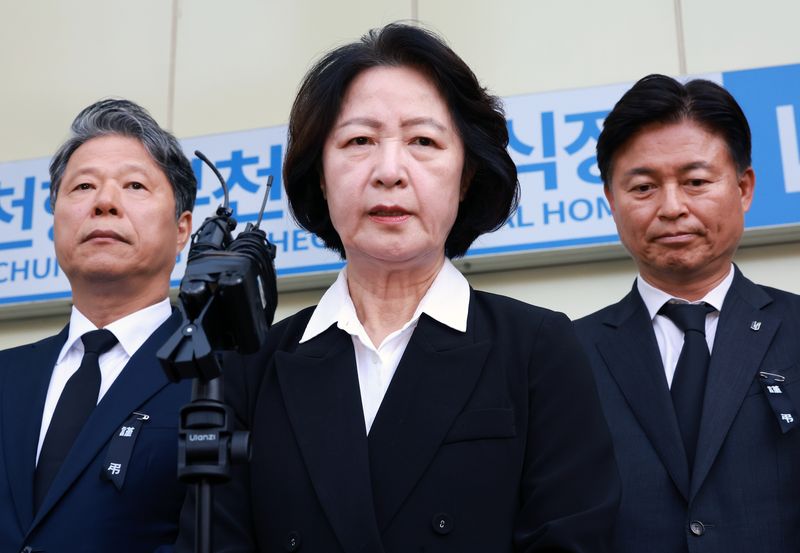
According to political sources on the 18th, Choo said at the National Assembly Public Administration and Security Committee’s audit of Gyeonggi Province on the 13th, “The fire service is the biggest, most troublesome drain on public finances.” The remark came as she explained that local governments bear a substantial share of related expenses, including personnel costs, even though firefighters had become national government employees. The firefighters’ union protested, saying she had treated firefighters’ role in protecting public safety and their dedication solely as a financial burden.
The controversy intensified after Fire Lieutenant Kim Jin-seok, who had been deployed to fight a fire at a paint factory in Bucheon, Gyeonggi Province, on the 16th, tragically died in the line of duty the following day. After paying his respects at the funeral hall set up at Soonchunhyang University Bucheon Hospital on the 17th, Choo said, “Since you want an apology, I sincerely apologize with all my heart.” Although she acknowledged that her remark was inappropriate and apologized, her words suggested she was doing so in response to demands, prompting further controversy.
Choo had also faced criticism over her response when she visited the fire scene on the 16th. Asked by reporters about the firefighters’ union’s opposition to her “fiscal drain” remark, she replied, “Don’t say that.” Choo later explained at the funeral that she meant it was inappropriate to answer that question at the fire scene, and that she had not been refusing to apologize.
Choo also explained that the controversial remark was a slip made while she was describing structural problems with fire service financing. She said she had been seeking increased central government funding to ease the burden on local governments and improve firefighters’ working conditions. “I had absolutely no intention of disparaging firefighters,” she said, adding that she would work to improve the safety system requested by the bereaved family and invest in fire safety.
The opposition, however, continued its criticism, questioning the sincerity of the apology. On the 18th, the People Power Party criticized her, saying, “An apology in words alone is secondary victimization.” The focus of the controversy appears to be shifting from the propriety of the original remark to her subsequent response and the way she apologized.
The Democratic Party of Korea issued a series of statements apologizing on behalf of the party and pledging to prevent a recurrence. On the 17th, party leader Kim Min-seok apologized to firefighters and the public. “I also asked the person involved to offer an apology with deep self-reflection,” Kim said, adding that the party would consider measures to prevent inappropriate remarks by its public officials from being repeated.
Jung Sung-ho, a key figure in the pro-Lee faction, also delivered a sharp rebuke on social media (SNS) that day, writing, “The mouth is a door that invites calamity, and the tongue is a knife that cuts the body.” The point was that the right thing to do was to sincerely apologize to those who had been hurt before explaining the remark’s intended meaning.
The public criticism from the party leadership and the pro-Lee faction is seen as once again exposing long-standing differences between Choo and the party’s mainstream. The two sides had previously clashed over the appointment of Kim Ji-yong as the first head of the Serious Crimes Investigation Agency. Choo led opposition to the appointment, citing, among other things, Kim’s investigative record from his years as a prosecutor, while the party leadership countered that the president’s appointment authority should be respected.
In a party YouTube broadcast on the 22nd of last month, Kim emphasized that internal criticism within the ruling party should be based on accurate grounds and proceed through internal procedures. He also made clear that once the appointing authority makes a final decision after deliberation, the ruling party should respect it. This was a move to rein in public opposition to the appointment by hard-liners such as Governor Choo.
Gyeonggi Province’s finances have also been a source of friction between the two sides. After Choo declared a fiscal emergency and questioned the previous provincial administration’s management of funds and spending structure, the controversy broadened into a debate over responsibility for provincial governance during the tenures of President Lee Jae-myung and former Governor Kim Dong-yeon. Choo cautioned against political interpretations, saying her aim was not to criticize her predecessors but to share the actual fiscal situation and develop solutions.
With disagreements between Choo and the party’s mainstream over prosecutorial reform and the running of Gyeonggi Province still unresolved, the controversy over her remarks about the fire service has added to the strain, and tensions within the party are expected to continue.
[email protected] Kim Hyung-gu Reporter