ELWs Freeze in Bear Market: Trading Value Falls 64% as Call-Type Warrants Are Delisted One After Another
- Input
- 2026-10-18 16:39:08
- Updated
- 2026-10-18 16:39:08
[Financial News] The equity-linked warrant (ELW) market, which had regained momentum in the first half of the year, has shrunk sharply in the second half. Trading has fallen significantly, and call-type warrants, which bet on prices rising, have been delisted one after another due to sluggish trading.
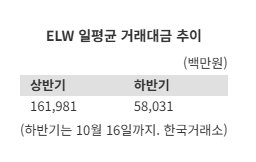
According to the Korea Exchange on the 18th, the average daily trading value of ELWs from the start of the second half through the 16th was 58 billion won, down 64.2% from 162 billion won in the first half. That was also 36.7% lower than the 91.7 billion won recorded in the second half of last year.
An ELW is a security that gives the holder the right to buy or sell an underlying asset, such as a stock or stock index, at a predetermined price. ELWs are divided into call types, which bet on an increase in the underlying asset’s price, and put types, which bet on a decline. Leverage can produce returns greater than the underlying asset’s price movement, but the risk of loss is also high.
Unlike ordinary stocks, ELWs have a set expiration date. If the price does not move in the expected direction by expiration, investors may incur a loss or lose their entire investment. For example, suppose an investor buys a call-type ELW for 1,000 won, with a strike price of 1,000 on the KOSPI 200 and a payout of 100 won per point at expiration. If the index is at 1,020 at expiration, the investor receives 2,000 won, but if it is at or below 1,000, the entire investment is lost.
In 2010, South Korea’s ELW market at one point reached a peak average daily trading value of about 1.6374 trillion won, growing to become the world’s second-largest. But regulations were tightened following losses among individual investors and controversy over the fairness of ultra-short-term trading. Trading contracted after the introduction of a minimum deposit requirement and restrictions on quotes by liquidity providers (LPs). Demand also shifted toward exchange-traded funds (ETFs) and other products, further reducing market interest in ELWs.
This year, investor interest appeared to be flowing into the ELW market alongside a buoyant stock market. But trading has contracted amid stock-market weakness in the second half, and the market has shrunk again.
As sluggish trading continued, delistings before expiration also mounted. From the start of the second half through the 16th, 422 ELW issues were delisted for reasons other than reaching maturity, including weak trading. Of these, 327 were delisted for sluggish trading, while 95 were delisted because the one-month all-holdings period had elapsed.
A delisting for one month of all-holdings applies when the issuer or LP has held the entire issue of an ELW for a month or longer. The product is discontinued when no holdings by ordinary investors persist.
Delistings were concentrated in call-type warrants. Of the 422 issues delisted in the second half, 369 were call types, accounting for 87.4%. That was an increase of 22.7 percentage points from the 64.7% share of call types in the first half, suggesting that bets on rising prices have declined as the bear market has persisted.
An official at a securities firm said, “Trading volume is an indicator of interest in the market, and as the stock market has failed to recover, interest in securities products as well as stocks is cooling quickly.”
The official added, “ELWs in particular have continued to lose ground because their structure is somewhat complex and issues such as regulation have compounded the challenges. Securities firms themselves see little need to focus on ELWs when demand is declining, so only some firms are keeping the business alive.”
[email protected] Seo Min-ji Reporter