Backlash over U.S. Gen. Brunson’s remarks on OPCON transfer; ruling party holds firm despite opposition’s call to “stop forcing it”
- Input
- 2026-10-18 14:18:20
- Updated
- 2026-10-18 14:18:20
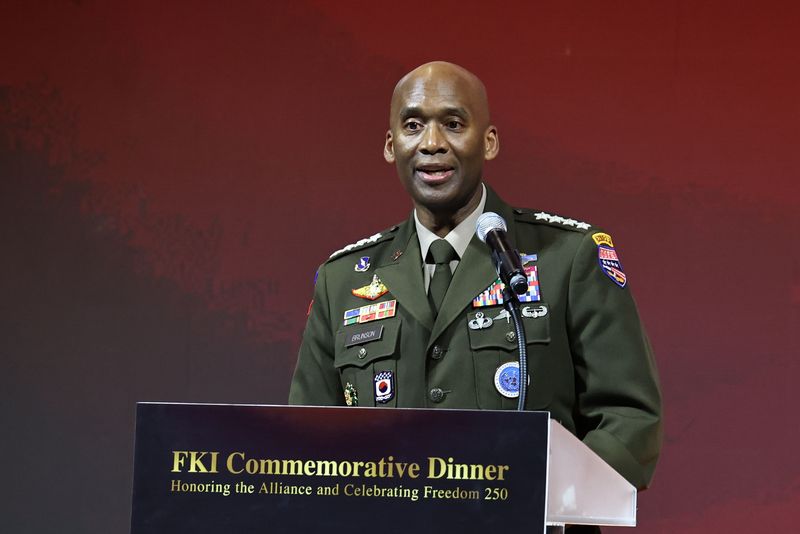
[Financial News] Intense political backlash is mounting after General Xavier T. Brunson, commander of U.S. Forces Korea, urged caution regarding the push for an early transfer of wartime operational control (OPCON). Members of the Democratic Party of Korea (DPK) have leveled criticism, including accusations of a “violation of sovereignty,” in response to General Brunson’s remark that “from the perspective of the United Nations Command (UNC), the Republic of Korea begins at the southern barbed-wire fence.” The People Power Party urged President Lee Jae Myung to hold thorough consultations with the United States.
At a briefing on the 18th, DPK floor spokesperson Jeon Eun-su said, “At a seminar in Washington, D.C., on the 14th, the commander (Brunson) said that new standards (conditions) suited to the changed circumstances must be met for OPCON transfer, effectively raising the bar.” Regarding the “southern barbed-wire fence” remark, Jeon criticized it as having “revealed an outlook that takes even our territorial sovereignty lightly.” Jeon added, “An alliance is based on mutual respect and reciprocity,” and said, “If we have to remain silent for fear of offending someone even when they make remarks that treat the other side’s sovereignty lightly, that is not the conduct of an ally but of a vassal state.”
Earlier, DPK lawmaker Kim Byung-joo, the president’s special adviser on defense policy, shared General Brunson’s remarks on the 17th and criticized them, saying, “General Brunson must immediately retract his remarks violating sovereignty and apologize to the people of the Republic of Korea.” DPK lawmaker Jin Seong-jun, chair of the National Defense Committee, stressed, “We must correct the UNC commander’s perception, which denies the territorial sovereignty of the Republic of Korea.”
General Brunson’s reference to “new conditions” has prompted analysis that a red light may have come on for the Lee administration’s push to transfer OPCON within its term. Although General Brunson did not specify what the conditions were, deteriorating inter-Korean relations—including frequent North Korean provocations—and changes in the security environment could meet them. General Brunson also added, “Someone may make a decision not to oppose OPCON transfer, but I want us to meet the conditions that were set previously.”
The DPK maintains that all the conditions have already been met. “Even the United States has assessed that, given South Korea’s strong military, high level of defense spending, robust defense industry and conscription system, South Korea is capable of taking primary responsibility for deterring North Korea,” Jeon Eun-su said. “It is unthinkable that a country like this would be unable to command its own armed forces if war broke out.” This is understood to mean that the DPK will continue pushing for an early OPCON transfer regardless of General Brunson’s assessment.
The People Power Party agreed that the security environment had changed and urged a reconsideration of the OPCON transfer decision through thorough consultations with the United States. Floor leader Jeong Jeom-sik said, “OPCON is directly tied to national security, and it is extremely dangerous to keep repeating emotional slogans and merely look for ways to tout it as an achievement during the term,” adding, “Depending on changes in the conditions, South Korea and the United States can adjust the OPCON transfer timeline as needed.”
Jeong stressed, “First, we must have the capability and will to overwhelm our principal enemy, North Korea,” and said, “The government and ruling party must stop trying to force OPCON transfer to fit the president’s term timetable.”
[email protected] Lee Hae-ram Reporter