[On-the-Scene Report] Mixing 50 ingredients, robot arms package the products ... The factory where K-beauty hits are born
- Input
- 2026-10-18 13:58:04
- Updated
- 2026-10-18 13:58:04
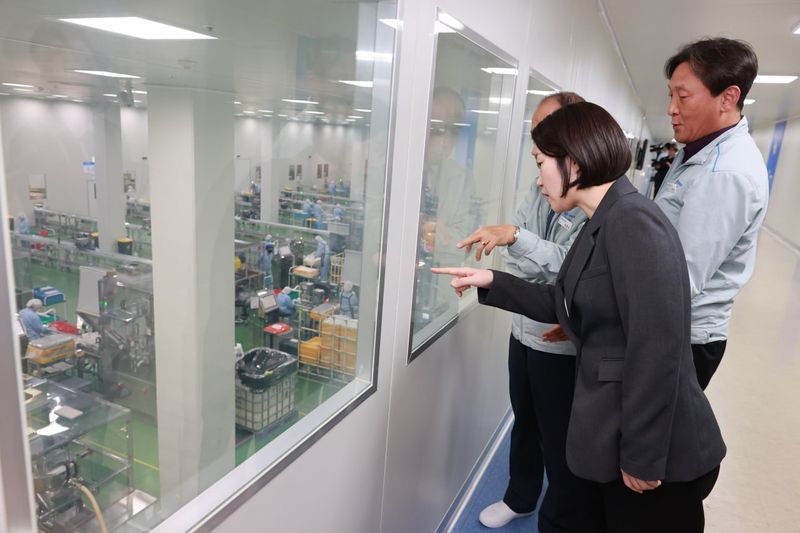
Minister Lee So-young of the Ministry of SMEs and Startups said this while touring Kolmar Korea’s Sejong plant in Jeonui-myeon, Sejong City, on the 16th.
The visit was arranged to look at the operations of a cosmetics original design manufacturing (ODM) company that handles product development and production for small brands without their own manufacturing facilities, and to discuss ways to work together to expand those brands’ overseas reach.
Kolmar Korea, founded in 1990, was the first cosmetics ODM company in South Korea. It develops formulations and ingredients to match the concepts brands want and also handles mass production. Many hit K-beauty sun-care products that have ranked among Amazon’s top bestsellers—including Round Lab’s Birch Juice Moisturizing Sun Cream and d’Alba’s Waterfull Tone-Up Sun Cream—are ODM products made by Kolmar Korea.
That day, Minister Lee toured the main production facilities at the Sejong plant. A key production base that makes 890 million cosmetics products a year, the plant manufactures sunscreen and skin-care products, among others.
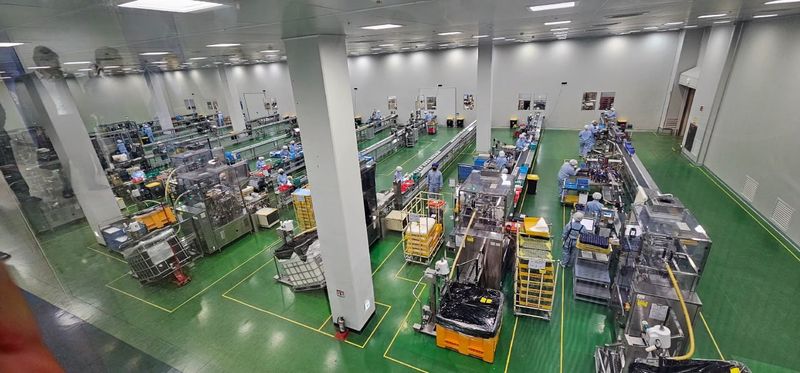
A Kolmar Korea representative explained, “It can take 40 to 50 ingredients to make a single cosmetic product,” adding, “After each ingredient undergoes quality testing, it is added to the manufacturing tank according to the set mixing ratio.”
The factory’s monitoring screens displayed real-time operating status for each manufacturing tank, output by product, and work progress. Kolmar Korea uses SAP enterprise resource planning (ERP) software to manage work in areas such as production and materials in real time, and collects and analyzes operating status and work data for each manufacturing tank through a manufacturing execution system (MES).
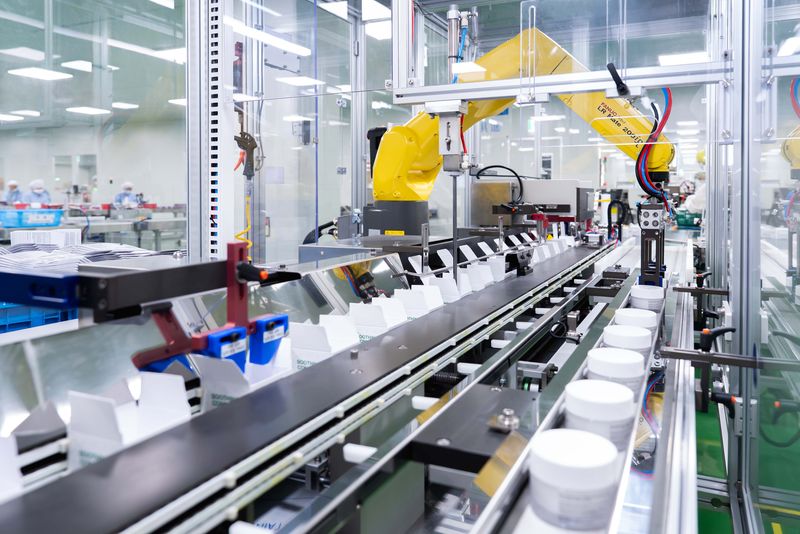
At the packaging stage, cosmetic contents were being filled into tubes, and robotic arms were placing the products directly into boxes. The Sejong plant has 11 filling and packaging lines.
Minister Lee noticed a robotic arm and showed interest, asking, “That’s a robotic arm. So do people just check?” A Kolmar Korea representative explained that workers handle some processes, such as supplying tubes and inspecting products, while automated equipment takes care of tasks such as packing products into boxes.
After touring the production facilities, Minister Lee held a tea meeting with Kolmar Korea CEO Choi Hyun-kyu and others. Key challenges raised at the meeting included imitation products from overseas, rising prices for raw and auxiliary materials, and how to respond to cosmetics regulations that vary by country.
Choi said that SME and indie brands exporting to North America and Europe were struggling with marketing because of imitation products made in China and other parts of Asia.
Shim Jae-yoon, MSS director for global growth policy, who was also present, replied, “We are discussing the formation of a consultative body to coordinate responses in cooperation with relevant agencies, including the Ministry of Intellectual Property.”
Difficulties arising from cosmetics regulations that vary from country to country were also discussed. Lee Young-joo, a Kolmar Korea vice president, explained, “In the United States, sunscreen is classified as an over-the-counter (OTC) drug, not an ordinary cosmetic,” adding, “Small brands sometimes struggle because they are not fully familiar with ingredient regulations and customs-clearance requirements that differ by country.”
In response, Minister Lee said, “It seems there needs to be capacity, starting with responding to requests for information,” and asked for views: “You started as a small business and have grown tremendously, and most of your clients are also small-business brands. Is there anything you would like the MSS to pay more attention to, or any requests you would like to make?”
Meanwhile, with that day’s schedule, Minister Lee wrapped up her two-day, one-night tour of sites in the Chungcheong region. Over the two days, she visited semiconductor materials, components and equipment companies in Cheonan, South Chungcheong Province; Daejeon, the “startup city”; the Global Innovation Special Zone in Osong, North Chungcheong Province; K-beauty companies in Sejong; and the Small Business Restart Support Center in Cheongju.
The minister said, “This visit to the field has helped me understand more concretely the policy issues I had previously encountered only through documents,” adding, “I’ll continue thinking them through when I get back.”
[email protected] Lee Ju-mi Reporter