Jin Air to Carry On the Legacy of a ‘Busan-Based Hub Airline,’ Expanding International Routes and Workforce
- Input
- 2026-10-18 12:40:49
- Updated
- 2026-10-18 12:40:49
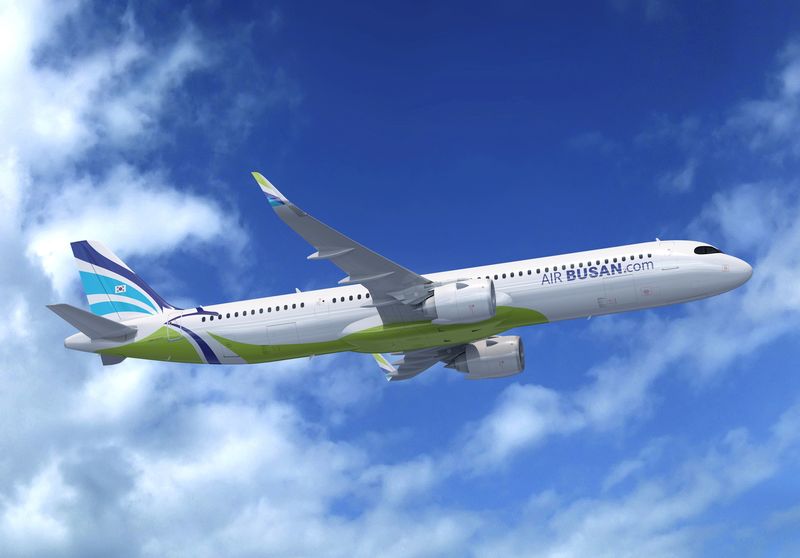
[The Financial News] As Jin Air is scheduled to merge with Air Seoul and Air Busan on March 17 next year, political circles in Busan are raising the absence of a hub airline as an issue, calling for the integrated Jin Air to be headquartered in Busan. Jin Air plans to add five international routes from Busan and expand its workforce and infrastructure, aiming to continue its role as a hub airline after the integration.
According to the ‘Plan to Establish Busan as a Second Hub for the Integrated LCC (Low-Cost Carrier),’ which People Power Party lawmaker Kim Mi-ae, a member of the National Assembly’s Land, Infrastructure and Transport Committee, obtained from Korean Air on the 18th, the number of international routes at Gimhae Airport is set to increase from 28 before the integration to 33. Weekly flights will rise from 281 to 339.
The new routes will include four to Japan and one to Southeast Asia. Flight frequencies will increase by 39 per week to Japan, 17 per week to Greater China and other regions, and two per week to Southeast Asia. The current level of 188–189 weekly flights on the two domestic routes to Jeju and Gimpo will be maintained.
The plan also calls for adding aircraft based in Busan, though the number has yet to be determined. Currently, 21 aircraft are stationed at Gimhae Airport: 16 operated by Air Busan and five by Jin Air.
The company will also increase the number of specialist staff based in Busan, including flight crew, cabin crew and aircraft maintenance technicians. It will expand local recruitment and industry-academia partnerships with universities and educational institutions. It has also pledged to retain existing employees. The company plans to rule out artificial restructuring and avoid unilaterally relocating employees against their wishes. Currently, 1,184 employees are based in Busan: 997 at Air Busan and 187 at Jin Air.
Air Busan’s flight operations control facilities, cabin crew training facilities and briefing rooms will also be maintained. Gimhae Airport will be developed into an independent maintenance hub capable of carrying out its own maintenance and supplying parts.
With plans to make Busan a second hub, Jin Air is deferring a response to local political circles’ demands that its headquarters be relocated.
Instead, it has outlined how functions will be divided between Seoul and Busan. Seoul will handle overall policy development, while headquarters functions will be divided by business area, with Busan taking on its share. Busan will be assigned the role of regional representative, responsibility for developing marketing and sales strategies tailored to the Yeongnam region, and the operation of the Busan hub.
Korean Air plans to gather input from relevant organizations, including Busan City, the Ministry of Land, Infrastructure and Transport, and the Korea Development Bank, by the end of November. It is also in talks with employees of Jin Air, Air Busan and Air Seoul.
Jin Air has yet to complete all the integration procedures, including approval of the business combination by the Fair Trade Commission and merger approval by the Ministry of Land. That is why it is facing pressure from calls by political circles in Busan.
[email protected] Kim Yun-ho Reporter