Is the Era of Valuations Soaring Just for Being AI Over? IPO Calculus Gets ‘Complicated’ for Korean AI Firms
- Input
- 2026-10-19 15:46:46
- Updated
- 2026-10-19 15:46:46

[Financial News] As global AI companies such as OpenAI and Anthropic pursue initial public offerings (IPOs), moves to reassess their valuations are complicating the IPO calculus for Korean AI companies as well. This comes as markets, which once assigned high value to technological prowess and growth potential, begin to scrutinize actual revenue and profitability as well as the pace of future growth. Korean AI companies preparing to go public, including Upstage Co., Ltd., Wrtn and Furiosa AI, now face the challenge of proving their potential to generate concrete revenue—not just their technological competitiveness—in order to command high valuations.
According to foreign media reports and the IT industry on the 19th, the valuation of U.S. AI company Anthropic was marked down to around $1.5 trillion (about 2,006.7 trillion won), 25% below the previous expectation of $2 trillion (about 2,675.6 trillion won), at an IPO investor briefing held in San Francisco on the 14th (local time).
What stands out is that Anthropic’s results actually improved. Revenue in the third quarter of this year was $16.8 billion, up 45% from the previous quarter, and the company recorded adjusted operating profit for two consecutive quarters. But its valuation expectations fell after revenue growth slowed from more than 100% in the previous quarter. Even if revenue surges and the company turns a profit, maintaining its previous lofty valuation has become a separate question.
This climate is also putting pressure on Korean AI companies preparing for IPOs. Upstage Co., Ltd., Wrtn Technologies and Furiosa AI are rapidly expanding their respective business areas on the strength of their technological competitiveness, but they still have a long way to go before achieving profitability.
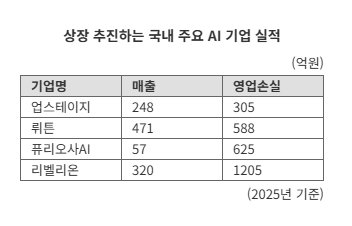
Upstage Co., Ltd. recorded revenue of 24.8 billion won and an operating loss of 30.5 billion won last year. The company is expanding its influence in the enterprise AI market, but its operating loss still exceeds its revenue. Whether it can turn customer acquisition and expanded service delivery into stable earnings will be key to its future valuation.
Wrtn is in a similar position, despite securing investment worth 100 billion won last August after receiving a valuation of at least 1 trillion won. Its revenue rose to 47.1 billion won last year, more than 15 times the 3.1 billion won recorded the previous year—a notable achievement—but its operating losses remain. It needs to improve profitability while sustaining growth through overseas businesses, including the North American AI entertainment platform OOC.
Furiosa AI also posted revenue of 5.7 billion won and an operating loss of 62.5 billion won last year. Having begun mass production of its second-generation AI inference accelerator, RGND, in January this year, the company is now drawing attention over whether expanded deliveries to customers will lead to improved results.
Of course, it is difficult to judge these companies’ growth potential based solely on the size of their losses. Developing AI models and designing semiconductors require massive research and development spending, and investment inevitably comes ahead of revenue in the early stages of a business. Some also argue that it is inappropriate to assess valuations based only on short-term profitability, especially since Korean companies differ greatly from global Big Tech firms in terms of capital and market size.
The industry expects, however, that it may become increasingly difficult for companies to command high valuations on the strength of expectations for AI technology alone. This means they need to show investors concretely when they can turn a profit—not only by demonstrating the strength of their technology, but also by securing customers, increasing revenue and improving costs.
An industry official said, “It is difficult to explain an AI company’s valuation by revenue or profit alone,” but added, “If its technological potential does not translate into actual sales and recurring revenue, it may be difficult to maintain a high valuation.”
[email protected] Jang Min-kwon Reporter