Gangwon State’s living-population boost brings an extra 25.1 billion won in ordinary local allocation tax
- Input
- 2026-10-18 10:43:54
- Updated
- 2026-10-18 10:43:54
【Financial News | Chuncheon—Reporter Kim Gi-seop】Gangwon State, where many people stay, including tourists and short-term visitors, is estimated to have secured an additional 25.1 billion won in ordinary local allocation tax after the living population was incorporated into this year’s local allocation tax calculations for the first time.
According to the Gangwon Research Institute on the 18th, the institute recently published Policy Talk Talk No. 52, titled “Stronger Local Finances Through Incorporating the Living Population: Gangwon’s Ordinary Local Allocation Tax Rises by 25.1 Billion Won.” The analysis found that ordinary local allocation tax allocations increased by about 20.07 billion won for 12 cities and counties in Gangwon’s population-decline areas and by about 5.02 billion won for the provincial government headquarters, for a total increase of about 25.1 billion won.
Until now, local allocation tax has been calculated based on the floating population, meaning the population inflow minus the population outflow. However, in most of Gangwon’s population-decline areas, more people leave than arrive, so demand based on the floating population was effectively not reflected in local allocation tax allocations.
In response, the government changed the criteria starting this year so that, for the country’s 89 population-decline areas, whichever is more favorable—the floating-population method or the living-population method—is applied. The living population comprises registered residents and foreign nationals, as well as people who stay in an area for at least three hours on one day each month.
Under the new method, the weighting factor has been reduced from 20% to 10%, but it is more favorable than the previous method when the living population exceeds twice the net inflow population. Of the demand amount calculated on the basis of the living population, 80% goes to cities and counties and 20% to the provincial government headquarters. The average daily living population over the past year in the 12 cities and counties in Gangwon’s population-decline areas included in this year’s calculations was 354,946. Hongcheon County had the largest figure, at 51,606, followed by Pyeongchang County with 43,664, Goseong County with 38,214, Yangyang County with 34,697 and Samcheok City with 31,781.
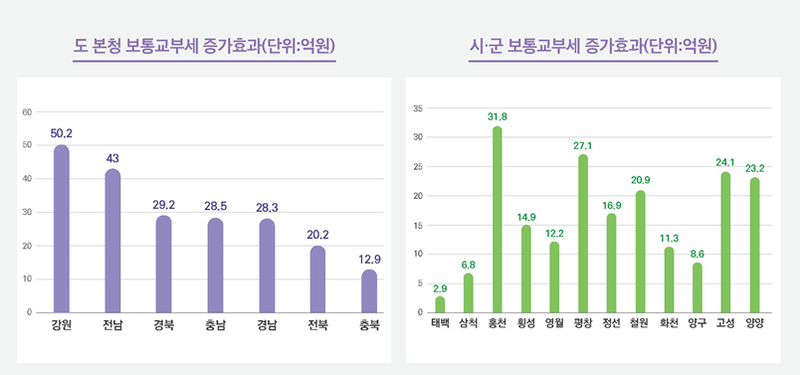
Compared with applying only the previous floating-population method, the standard fiscal demand amount for the 12 cities and counties increased by about 28.64 billion won. Applying this year’s adjustment rate for ordinary local allocation tax, the increases by city and county were largest in Hongcheon County at 3.18 billion won, followed by Pyeongchang County at 2.71 billion won, Goseong County at 2.41 billion won, Yangyang County at 2.32 billion won and Cheorwon County at 2.09 billion won. In Hongcheon County alone, environmental protection demand was just 307 million won under the previous method but rose more than sixfold to 1.976 billion won under the living-population method.
Gangwon State was also the biggest beneficiary in comparisons among provinces. The increase in ordinary local allocation tax for the provincial government headquarters was 5.02 billion won in Gangwon, exceeding South Jeolla’s 4.3 billion won, North Gyeongsang’s 2.92 billion won, South Chungcheong’s 2.85 billion won, South Gyeongsang’s 2.83 billion won, North Jeolla’s 2 billion won and North Chungcheong’s 1.29 billion won. Gangwon accounted for 23.7% of the total increase of about 21.2 billion won across the seven provinces compared.
The institute emphasized that living-population policy should be used not only to promote tourism and regional revitalization but also as a means of strengthening public finances. It recommended creating a virtuous cycle by reinvesting the additional funds in projects that encourage people to stay, and establishing performance indicators to track the size of the living population, length of stay and the impact on local allocation tax. It also said that accumulated performance data should be regularly presented to the central government as a basis for improving the local allocation tax system and expanding fiscal support. Since the impact may vary depending on each region’s standard administrative demand amount and the adjustment rate, which changes annually, continued monitoring is also needed, it added.
Jeong Yeong-ho, an associate research fellow at the Gangwon Research Institute, said, “Even when there were many tourists or short-term visitors, the previous method, which considered only net inflows, made it difficult to capture Gangwon’s actual administrative needs. But incorporating the living population has clearly improved the fiscal conditions of areas with strong visitor demand, such as Hongcheon, Pyeongchang, Goseong and Yangyang.” He added, “Since the living population is calculated by multiplying the population staying in an area by the number of days they stay, the key challenge ahead is to have visitors stay ‘more often and longer’ by expanding stay-based tourism, workations and the relationship population.”
[email protected] Kim Gi-seop Reporter