‘A good time to buy the dip?’ Overdraft balances rose 1.6 trillion won as the KOSPI plunged 16%; debt-fueled investing resurfaces in the crash
- Input
- 2026-10-18 16:11:18
- Updated
- 2026-10-18 16:11:18
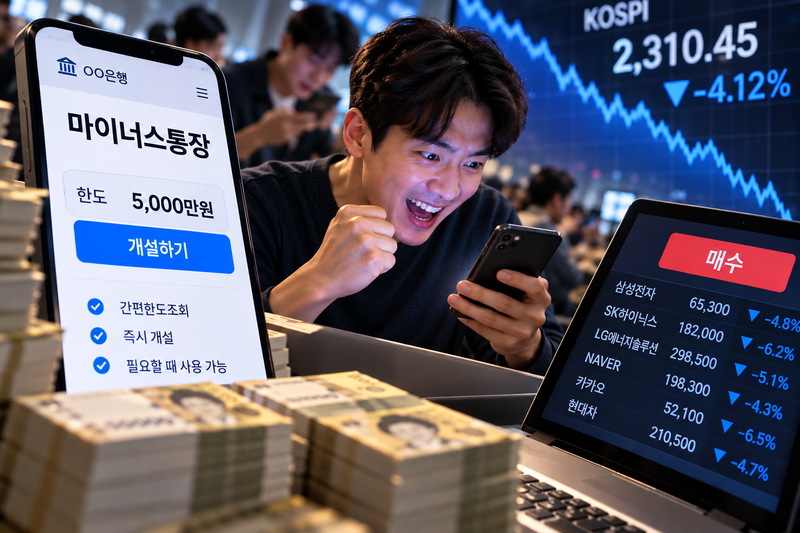
[Financial News] Demand for ‘debt-fueled investing’—investing with borrowed money—is resurfacing as South Korea’s stock market has plunged recently. As share prices tumbled last week, overdraft balances at the country’s five major commercial banks swelled by more than 1.63 trillion won this month. Personal credit loan balances, which had fallen sharply in September, also surged by nearly 1.5 trillion won last week. This is believed to reflect demand from investors who saw the falling share prices as an opportunity to buy at lower prices. But with volatility in the stock market rising, concerns are growing that borrowing to invest in hopes of a rebound could increase both investment losses and interest costs.
Overdraft balances swell ... Demand for bargain buying?
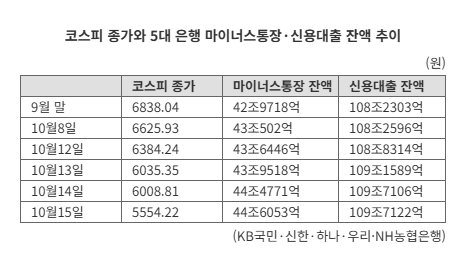
According to financial-sector sources on the 18th, overdraft balances at the five major commercial banks—KB Kookmin, Shinhan, Hana, Woori and NH NongHyup—stood at 44.6053 trillion won as of the 15th. That was up 1.6335 trillion won from 42.9718 trillion won at the end of September.As the stock market’s losses deepened, overdraft balances grew even faster. While the KOSPI fell 16.17% over four trading days, from a close of 6,625.93 on the 8th to 5,554.22 on the 15th, overdraft balances rose by 1.5551 trillion won, from 43.0502 trillion to 44.6053 trillion won. On the 14th in particular, balances reached 44.4771 trillion won, up 525.3 billion won from the previous day and topping 44 trillion won.
Overall personal credit loan balances, including overdrafts, also rose sharply during the period when the stock market’s losses widened. As of the 15th, personal credit loan balances at the five major commercial banks totaled 109.7122 trillion won, up 1.4819 trillion won from 108.2303 trillion won at the end of September. In particular, as of the 14th, when the KOSPI had fallen to the low 6,000s, personal credit loan balances were up 1.451 trillion won from the 8th.
Banks believe demand for bargain buying in anticipation of a rebound after the market’s sharp decline contributed to the increase in personal credit loan balances. An official at a commercial bank said, ‘The recent increase in overdraft balances appears to reflect demand from people who saw falling share prices as an opportunity to buy at lower prices,’ adding, ‘In the past, too, overdraft balances tended to rise when the stock market underwent a short-term correction.’
‘Beware of debt-fueled investing in hopes of a rebound’
At private banking (PB) desks at commercial banks, inquiries continue from investors asking when to put their funds on standby to work, as well as from existing investors seeking advice on how to respond to losses.Yoon Ji-young, PB manager at Hana Bank’s Seogyo-dong branch, said, ‘It looks like more money is waiting to buy at lower prices following the recent market correction.’ She added, ‘Customers visiting PB centers are making additional purchases using existing investment funds they had put in demand-deposit-type specific money trusts (MMTs) or money market funds (MMFs).’
PBs, however, advised caution about investing with borrowed money. If investors borrow to invest in hopes of a short-term rebound and share prices fall further, they could face both investment losses and interest costs.
Yoon said, ‘Given interest rate trends, winter energy-price volatility and policy uncertainties surrounding the U.S. midterm elections, it is difficult to conclude that now is the time to buy at lower prices.’ She said investors should ‘consider buying in stages, taking into account their investment horizon and available funds, rather than investing all at once.’ She added, ‘Investments using borrowed funds, particularly through overdrafts, require consideration of both the interest costs and the possibility of further declines.’
Some also said investors should first consider the uncertainties surrounding the market, including the semiconductor industry outlook, foreign investor flows and geopolitical risks. Expectations for the future profitability of artificial intelligence (AI) companies have already been priced into stocks, they said. A PB expert at a commercial bank warned, ‘When foreign investors are selling, people should be cautious about buying domestic stocks solely because prices have fallen a lot.’ The expert added, ‘If an unexpected factor emerges over the weekend, investors could bear the full brunt of its impact in Monday’s trading.’
[email protected] Lee Hyun-jung Reporter