“Are semiconductors okay as they are?” ... KOSPI plunges, eyes turn to Big Tech earnings [Weekly Stock Market Outlook]
- Input
- 2026-10-18 12:22:34
- Updated
- 2026-10-18 12:22:34
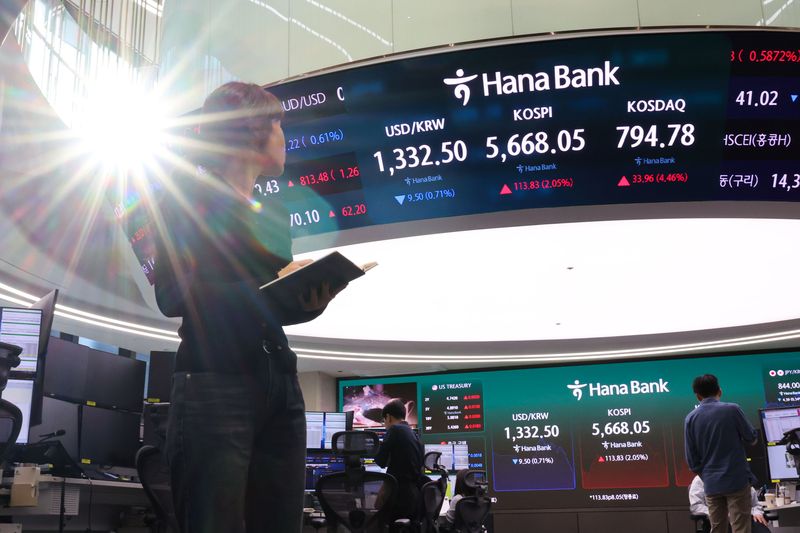
[The Financial News] Amid doubts about the sustainability of AI investment and the burden of high interest rates, the domestic stock market is expected to look to U.S. Big Tech earnings for clues to a rebound this week. With foreign selling continuing, particularly in semiconductors, whether major companies can allay market concerns through their earnings and investment plans is expected to be a gauge of any recovery in investor sentiment.
According to the Korea Exchange on the 18th, the KOSPI fell 11.21% from 6,384.24 to 5,668.05 between the 12th and the 16th. Over the same period, individuals and other corporations were net buyers on the securities market, purchasing 4.3123 trillion won and 3.4761 trillion won, respectively. Institutions were also net buyers, with purchases exceeding sales by 3.4183 trillion won. Foreign investors, by contrast, were net sellers of 11.2394 trillion won.
The market’s biggest focus this week is the earnings of major U.S. technology companies. Meta, Lam Research, IBM and Texas Instruments (TI) are scheduled to report earnings on the 21st, followed by Western Digital on the 22nd. The key questions are whether investment in AI infrastructure and related demand are translating into actual revenue and profits, and whether the investment trend will continue.
Investor sentiment toward semiconductors has weakened recently amid concerns that Chinese memory chipmaker CMXT is catching up technologically, compounded by funding pressure at CoreWeave. As high interest rates increase the financial burden on AI infrastructure companies, doubts about the profitability of their investments appear to be spreading to domestic semiconductor stocks.
Lee Kyung-min, a researcher at Daishin Securities, explained, “The key question is whether (earnings announcements from major technology companies) can provide an opportunity to ease doubts about the sustainability of AI investment and the outlook for the semiconductor industry.” He also drew attention to the earnings of domestic companies, assessing, “Both earnings visibility and valuation appeal need to be considered.”
Domestic and overseas economic indicators and monetary policy events are also on the agenda. On the 19th, China will release its third-quarter gross domestic product (GDP), as well as September retail sales, industrial production and other figures. At its meeting on the 22nd, the Bank of Korea’s Monetary Policy Board is set to announce its base rate decision and provide a message on the possibility of further rate hikes. Preliminary U.S. manufacturing and services purchasing managers’ index (PMI) figures for October will be released on the 23rd.
Lee Sang-jun, a researcher at NH Investment & Securities, said, “Rather than interpreting the current situation as a crisis across the entire AI industry, it is necessary to focus on identifying companies that can withstand delays in generating profits amid high interest rates.” He assessed that “if the CoreWeave situation is confirmed to be an issue specific to an individual company, semiconductors could be the first to rebound strongly.”
[email protected] Choi Doo-sun Reporter