Lifelong and vocational education gets just 1.4% of the budget in the AI era... one-sixty-first of spending on pre-primary, primary and secondary education
- Input
- 2026-10-18 10:16:08
- Updated
- 2026-10-18 10:16:08
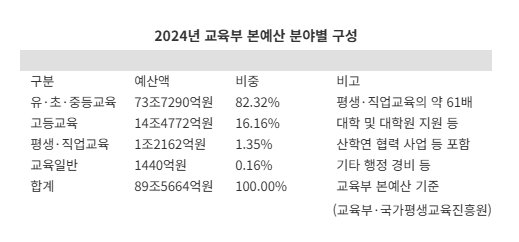
[Financial News] Although lifelong learning is becoming more important amid changes in artificial intelligence (AI) technology and population aging, lifelong and vocational education accounted for only about 1.4% of the Ministry of Education’s 2024 initial budget. That was about one-sixty-first of the budget for pre-primary, primary and secondary education.
According to the report “National Human Resource Development Strategy in the Era of the Triple Transition,” released on the 18th by the Korea Research Institute for Vocational Education and Training (KRIVET), the lifelong and vocational education budget amounted to 1.2162 trillion won out of the Ministry of Education’s 2024 initial budget of 89.5664 trillion won. The budget for pre-primary, primary and secondary education was 73.729 trillion won, accounting for 82.32% of the total. Higher education received 14.4772 trillion won, or 16.16%.
The researchers proposed that “a system for developing talent across the life cycle should be established amid converging demographic shifts, rapid advances in new technologies such as AI, and the climate crisis.” Hwang Seong-su, KRIVET’s vice president, said, “A presidential committee to integrate the planning, implementation and evaluation of human resources policies, along with a dedicated headquarters to support it, should be established.”
Measures to provide financial support for lifelong learning were also proposed. The proposal is to improve the Lifelong Learning Account System and gradually expand eligibility for lifelong education vouchers, while pursuing the introduction of a provisionally named “Skills Development Benefit” to cover living expenses and training costs during periods of study. Hwang said this would “elevate lifelong learning to a fundamental right of citizens.”
However, the budget share is based solely on the Ministry of Education’s initial budget. It does not include the Ministry of Employment and Labor’s vocational training budget or local governments’ education and training budgets. The report proposed that budgets from relevant ministries and local governments also be examined to determine the total funding allocated to education and training at each stage of life.
The breakdown of the lifelong and vocational education budget also warrants closer examination. Of the total 1.2162 trillion won, 813.2 billion won went to a project to promote industry-academia-research collaboration, accounting for 66.86%. The budget for a project to establish a lifelong vocational education system was 72.4 billion won. Therefore, it is difficult to interpret the entire lifelong and vocational education budget as funding directly allocated to lifelong learning for adults.
The researchers surveyed 60 experts in the fields of demographic, AI and climate transitions. The survey identified the use of women and older people in the demographic field, the development of core technologies and creation of an industrial ecosystem in AI, and the transition to an eco-friendly energy system in the climate field as important and urgent policy priorities.
Experts described the talent needed in the era of the triple transition as people who can connect technology, humans and the environment. The researchers concluded that, to achieve this, digital literacy should be improved across the entire population in the short term, practical talent for industry should be developed in the medium term, and greater emphasis should be placed on cultivating creative, interdisciplinary talent in the long term.
[email protected] Kim Man-gi Reporter